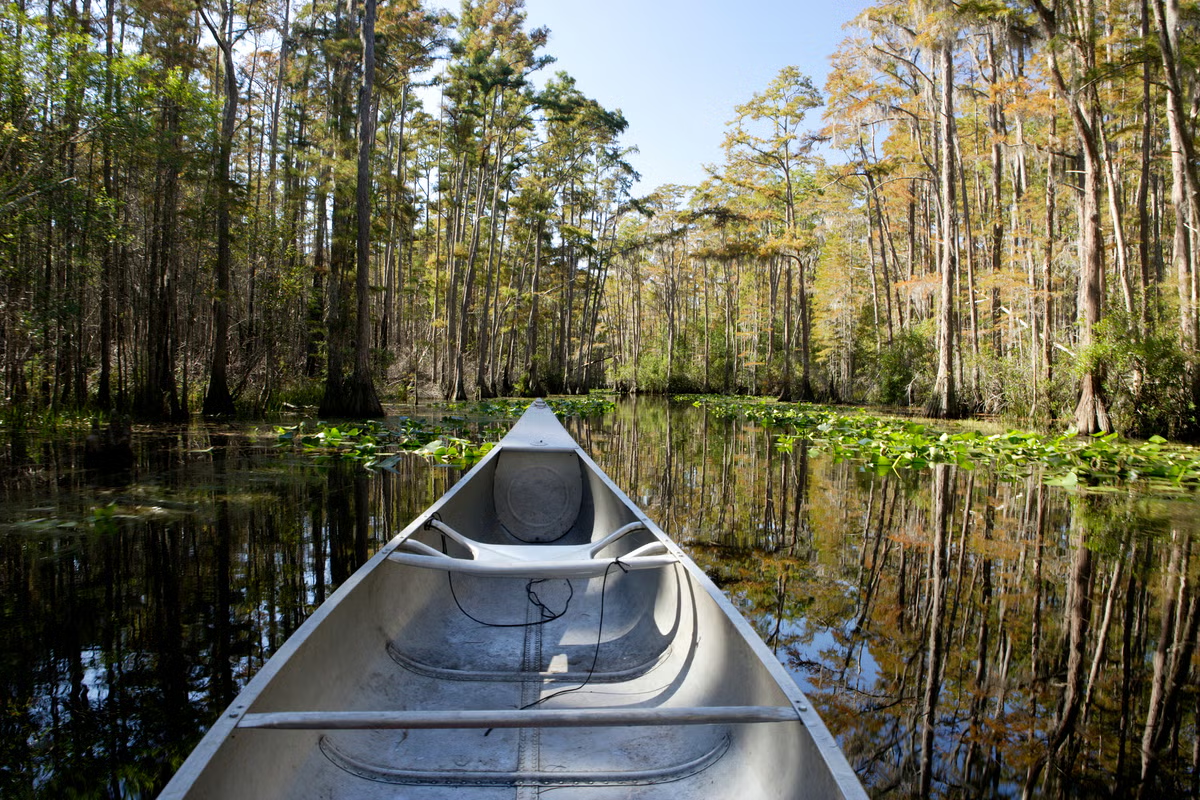
The Okefenokee swamp is poised to join awe-inspiring U.S. landscapes including the Grand Canyon and the Everglades as the nation’s 27th World Heritage Site, a designation a United Nations committee will vote to formalize early Saturday in South Korea.
Despite the prestige, this honor has been met with strong resistance from local residents who, while loving the Okefenokee, object to the United Nations.
For years, lawn signs urging “Keep the U.N. (UNESCO) out of the Okefenokee” have dotted roads around Ware and Charlton counties, with the same slogan appearing on t-shirts. It’s a widespread sentiment around the swamp, according to Ware County Commissioner Barry Cox, who spent 40 years running the county’s vehicle maintenance shop before being elected in 2024.
The three rural counties surrounding the swamp – Ware, Charlton, and Clinch – are politically conservative, with President Donald Trump securing over 70 percent of the vote in each in 2024. Trump’s “America First” agenda resonates here. The United Nations, not so much.
In July 2025, Trump announced the U.S. would withdraw from UNESCO, the UN body overseeing World Heritage Sites, citing its goals as “at odds with our America First foreign policy.”
The U.S. Fish & Wildlife Service, which owns and manages the Okefenokee National Wildlife Refuge, said that a World Heritage Site designation “increases a site’s significance to the world.”
A 2024 USFWS explainer stated, “Becoming a World Heritage Site does not confer any ownership or management authority to the United Nations. UNESCO only monitors the current conditions and potential threats to the designated properties. The Refuge would continue to be wholly owned and managed by the US Fish and Wildlife Service.”
Cox said he opposes the World Heritage Site designation because his constituents oppose it.
“All I could hear was the people that I represent were scared that they was going to come in here and maybe start taking their land, or you know kind of ruling them what they could do,” he told The Current. “And to be honest with you, I went to one of the meetings that they had that showed, you know, about UNESCO, and it was kind of very unsettling to me, and that’s basically about all I know.”
The meeting he attended was sponsored by an anti-UNESCO group, but he couldn’t recall which one. Cox was unable to attend a meeting held by the pro-UNESCO faction, he said.
The Current tried unsuccessfully to contact the two main anti-UNESCO groups active on social media in South Georgia. Americans for the Okefenokee declined an interview, saying “After review, I don’t think we are interested in an interview with The Current GA at this point, but thanks for asking,” via Facebook messenger. Georgia Republican Assembly did not reply to multiple messages sent via Facebook messenger and through its website.
In June of 2025 Cox and his fellow commissioners passed a resolution addressing the World Heritage Site nomination. They voted to affirm the county’s “commitment that it shall not adopt, implement, or enforce any rule, regulation, policy, or mandate originated by, or traceable to, the United Nations or a subsidiary entity of the United Nations which infringes upon or restricts private property rights without due process in violation of the U.S. Constitution or Georgia Constitution.”
The anti-UNESCO contingent points to several examples of how public opinion is on their side. They’re laid out in a Youtube video produced by Committee For A Constructive Tomorrow, a Washington, DC-based nonprofit that advocates for a free-market approach to environmental issues and rejects the scientific consensus around man-made climate change.
Gabriella Hoffman is a CFACT policy analyst and host of “Save Okefenokee from UNESCO Control,” the December 2025 addition to CFACT’s “Conservation Country Series” that focuses on the World Heritage Site nomination.
She points to the Ware County resolution as well as a similar one in Charlton County. Then there’s a vote in Ware County that Hoffman said provides evidence that “there was a lot more opposition than was being reported.”
That vote was a Republican party question posed by the county Republican party in the June 2024 primary. Party questions are nonbinding. They do not enact any policies but rather function as polls. And they’re not a random sample, scientific poll, said Andra Gillespie, associate professor of political science at Emory University. Instead they’re taking the pulse of party faithful, the people who turn out for primary elections.
The 2024 Ware County party question read: “The Okefenokee National Wildlife Refuge is being considered for the United Nations designation as a UNESCO (United Nations Educational, Scientific, and Cultural Organization) World Heritage Site. The UN has an agenda which includes a policy for control of local school curricula, infrastructure plans, land use, transportation and housing. Knowing that this infringes on United States sovereignty, do you favor the designation of the Okefenokee National Wildlife Refuge as a United Nations UNESCO World Heritage Site?”
Of the 3,144 Republican primary voters, 93% said “no.”
Charles Bullock, longtime distinguished professor of Public International Affairs at the University of Georgia, noted the question’s wording leads to this answer.
“Who in the world is going to vote for that?” he said. “Right? We’re going to be taken over by the UN.”
The CFACT video and a shorter version released in late June label the World Heritage Site designation a “land grab.” In the long video, Cox and other local residents appear on camera to voice their concerns.
“If I had 10 minutes with Donald Trump, we could talk about these issues as clear and concise,” Charlton County Commissioner Drew Jones told CFACT in the video. “I think it’s just flown under the radar, some maybe deliberately by the NGOs who pushed this, and I think Trump’s just busy.”
He also suggests there should be state and federal level laws passed “that just basically codify the fact these international organizations have no jurisdiction here.”
In speaking to The Current GA, Jones said his fear about the UNESCO designation is really a more subtle effect.
“I absolutely understand it would not be a direct land grab, but I think what people mean is metaphorically they would have some implicit influence on lands, public lands, and they shouldn’t,” Jones said.