Just when the Republican Senate caucus thought that President Donald Trump’s “slush fund” was done for, it once again rises from the grave.
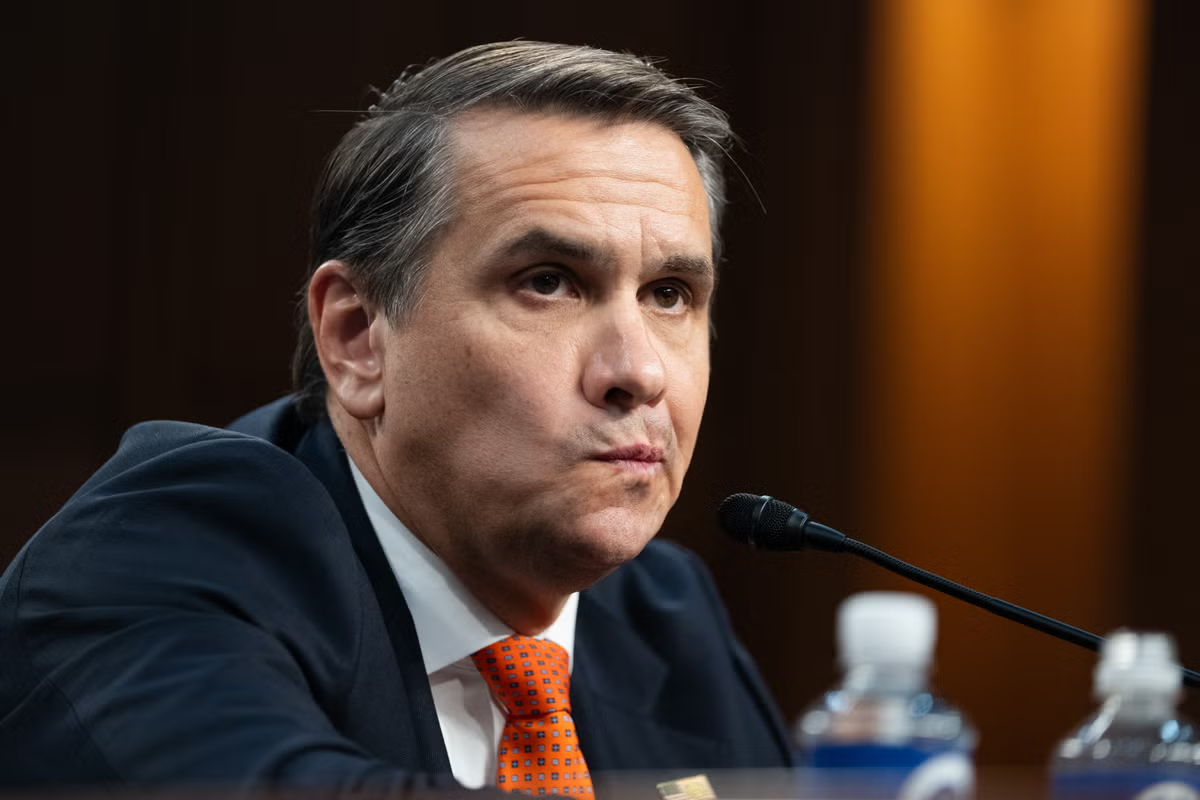
Wednesday’s hearing of acting Attorney General Todd Blanche, who is nominated by Trump to take the role permanently, was highlighted by tense moments as senators questioned Blanche over the Epstein files, his work to protect the president, and the killing of an apparently innocent man by ICE agents in Maine.
But it was the resurgence of the Department of Justice “weaponization fund” that really threatens to gum up the works. Proposed, then rejected — under media and public pressure — by Blanche, the GOP Senate caucus’ demand that the White House back down from that idea entirely is now threatening Blanche’s nomination altogether, and could even have further consequences for the administration.
“The weaponization fund is dead,” Blanche declared on Capitol Hill Wednesday. But his bluff was called by a Republican senator.
During a heated Q&A with Sen. John Cornyn of Texas, one of the so-called “YOLO” Republicans spurned by Trump and operating in lame-duck mode, Blanche was cornered by the senator into admitting that the DOJ had not officially agreed to cease pushing for the fund to be set up, as it remained in the text of a settlement agreement between the Department of Justice and Donald Trump’s legal team. That settlement was voided by a judge, but the president is appealing.
Afterwards, Cornyn was blunt: “He confirmed that it’s not dead.”
Adding that he had “concerns” and wasn’t making a final judgement on Blanche’s nomination yet, Cornyn left the future of Trump’s next nomination fight in limbo. And the Senate GOP’s feud with the White House was back on, just like that.
That’s not somewhere Trump wants to be, with four months to go before the midterm elections. Engaging in another fight with Congress will only sap the administration’s but also congressional Republicans’ strength at a crucial time. Republicans are still seeking to pass a third legislative package through the budget reconciliation process, and the issue has also held up renewal of the Foreign Intelligence Surveillance Act (FISA).
More than that, it adds to a perception of dysfunctional government that Republicans are trying to avoid as voters decide whether Republicans should maintain control of the House and Senate.
The feud between Trump and the Senate GOP dates back several months. The chamber has resisted all of his calls, for more than a year, to ditch the legislative filibuster and pass the “SAVE America Act”, a piece of legislation that would impose voter ID and largely restrict mail-in ballots. It has also been a source of increasing embarrassment for the administration as its GOP members have defected to join Democrats in passing War Powers Resolutions to restrict his warmaking abilities.
Republicans’ opposition to the slush fund materialized earlier this year. First announced in May, the fund’s intended purpose was to reward those targeted “unfairly” by the Department of Justice for Prosecution under President Joe Biden. Immediately, Republicans and Democrats alike became concerned that it would be used to offer payouts to January 6 rioters.
What followed was a full-scale revolt in the Senate. At an explosive meeting, Blanche was harrangued by lawmakers who wanted him to drop the fund, incensed that the administration would push such an unpopular idea in a close election year. Former Senate GOP leader Mitch McConnell, currently hospitalized, released a statement after the meeting concluded calling the fund an “utterly stupid” idea. The administration claimed afterwards that it was backing down, but senators like Cornyn have reacted to that news with overt skepticism.
Senate Republican leaders have been in a cold war with Trump this entire year. Between the slush fund, Trump’s endorsement against two of their own incumbents, the war with Iran and the demand to scrap the filibuster, the president has worked against Senate Majority Leader John Thune and his bid to protect a GOP majority in multiple instances.
In late June the relationship was deteriorating to such a point that Trump made a rare stop on Capitol Hill to mend ties with the Legislative Branch. Instead, he got an earful from Sen. Bill Cassidy. It’s hard to see how things have improved from that point.
The confirmation by Blanche on Wednesday that the “weaponization fund” can’t be dismissed entirely until both parties agree on a new settlement or a judge delivers a final ruling indicates that the president remains unable to get out of his own way when it comes to resolving that gulf between the Executive and Legislative branches.
It’s unclear how much longer it will remain an issue — the appeals process could be lengthy, and realistically the only time limit the president faces to wrap up the case entirely will be self-imposed, in the end. The only way the slush fund truly dies in the near future will be if Donald Trump agrees to kill it, and puts it in writing with the DOJ.
Cornyn’s opposition could block Blanche’s nomination in committee, or — more likely — imperil it in a larger floor vote. And Blanche will be back for round 2 on the Hill Thursday.
But it’s also a sign of a larger problem for Trump, a growing disatisfaction with his leadership in the Senate that now seems to be sticking around. Even with Cornyn and fellow “YOLO”-er Bill Cassidy leaving the chamber at the end of the year, the president could be looking at a frozen legislative branch for the remainder of 2026.