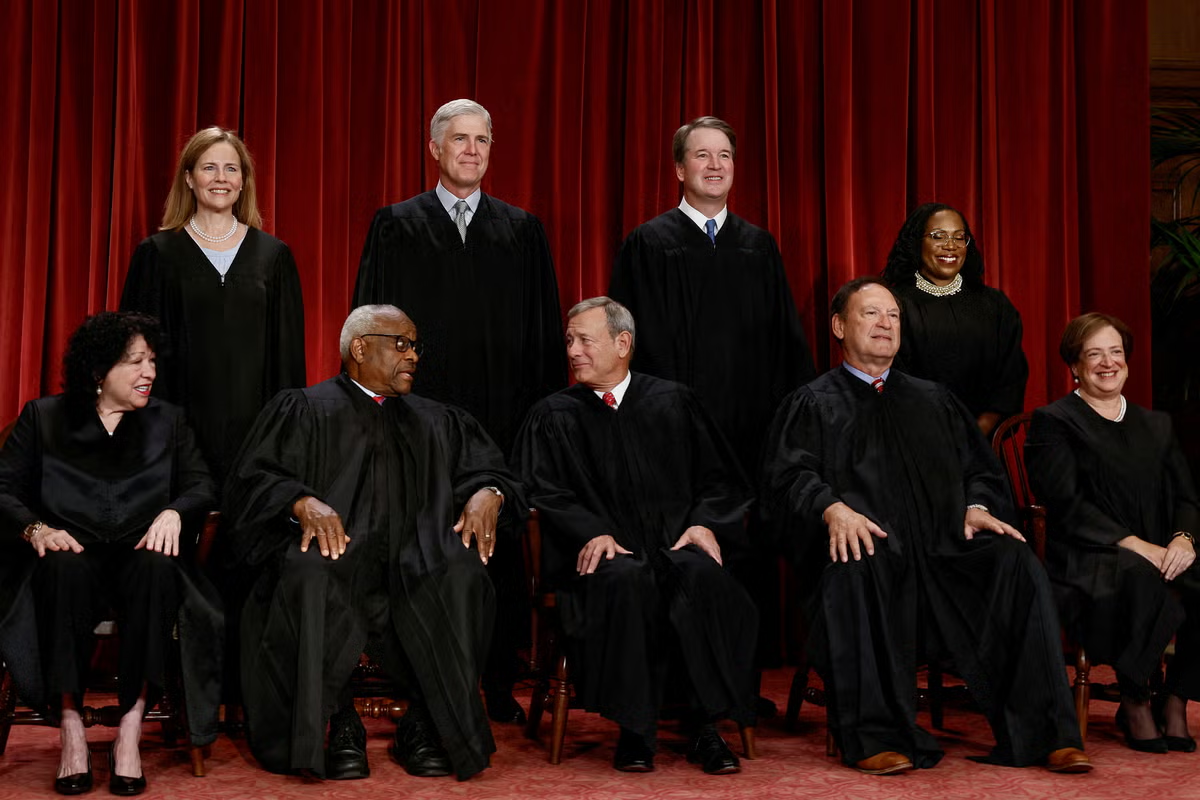
The Supreme Court has ended one of its most ideologically divided terms in decades, with six conservative justices on the nation’s high court splitting from the three liberals in nearly a quarter of the cases argued before them.
Justices were ideologically split in at least 13 argued cases this term, including in high-profile decisions on voting rights, presidential power and birthright citizenship, among other landmark cases with far-reaching impacts.
The court’s six conservative justices voted together against three dissenting liberals more than 22 percent of the time, compared to just 10 percent of cases before the court 20 years ago, according to an analysis from SCOTUSblog.
The court’s docket is increasingly dominated by President Donald Trump, whose administration turned to the court for emergency action more than two dozen times over the last year. The president was a named party in several cases that reached oral arguments within his second term in office, turning the nation’s high court into what nonprofit watchdog group Court Accountability called “ground zero for an escalating constitutional clash with the Trump regime.”
The court is behaving “even more politically,” and cases where conservative justices peel off from the majority are “the exception that proves the rule rather than evidence of genuine independence,” wrote Steve Vladeck, a professor of law at the Georgetown University Law Center.
That division comes into sharp relief in the dissenting opinions, where liberal justices routinely fire back at their conservative counterparts over what they see as a court at risk of undermining its legitimacy with increasingly politically dominated decision-making.
In a case that allowed Alabama Republicans to adopt a new congressional map that had been struck down as an unconstitutional gerrymander, Justice Sonia Sotomayor criticized the court’s conservative majority for “disregarding both democratic values and the rule of law.”
Following a 6-3 decision that backed Trump’s efforts to effectively shut down asylum claims at the U.S.-Mexico border, she read her dissent from the bench, warning that “more people will die” with their decision that “regrettably tragically extinguishes the light of the torch of the Statue of Liberty.”
Conservative Justice Samuel Alito even issued a rare statement from the bench after Sotomayor read from her dissent.
“There is much that I would have added to my bench statement had I known there would be a dissent read,” Alito said before reading a summary of his own opinion.
Liberal Justice Ketanji Brown Jackson, the newest member of the panel nominated by Joe Biden, has also said in public remarks that the Supreme Court “can and should be better.”
“Courts are apolitical, not supposed to be issuing rulings that are in the political realm,” she said in remarks earlier this year. “We have to be scrupulous about sticking to the principles and the rules that we apply in every case, and not look as though we’re doing something different in this kind of context.”
Jackson is least often in the majority opinion, according to an analysis from SCOTUSblog.
She was in the majority 67 percent of the time overall this term and 41 percent of the time in non-unanimous cases.
Chief Justice John Roberts and Trump-appointed Justice Brett Kavanaugh were in the majority most often this term, each at 95 percent, followed by Trump-appointed Justice Amy Coney Barrett at 92 percent, SCOTUSblog found.
Last year, 15.2 percent of the court’s decisions were decided by a 6-3 vote, and 9 percent of all decisions were 6-3 ideological splits.
This term, those figures rose significantly, to 28.8 percent and 22.7 percent, respectively, according to SCOTUSblog.
Liberal justices dissented nearly one-quarter of the time.
But a final series of rulings this year complicated that broader issue of a more polarized court.
Seven of the nine decisions in the penultimate week of this year’s term were split 6-3 along ideological lines, and only four of seven decisions in the final week were similarly split, while all three liberal justices were in the majority in several high-profile opinions issued within the final week of decisions.
In her final writing this term, Jackson directly rebuked conservative Justice Clarence Thomas by name, ribbing him for his alleged “colorblind” approach to the Constitution in his objection to the court upholding birthright citizenship for all U.S.-born children.
“Despite his longstanding endorsement of a ‘colorblind’ Constitution, Justice Thomas now surprisingly suggests that the Citizenship Clause was a race-conscious remedial measure,” she wrote.
His “narrow vision” of the 14th Amendment — among a suite of civil rights protections in the aftermath of the Civil War — “bears little relationship to the history of its ratification,” Jackson fired back.
Thomas, meanwhile, said the ruling “devalues” American citizenship, and Alito suggested that the majority’s opinion will “degrade” the concept of American citizenship by making the children of “birth tourists” citizens.