By Mobolaji Sanusi
“Sport must retain its political neutrality and be the standard-bearer of global unity in a world of extreme aggression and division.”
— Gianni Infantino, FIFA President.
President Donald Trump of the United States is a conqueror of sorts. Despite inheriting wealth from his father, he has taken it to another level by conquering the business world. He then moved into the political arena, winning a second term as president of America and, in the process, becoming for the second time the world’s most powerful leader.
Quite unrelentingly, he has now moved a notch higher into the soccer arena. Despite the sport’s globally touted norm of political neutrality, Trump has thrown his weight around in a way that has left the entire world aghast.
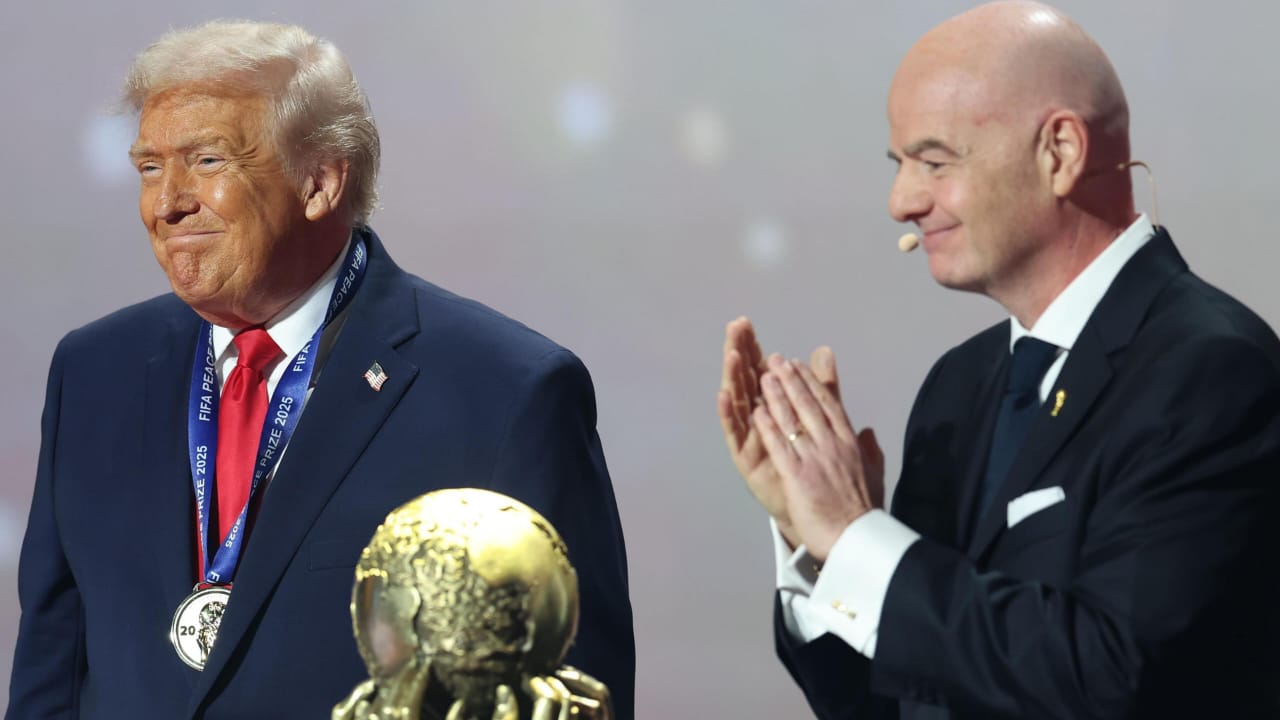
At the ongoing World Cup, co-hosted by the United States, Canada, and Mexico, Trump dabbled in global football affairs. He did not go through America’s football federation. Instead, he acted unilaterally, compelling the president of Fédération Internationale de Football Association, FIFA, Gianni Infantino, through a phone call, to suspend a red card issued to an ‘immigrant American’ player by the referee. To Trump, the red card was unfair and should not stand, but to the world, it is nothing but an arbitrary and condemnable political intrusion in football affairs.
Donald Trump became a spectator-stand referee when he not only ventilated his views on the red card from the comfort of his White House residence but also questioned the professional integrity and character of the match official. “He didn’t do anything wrong and he is our best player. When they take your best player and say ‘You can’t play,’ it’s very unfair,” Trump declared. Simply because Balogun, a boy of immigrant ancestry that Trump unpretentiously despises, is America’s ‘best player,’ his unruly football conduct should be condoned and overlooked by the referee in the myopic lens of the American president.
He was also effusive in his praise of FIFA for suspending the red card sanction, saying: “I think they made a really brilliant decision. I asked for a review. If they would not allow a top player to play, I think it [the World Cup] would have had a big stain…” Trump, who should institutionally not have control over the United States Soccer Federation despite his enormous political power as United States president, crossed the red line of FIFA convention against political interference by stating: “I asked for a review,” and Gianni Infantino, his friend and FIFA president, compellingly granted his encroaching political request.
The worst of his comments was his attack on the personality of Brazilian referee Raphael Claus, coupled with FIFA’s contemptible acquiescence to Trump’s slanderous remarks. Trump offered no evidence relating to the referee’s technical competence or past performance record. Yet, he carelessly impugned the referee’s character by saying he was “a little bit suspect if you check his past.”
The bullish diplomacy of Trump, fueled by his friendship with FIFA president Gianni Infantino, was evident in his erroneous belief that anything American should not be questioned, even when wrong. Defending Balogun, he said: “He didn’t do anything wrong and he is our best player. When they take your best player and say ‘You can’t play,’ it’s very unfair.”
What this means is that, in Trump’s eyes, no American can go wrong on that pitch, even if such a person is of his highly derided immigrant ancestry. He’s shockingly not perturbed even if a referee in such a game of football has appropriately deemed such a player as having committed a foul on the soccer pitch. To agree with this presidential illogicality is to irresponsibly embrace leadership hypocrisy and incorrigibly trample on the globally espoused norm that football’s disciplinary decisions and overall affairs should be insulated from political interference or influence.
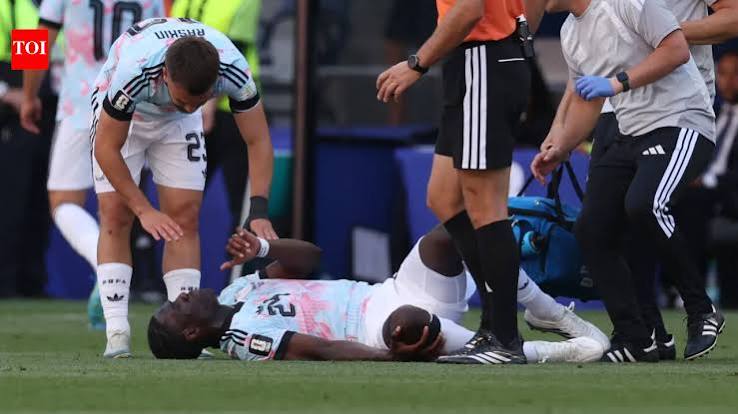
Folarin Balogun, the immigrant American of Nigerian ancestry who is at the centre of it all, was given a red card for awkwardly stepping on the right ankle of Tarik Muharemovic of Bosnia-Herzegovina in a game the United States won 2-0. Just because of Trump’s subtle threat, FIFA announced it has suspended Balogun’s match ban for “a probationary period of one year,” subject to his not infringing in “a similar nature and gravity” during that period. Through this announcement on its portal, FIFA pointedly confirmed that the referee’s decision on the field against Balogun was correct. What an institutional shame on FIFA for not standing solidly by the referee’s decision, even if heaven were to fall.
Yours sincerely cannot but agree with Sepp Blatter, FIFA’s eighth president from June 8, 1998 to October 8, 2015, when he was forced out of office over allegations of corruption, when he recently said that “red cards are not overturned by political phone calls. They are overturned by rules, evidence, and independent bodies.” Where is the empirical evidence adduced through Trump’s inducing phone call to Infantino on the matter, and why should it be him? The last time yours sincerely checked the rules, football and sports issues generally are not intra vires any country’s presidential powers. And definitely, the way the red card issue involving an American national football team player in the 2026 World Cup was handled between Infantino and Trump shows one thing: football may henceforth become a “playground for political power.” But this bad precedent-setting ugly trend should not be allowed.
In recent times, FIFA has reversed referees’ decisions without its actions generating as much hullabaloo. Articles 10 and 66 of its Disciplinary Code provide an automatic suspension of a player from his team’s subsequent match if he gets a direct or indirect red card. But the Code’s Article 27 provides a proviso stating that such a sanction can be suspended, following due process. And the global football body has deployed this power in recent times.  Christiano Ronaldo got a red card during Portugal’s World Cup qualifier against Ireland, which was suspended to allow him to play in the World Cup opener.
Also, Nicolás Otamendi of Argentina and Moisés Caicedo of Ecuador were given red cards in April during their countries’ World Cup qualifiers but all offending players had their one-game bans deferred so they could play in the World Cup openers. These cases were handled through requests made by the recognised sporting federations of the affected players’ countries, not through any presidential bullying.
History has shown that the precedent for suspending a red-carded player can be traced to the 1962 World Cup in Chile. Brazilian superstar player and the first player ever to win the Golden Ball and Golden Boot in the same World Cup fiesta, Manuel Francisco dos Santos, globally known as Garrincha, received a red card for kicking an opponent in the 83rd minute of their semifinal match against the host nation, Chile. Since he was widely regarded as one of the best players to have ever played football with his dominating form in the Brazilian national football team alongside Pele, he was allowed to play in the final against Czechoslovakia but not until the Brazilian Football Confederation embarked on a lobbying campaign that reportedly received the support of then Chile’s President Jorge Alessandri. This was understandable, given that Garrincha was not even Chilean. Brazil won the final through his domineering influence on the football pitch, for its second straight title.
In the Olympic Charter and the statutes of international football federations across the world, FIFA forbids political interference. Why was America’s case under Trump treated differently?
Gianni Infantino’s FIFA presidency has not set a good precedent in the United States football player’s case by capitulating to Trump’s subtle telephone call threat when he’s not a football referee. Decades after this America/Canada/Mexico co-hosted World Cup is over, football fans and scholars in the field of sports will keep referencing it as a bad example of how FIFA’s decision was influenced by political power intrusion.
The Union of European Football Associations, UEFA, captures Trump’s disturbing football intrusion, FIFA’s capitulation and what it portends for the future of global football when it said: “When the certainty of rules is no longer guaranteed by its guardians, the integrity of the game is at stake and the credibility of a competition is undermined.”
What more is left to be condemned regarding the Trump/Infantino football aberration in the ongoing United States/Canada/Mexico co-hosted World Cup fiesta? It is now pertinent to remind FIFA leadership under Mr. Infantino to let the world know what has happened to the freely uttered statement he reportedly made some time ago that “sports must retain its political neutrality and be the standard-bearer of global unity in a world of extreme aggression and division.”
The question: Can it be said that Infantino is carrying out his altruistic and global wish on sports neutrality or pandering to the selfish coercive bid of a haughty superpower? History is watching.
•Sanusi, former MD/CEO of Lagos State Signage & Advertisement Agency, is currently managing partner at AMS RELIABLE SOLICITORS. (WhatsApp Only-07011117777)