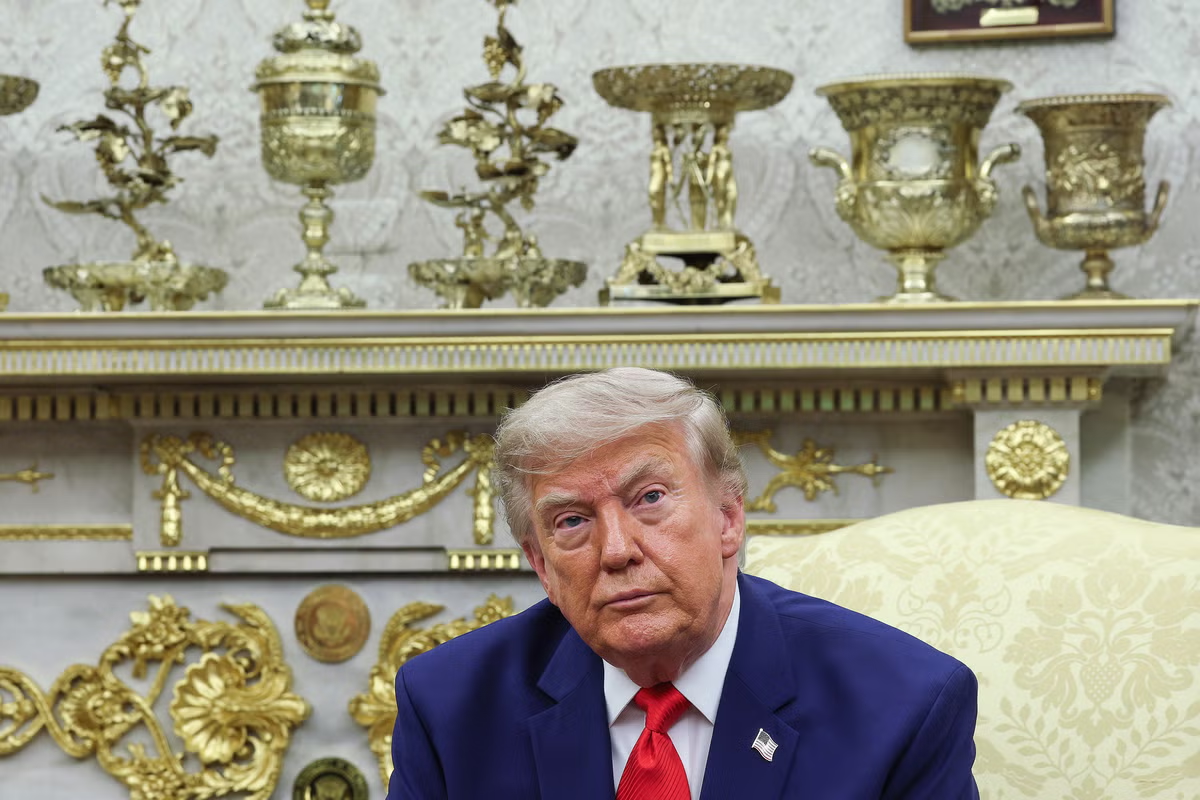
President Donald Trump has framed the American death toll in the Iran war as relatively low compared to past conflicts, drawing criticism from across the political spectrum.
On Tuesday night, Trump posted a graphic on his Truth Social social media platform which outlined the duration and casualties of wars initiated under previous presidents.
“Vietnam War: 19 years, 58,220 DEAD. Korean War: 3 years, 36,574 DEAD. Iraq War: 9 years, 4,600 DEAD. Afghanistan War: 20 years, 2,000 DEAD,” it stated.
The current war was labeled simply as the “Iran Military Conflict,” accompanied by the line “18 DEAD.” The graphic also included “Venezuela War: 1 day, 0 DEAD.”
“These are the real facts,” the 80-year-old Republican wrote. “REPORT THEM!”
The president’s post came days after Iranian strikes on U.S. bases in Jordan and Iraq killed four American service members, underscoring the human toll of a conflict that has ravaged the Middle East and spiked global fuel prices.
In addition to the 18 U.S. service members who have been killed, an estimated 500 more have been wounded, the Pentagon said. This week, The New York Times reported that the Trump administration has withheld information on dozens of injuries.
In Iran, at least 3,000 people have been killed since the war broke out in late February, including 168 children, according to NPR, citing the Iranian government.
The president’s posts prompted swift condemnation from a number of politicians, some accusing him of appearing to boast about fallen U.S. service members and downplaying the cost of the conflict.
“Trump is bragging about killing 18 US soldiers,” former Republican Georgia Rep. Marjorie Taylor Greene wrote on X. “Thats how I read this stupid posts. The ‘peace president’ went to war and is killing and wounding our troops.”
“Donald Trump is a disgusting Little Man,” California Governor Gavin Newsom, a Democrat, wrote on X. “Treat our brave American soldiers with some respect.”
“I take such great exception to Donald Trump’s Truth Social post where he seems to imply that it’s only 18 — it’s only 18 service members. Why should we be concerned about it?” Rep. Jason Crow, a Colorado Democrat, told CNN.
“Well you know what, it matters a lot to their families, to their brothers and sisters, their kids. And it’s exactly that mentality, frankly, that shows why he is unfit to serve in this role.”
On Wednesday, Trump will travel to Dover Air Force Base to attend the dignified transfer of the four service members recently killed in the Middle East. It will be the third such ceremony Trump has attended since the war began.
“We feel very badly, but you know, those great people, those great patriots were out there fighting so that Iran cannot have a nuclear weapon,” Trump told reporters Sunday. He said the U.S. was striking Iran in “honor” of the deceased troops.
The war shows no sign of abating, with the U.S. striking Iran for a tenth straight night Tuesday.
Hopes for an end to the fighting briefly rose after a peace framework, known as a memorandum of understanding, was signed June 17. But the agreement unraveled after strikes resumed in the following weeks, with the Strait of Hormuz emerging as a major sticking point.
Trump decided that the ceasefire was over in late June after Iran fired on three ships traversing the waterway, The Wall Street Journal reported. On July 1, Trump removed any lingering ambiguity, telling reporters: “To me, I think it’s over.” Dealing with the Iranians, in his telling, was “a waste of time.”
The U.S. has signaled that diplomacy remains possible. On Sunday, Secretary of State Marco Rubio told reporters that Iran continues “to send signals that they want to talk, that they want to negotiate, but their behavior is what we’re responding to. And their behavior is they’re launching missiles and drones at ships” in the Strait of Hormuz.
During congressional testimony this week, Defense Secretary Pete Hegseth estimated that the financial toll of the conflict has now surpassed $37 billion. He is asking lawmakers for an additional $67 billion.
Multiple recent polls indicate most Americans remain opposed to the conflict.