A top Trump official has warned state election leaders that they could face criminal charges if they knowingly permit noncitizens to vote or remain on voter rolls — marking the administration’s latest attempt to police election integrity.
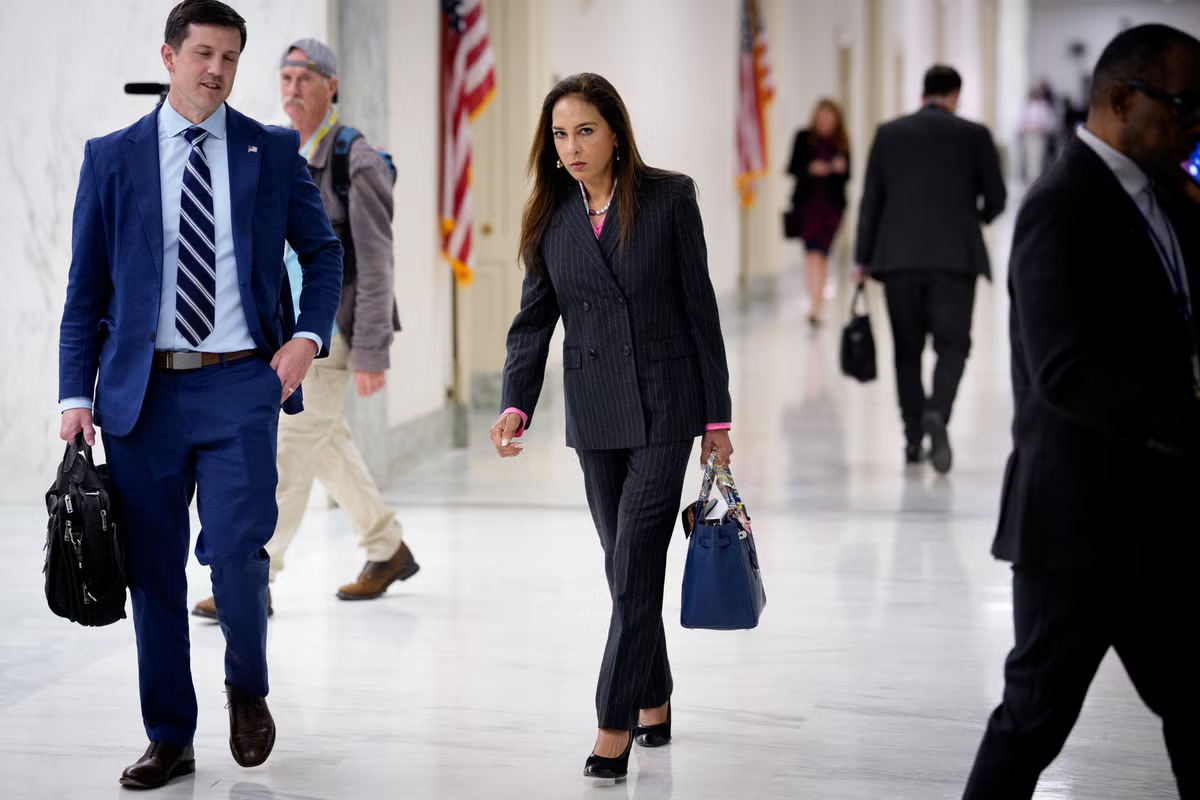
On Tuesday, Assistant Attorney General for Civil Rights Harmeet Dhillon dispatched letters to officials in all 50 states, invoking statutes that have long existed but are being pointed to with renewed urgency.
“Any election officer, including the chief election officer of the state, who knowingly retains noncitizens on the state’s [state voter registration list] or facilitates noncitizens in receiving and casting ballots could be subject to criminal liability,” Dhillon wrote in letters to officials from Maine, Michigan and Arizona, that were obtained by CBS News.
“We encourage you to contact us to discuss what steps your state should take to maintain clean voter lists as required by law,” added Dhillon.
The letters are part of a broad effort by the Trump administration to tighten election rules ahead of November’s midterms on an issue that numerous reviews have found to be vanishingly rare: voter fraud.
The president has pressed Congress to pass the SAVE America Act, which would require new voters to show proof of citizenship.
He has also declined to rule out deploying National Guard troops or ICE agents to polling places, while baselessly claiming that Democratic-led states are engaged in “BIG cheating.” For years, Trump has asserted without evidence that widespread voter fraud by noncitizens benefits Democrats.
The Independent has contacted the Justice Department for comment.
A DOJ spokesperson told CBS News: “The Department sent these letters to all 50 states and the District of Columbia, asking for voluntary compliance in a timely manner with their obligations under federal law to ensure only citizens vote in federal elections.”
The letters arrived as the DOJ remains entangled in litigation with numerous states in a bid to compel them to hand over their uncensored voter rolls. The Civil Rights Division says the records are needed to enforce compliance with federal law, though officials have also conceded the data will be shared with the Department of Homeland Security to check for noncitizen voters.
To date, the administration has come up short, racking up 11 defeats at the district court level.
Some state officials have openly balked at the federal government’s overtures.
Utah Lieutenant Governor Deidre Henderson, a Republican and the state’s top election official, expressed concern in a post on social media.
“Got another love letter this morning from the DOJ sprinkled throughout with threats of criminal prosecution,” Henderson wrote, according to The New York Times, which reported that the letter highlighted multiple federal election laws over the span of seven pages.
“I’m sure I’m not the only chief election officer of a state who is being targeted for following state and federal laws by resisting DOJ’s demands for private voter data that have thus far been ruled illegal by at least a dozen courts,” she continued. “This is truly bizarre behavior by the federal agency that is supposed to be protecting civil rights.”
Arizona Secretary of State Adrian Fontes, a Democrat, also issued a lengthy response defending his state’s election measures.
“It is insulting to insinuate that the good people at our county recorders’ offices across the state are not doing their jobs correctly,” Fontes said in a statement. “Arizona election officials have always worked to ensure that only eligible citizens are registered to vote, and we will continue following Arizona law—not directions that come from political rhetoric or intimidation.”
Also on Tuesday, Dhillon announced that the Civil Rights Division would send election monitors to 15 jurisdictions across six states during the “upcoming primary season.”
The states are Arizona, Michigan, Massachusetts, Minnesota, New Hampshire and Virginia — four of which voted for former Vice President Kamala Harris in 2024.
Dhillon emphasized that the move is routine, noting that the Biden administration sent monitors to nine jurisdictions in 2022.