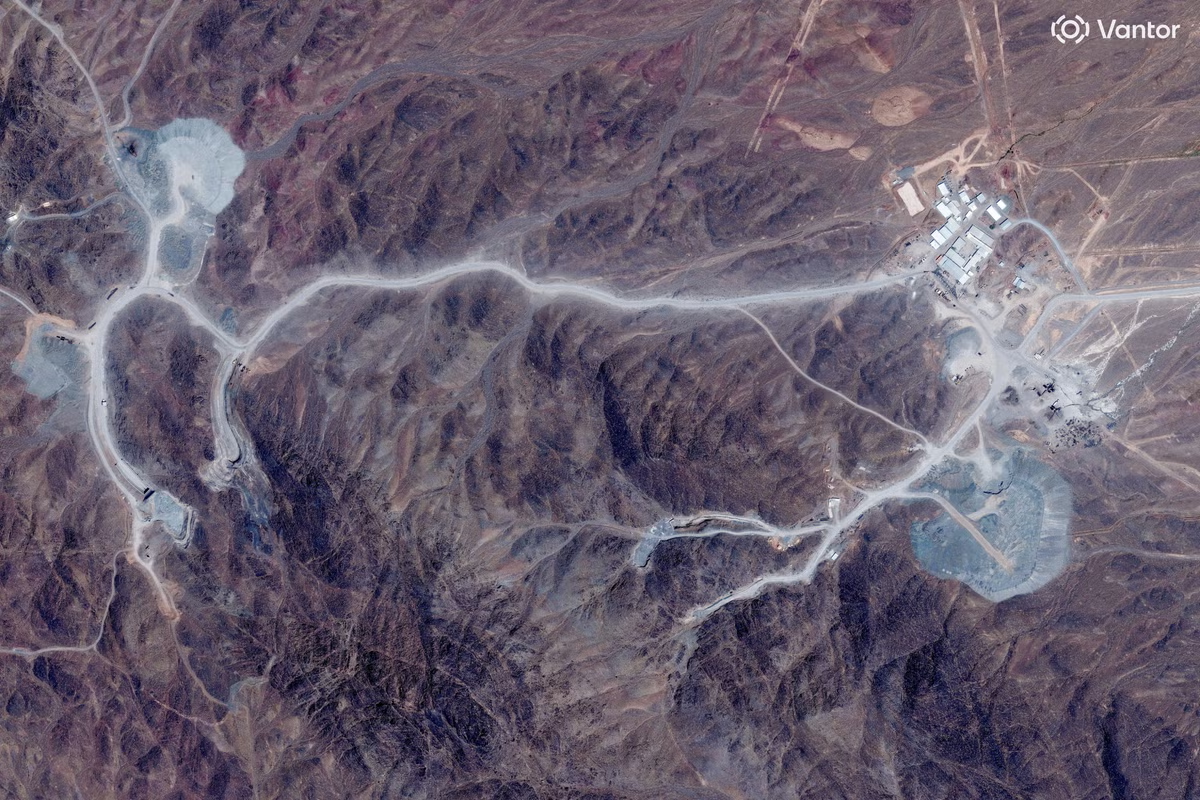
Donald Trump has issued threats to bomb a secretive under-construction Iranian nuclear site buried deep under a mountain.
The site, known as Kuh-e Kolang Gaz La, or “Pickaxe Mountain,” lies on the south side of Iran’s Natanz nuclear enrichment site, which was bombed by the United States during Operation Midnight Hammer in 2025’s 12-day war between Iran and Israel. But Pickaxe Mountain has remained untouched as Iran continues to dig at the site.
It remains unclear just what has been placed at Pickaxe Mountain, as the United Nations’ nuclear watchdog has never gained access to the site.
The threat comes as the two nations continue to exchange blows over the Strait of Hormuz. U.S. Secretary of State Marco Rubio said on Wednesday the United States is still willing to negotiate an end to the Iran crisis but claimed Tehran is not serious about talks. Rubio made his comments in a meeting of Southeast Asian foreign ministers a day after three oil tankers carrying Saudi crude to Asia reversed course in the Red Sea, apparently in response to threats from Yemen’s Iran-aligned Houthis.
But Trump on Tuesday talking with journalists in the Oval Office acknowledged the possibility Iran may have moved centrifuges there, potentially at a depth that would challenge even the most-powerful bombs in America’s arsenal.
Discussing plans to stop Iran from obtaining a nuclear weapon, Trump said the United States will soon target the area near Pickaxe Mountain.
“We’ll be hitting that area pretty soon, and very heavily,” Trump told reporters on Tuesday. The president made the comment after being asked whether he believes Iran has moved nuclear centrifuges to the site. He said it “doesn’t mean anything” unless Iran has uranium to enrich.
“We follow the material,” he said. “That’s where the action is.”
“We’ll be hitting that area … probably pretty soon. And there’s not a thing they can do about it,” Trump said.
The new project at Pickaxe Mountain is being constructed next to Natanz, about 225 kilometers (140 miles) south of Tehran, Iran’s capital. Natanz, a mix of above- and underground facilities, has been a point of international concern since its existence became known two decades ago. Repeated sabotage attacks on Natanz, including one likely carried out by Israel that destroyed a manufacturing site for centrifuges, led Iranian officials to start work on the Pickaxe Mountain site.
Protected by anti-aircraft batteries, fencing and Iran’s paramilitary Revolutionary Guard, the facility sprawls across 2.7 square kilometers (1 square mile) in the country’s arid Central Plateau. It has multiple entrances visible from satellite images.
In 2023, an Associated Press story on Pickaxe Mountain included analysis from experts at the James Martin Center for Nonproliferation Studies that suggested Iran is likely building a facility at a depth of between 80 meters (260 feet) and 100 meters (328 feet). Digging has continued at the site in the time since, with some experts suggesting it could be even deeper underground.
Experts say the size of the construction project indicates Iran will likely be able to use the underground facility to enrich uranium as well as to build centrifuges.
Centrifuges, tube-shaped devices arranged in large cascades of dozens of machines, rapidly spin uranium gas to enrich it. Additional cascades spinning would allow Iran to quickly enrich uranium under the mountain’s protection.
Such underground facilities led the U.S. to create the GBU-57 bomb, which can plow through at least 60 meters (200 feet) of earth before detonating, according to the American military. U.S. officials reportedly have discussed using two such bombs in succession to ensure a site is destroyed. It is not clear that such a one-two punch would damage a facility as deep as the one at Pickaxe Mountain.
Speaking alongside Lebanese President Joseph Aoun on Tuesday, Trump initially sought to downplay Pickaxe Mountain by bringing up Iran’s stockpile of highly enriched uranium. Iran had enriched uranium up to nearly weapons-grade levels of 60% before the 2025 strikes. In the time since, Iran is not known to have restarted enrichment and its stockpile is believed to be at still at the bombed enrichment sites.
“We follow the material, that’s where the action is,” Trump told journalists.
Trump, however, said Pickaxe Mountain was a potential target for American bombers as back-and-forth attacks between Iran and the U.S. rage on.
“Normally I wouldn’t say that,” the president added. “If I thought they could do something about it, I would never say that, but we’ll be hitting that area pretty soon. And very heavily.”
Iran says that areas around its only nuclear power plant at Bushehr have already come under attack during the war, though no damage was done to its Russian-run reactor. Tehran also said the U.S. attacked the cleared area where it plans to build the Darkhovin nuclear plant, though the U.N.’s International Atomic Energy Agency says there was no atomic material there the last time they inspected the site.
The only nuclear power plant in the United Arab Emirates, its four-reactor facility at Barakah, also has been targeted during the war. Iran has since warned that it would take unspecified “required actions” to respond to the Darkhovin attack.
In 2025, the U.S. bombed Iran’s nuclear sites at Fordo, Isfahan and Natanz. All three had conducted uranium enrichment.
At the time of the 2025 war and the recent Iran war, both Israel and the U.S. said they aimed to stop Iran from ever be able to build a nuclear weapon. Iran has long insisted its program is peaceful, and it isn’t believed by the IAEA or the West to have had an active military nuclear program since 2003. Israel long has been believed to be the Middle East’s only nuclear-armed state.
However, even before the recent wars Iranian officials have increasingly threatened to pursue an atomic bomb. The late Iranian Supreme Leader Ayatollah Ali Khamenei, killed Feb. 28 in the opening moments of the war, issued a verbal fatwa, or religious ruling, that nuclear weapons were un-Islamic. However, his son, Iran’s new Supreme Leader Mojtaba Khamenei, has not issued any statement regarding his views on the atomic bomb.
To build a usable weapon, Iran would first need to enrich uranium up to 90% purity. It would then need to build an actual bomb, and then likely also need to miniaturize it and mount it on a ballistic missile. That process would take months or years, and would face the risk of discovery by Israeli or U.S. intelligence in the meantime.