Donald Trump has always operated on a simple rhetorical principle: project absolute luxury, claim someone else is footing the bill — and ignore the structural rot.
When it comes to his sweeping architectural overhauls of the nation’s capital, the script remains unchanged: Trump often insists his ambitious projects — from a sprawling White House ballroom to a patriotic re-skinning of national monuments — are private “donations” to the republic.
“This is taxpayer-free. We have no taxpayer putting up 10 cents,” the president proudly declared to reporters in March about the ballroom’s cost.
But public records, internal construction logs and federal grant allocations tell a credit- and credulity-straining story about the bottom line. A close examination of the receipts reveals a pattern of ballooning budgets, non-competitive bidding and the weaponization of federal funds to bankroll what critics say amounts to a roster of partisan vanity projects.
Far from being free of charge, the actual price tag of Trump’s aesthetic conquest of Washington is soaring over a billion dollars — and taxpayers are firmly on the hook.
Most recently, the White House veiled the iconic North Portico entrance in a tarp bearing a photorealistic image of the very thing it was covering.
A White House official told The Independent that the tarp is meant to shield the portico while it undergoes “standard restoration work,” and during a media availability last week, Trump himself said work crews had already “taken about 150 years of paint off of the columns and re-did them” while claiming that they had been “in very bad shape” because they were “treated very badly by a lot of presidents,” though he offered no evidence to support the claims.
Separately, CNN reported that the project includes security upgrades to the White House’s front door that have long been advocated by the Secret Service.
The Oval Office remains awash in gold and gold-colored ornamentations, discarding its prior spartan but tasteful décor for one heavily reliant on the yellow precious metal that is also a hallmark of his Trump Tower and Mar-a-Lago homesteads.
What the president claims to be pure gold leaf paint now covers all manner of previously white surfaces — doorways, crown molding and the Great Seal of the United States that has long been installed in relief on the ceiling of the room. Plus at least two gilded decorations — angel statuettes now visible above a pair of doorways — were brought to the White House from Mar-a-Lago, which he shifted from his native New York during his first term.
Outside the Oval Office, there is now gold-colored lettering rendered in a typeface that largely resembles the signage at Trump’s Florida club — indicating that the entrance to the Oval Office is in fact “The Oval Office,” plus similar labels indicating locations of the Rose Garden and Trump’s “Presidential Walk of Fame.”
The total cost of these latest renovations is unknown, but last month the New York Times reported that the president’s various vanity projects and capital improvements around the nation’s capital appear to have drained at least $1 billion from the federal coffers.
These include his infamous ballroom project and the associated bunker beneath it — a project that was supposed to be free to taxpayers — plus a quarter-billion spent on “upgrades” to the John F. Kennedy Center for the Performing Arts (which was briefly named the Trump-Kennedy center until a federal judge said the Trump-appointed board for the center had no authority to change the name).
And inside the White House, the president has added new floors, tile and fixtures to the Lincoln Bedroom’s Truman-era bathroom, renovated the Palm Room and intends to turn the historic Treaty Room into a bedroom. He’s also paved over the Rose Garden, replaced the stone floor on the colonnade leading to the West Wing from the White House proper, and has coated most of the Oval Office in gilded things.
The cost of these interior updates is unknown, but here are a few items we do know the price of.
The crown jewel of the administration’s architectural ambition is the wholesale demolition of the White House East Wing to make way for a massive new presidential ballroom.
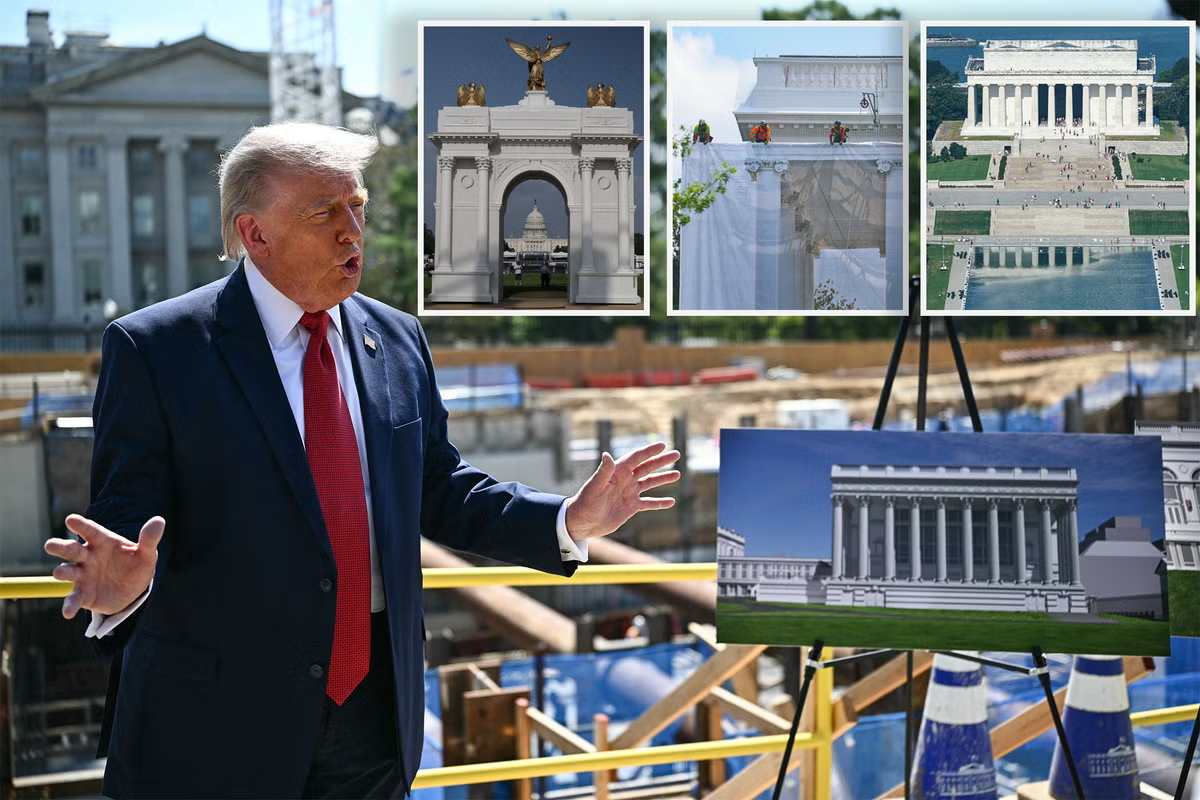
Earlier this year during what was billed as “executive time” on his schedule, Trump summoned the White House press pool for a nearly hour-long bull session at the edge of the cavernous excavation site.
Standing beside computerized renderings of a neoclassical facade he explicitly compared to Cass Gilbert’s Supreme Court building — and shouting over the sound of heavy machinery — the president spun a rambling soliloquy about a “drone-proof” roof that would double as a military “drone-port,” declaring that there would never be another building like it.
First announced in July 2025 with an estimated price tag of $200 million, the president initially promised the venue would be entirely financed by “generous American patriots.”
Promise made? Sure. Promise kept? Not so much.
According to a project summary from lead contractor Clark Construction, the estimated cost to complete construction has skyrocketed to $600 million. That’s more than double the $293 million the White House says it has raised from a who’s who of corporate and private donors, some of whom have been rewarded with intimate dinners hosted by Trump in the White House or in his revamped Rose Garden patio.
Those costs don’t include what’s happening below ground, where a World War II-era bunker is being replaced by what Trump has described as a “massive” military complex that includes a hospital and other emergency operations facilities.
Trump asked the Senate for a $400 million cash infusion for the underground portion of the project, but when it was stripped out, the White House reportedly took around $350 million from the Secret Service’s operating budget and redirected it to the bunker, justifying the move by declaring it all related to Trump’s security.
Meanwhile, around the north side of the White House, workers recently erected a large scaffold and draped a photorealistic tarp over the executive residence’s north portico in preparation for renovation work.
The massive covering was pre-printed with a shockingly accurate rendering of the very architectural feature it was intended to hide, making it appear to a casual observer as if there were no covering at all, sky peaking through and all.