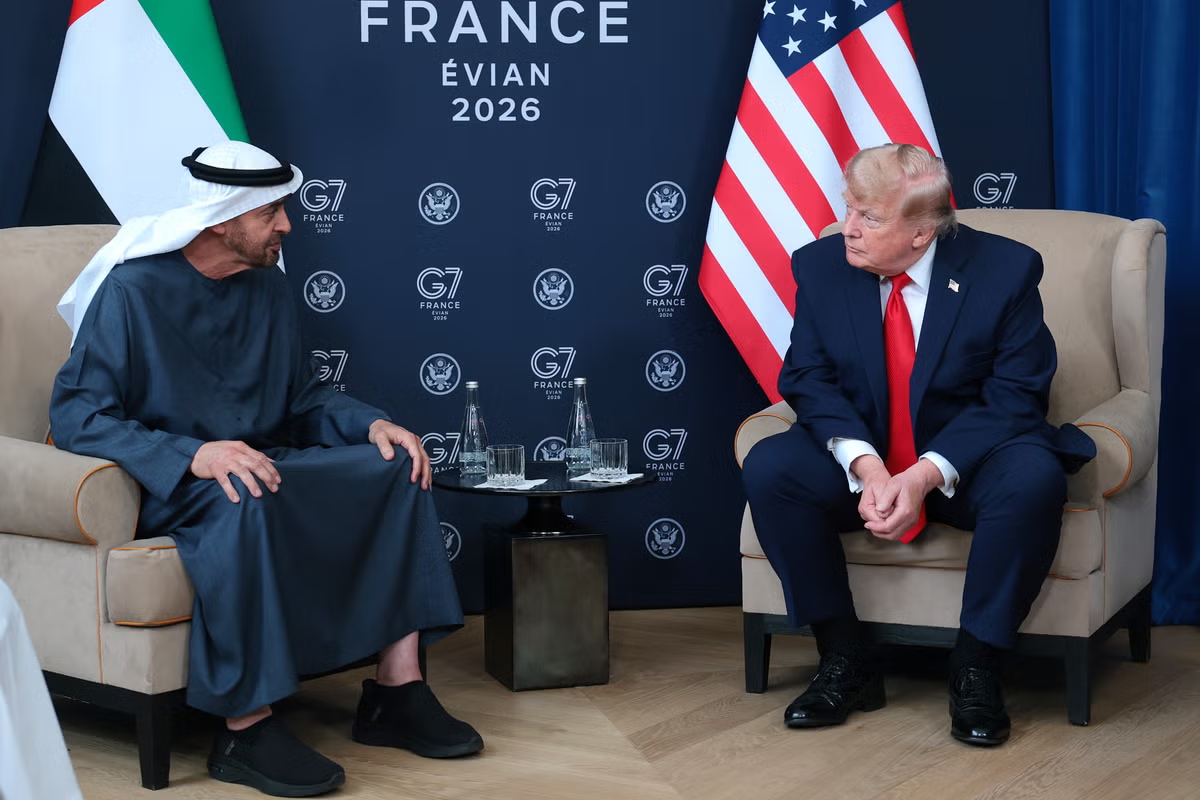
The Trump administration’s move to reward the U.A.E. for its support during the Iran war by granting it better access to U.S.-made AI chips has been attacked in Congress and likened to influence-buying.
A rule change introduced by the administration Friday promotes the emirate to a group of privileged trading partners that includes European allies, India and South Korea and means that it can freely purchase technology with potential military applications.
The emirate had appealed for the shift in designation since the Joe Biden era and its ultimate success principally stands to benefit its main AI company, G42, which can now buy the chips needed to run advanced AI models from Nvidia and its competitors.
G42 is controlled by Sheikh Tahnoon bin Zayed Al Nahyan, the U.A.E.’s national security adviser and the brother of the country’s president, Sheikh Mohamed bin Zayed Al Nahyan. Tahnoon reportedly intends to see G42 become a U.S. company with majority ownership by American investors.
The development represents a potential great leap forward for the Middle Eastern state’s economy as it seeks to diversify and could be worth billions of dollars, according to industry experts cited by The Wall Street Journal.
However, California Democratic Rep. Sydney Kamlager-Dove expressed conflict of interest concerns at a House of Representatives committee hearing Tuesday.
“It smells like it could be an illegal pay-to-play scheme,” she said, echoing Massachusetts Sen. Elizabeth Warren’s earlier denunciation of the deal as “corrupt.”
Their criticism stems from the fact that the U.A.E. bought a 49 per cent stake in Donald Trump family’s cryptocurrency venture World Liberty Financial just four days before his second inauguration in January 2025, an investment worth $500 million.
The country has also promised to invest $1.4 trillion in the U.S.
Kamlager-Dove questioned Commerce Department official Jeffrey Kessler at the hearing, who said he had not discussed chip exports with Trump’s family and called the agreement with the U.A.E. “one of the most significant achievements of the administration.”
The White House has also dismissed her concerns.
Previously, the emirate languished in a lesser trading grouping, alongside the likes of China and Yemen, which required it to apply for a license from the Commerce Department, a lengthy and bureaucratic process.
The new designation also means that Silicon Valley titans like Microsoft and Open AI can now build data centers in the country without complications.
Yousef Al Otaiba, the state’s ambassador to the U.S., downplayed any disquiet over the development and said it merely “advances decades of deep and dependable U.A.E.-U.S. cooperation.”
The emirate originally lobbied Trump against launching his Operation Epic Fury airstrikes against Tehran but, once he proceeded, the country joined the fight by firing missiles of its own, intercepting Iranian counterblasts and continuing to ship oil through the contested Strait of Hormuz.
In addition to backing the war, the U.A.E. signed the Abraham Accords during his first term and has proven itself a loyal ally, a quality the current president particularly values.
“They’ve been with the United States for a long time, but I would say much more so since I came on board,” Trump said in praise of the country at a recent G7 gathering in France.