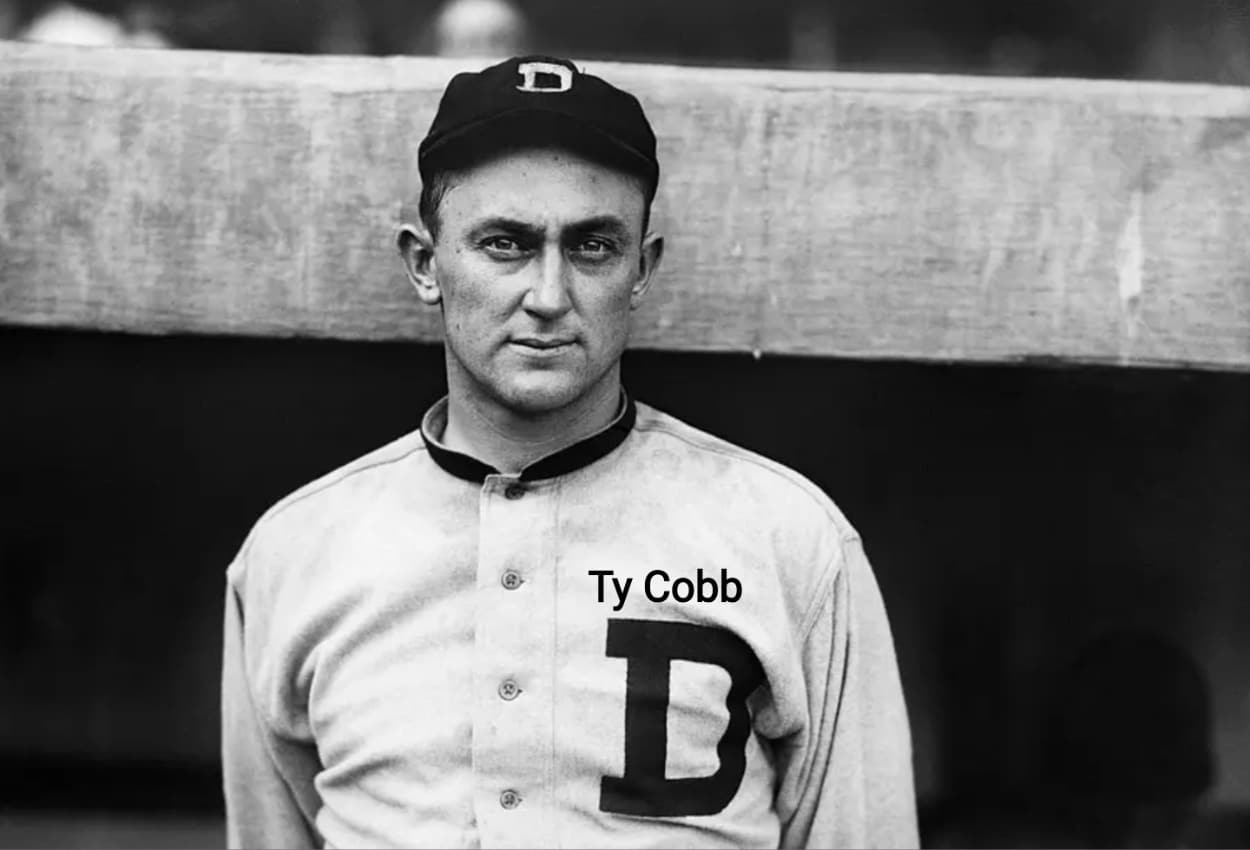
Tyrus Raymond Cobb (December 18, 1886 – July 17, 1961), known as “the Georgia Peach,” was a professional baseball center fielder from Narrows, Georgia. Cobb played 24 seasons in Major League Baseball, spending 22 years with the Detroit Tigers, where he was also the player-manager for his last six seasons. He finished his career with the Philadelphia Athletics. In 1936, Cobb received the most votes on the first ballot for the National Baseball Hall of Fame, with 222 out of 226 possible votes (98.2%). No other player matched that percentage until Tom Seaver in 1992. In 1999, The Sporting News ranked Cobb third among “Baseball’s 100 Greatest Players.”
Cobb set 90 Major League Baseball records during his career. He won more batting titles than anyone else, with 12. Over 24 years, he hit .300 or better in 23 straight seasons, except for his rookie year. He batted .400 in three seasons, a record he shares with three others. Cobb had more five-hit games (14) than any other player. He also holds the record for stealing home 54 times and for stealing second, third, and home in order four times. His combined total of 4,065 runs scored and runs batted in (after adjusting for home runs) is still the highest ever by a major league player.
Profile Summary
| Category | Details |
|---|---|
| Name | Ty Cobb |
| Date of Birth | December 18, 1886 |
| Place of Birth | Narrows, Georgia, U.S. |
| Date of Death | July 17, 1961 (aged 74) |
| Place of Death | Atlanta, Georgia, U.S. |
| Batted | Left |
| Threw | Right |
MLB Career
| Category | Details |
|---|---|
| MLB Debut | August 30, 1905, for the Detroit Tigers |
| Last MLB Appearance | September 11, 1928, for the Philadelphia Athletics |
MLB Statistics
| Statistic | Value |
|---|---|
| Batting Average | .366 |
| Hits | 4,189 |
| Home Runs | 117 |
| Runs Batted In (RBIs) | 1,944 |
| Stolen Bases | 897 |
| Managerial Record | 479–444 |
| Winning Percentage | .519 |
Teams
| Role | Team | Years |
|---|---|---|
| Player | Detroit Tigers | 1905–1926 |
| Player | Philadelphia Athletics | 1927–1928 |
| Manager | Detroit Tigers | 1921–1926 |
Career Highlights and Awards
| Achievement | Year(s) |
|---|---|
| AL Most Valuable Player (MVP) | 1911 |
| Triple Crown | 1909 |
| AL Batting Champion | 1907–1915, 1917–1919 (12×) |
| AL Home Run Leader | 1909 |
| AL RBI Leader | 1907–1909, 1911 (4×) |
| AL Stolen Base Leader | 1907, 1909, 1911, 1915–1917 (6×) |
| Name Honored by the Detroit Tigers | Yes |
| Member of the Major League Baseball All-Century Team | Yes |
Biography & Early life
Tyrus Raymond Cobb was born on December 18, 1886, in Narrows, Georgia, a small, unincorporated rural community of farmers. He was the first of three children born to William Herschel Cobb (1863–1905) and Amanda Chitwood Cobb (1871–1936). Cobb’s father was a state senator.
When Cobb was an infant, his family moved to Royston, where he grew up. He became interested in baseball as a child and wanted to play professionally, even though his father strongly opposed it. As a teenager, he tried out for local teams. He started playing organized baseball with the Royston Rompers, then the semi-pro Royston Reds, and later joined the Augusta Tourists of the South Atlantic League, who released him after just two days.
Cobb then tried out for the Anniston Steelers in Alabama, a team in the semipro Tennessee–Alabama League. His father warned him, “Don’t come home a failure!” After joining the Steelers for $50 a month, Cobb promoted himself by sending postcards about his skills, using different names, to Grantland Rice, the sports editor of the Atlanta Journal. Rice later mentioned in the paper that a “young fellow named Cobb seems to be showing an unusual lot of talent.” After about three months, Cobb went back to the Tourists and finished the season with a .237 average in 35 games. While with the Tourists, he was coached by George Leidy, who taught him precise bunting and aggressive base running. In August 1905, the Tourists sold Cobb to the Detroit Tigers for $750 (equal to $26,875 in 2025).
More…
On August 8, 1905, Cobb’s mother, Amanda, shot and killed his father, William, with a pistol he had bought for her. According to court records, William suspected Amanda of being unfaithful and was sneaking past their bedroom window to catch her. She saw a silhouette, thought it was an intruder, and shot him in self-defense. Amanda was charged with murder and released on a $7,000 bond. She was found not guilty on March 31, 1906. Ty Cobb later said he played fiercely for his father, saying, “I did it for my father. He never got to see me play … but I knew he was watching me, and I never let him down.”
Cobb joined the Freemasons in 1907. He became a member of the Scottish Rite and reached the 32nd degree in 1912.
In 1911, Cobb moved to Detroit’s Woodbridge neighborhood, which is now historically protected. He used to walk with his dogs to the ballpark before games. The Victorian duplex where he lived is still standing.
Retirement
Cobb announced his retirement on September 11, 1928, to take effect at the end of the season. He hit .300 or better in 23 straight seasons, with only his rookie year below that mark—a record that is unlikely to be broken. He won 12 batting titles in 13 years and had three seasons with a batting average over .400, reaching as high as .420. Although not known for power hitting, he led the American League in RBIs four times, hit 295 triples, won the 1909 AL Triple Crown, and led the league in slugging percentage eight times between 1907 and 1917. Only Babe Ruth matched his streak of leading in slugging percentage for six straight years.
Cobb was very fast and led the American League in stolen bases six times. He retired with a modern record of 897 steals, which was 256 more than the next closest player. This record lasted for 49 years.
Cobb was an aggressive fielder and finished his career with 271 errors as an outfielder. As of 2025, this ranks 14th all-time and is the highest for any 20th-century player.
Death
In his final days, Cobb spent time with comedian Joe E. Brown, reflecting on his life choices. Brown said Cobb admitted he had made mistakes and would do things differently if given another chance. Cobb said he had played and lived hard, but ended up with no friends and regretted it. However, in public, he said, “I’ve been lucky. I have no right to be regretful of what I did.”
In June 1961, Cobb was taken to Emory University Hospital after falling into a diabetic coma. His first wife, Charlie, his son, Jimmy, and other family members joined him during his final days. He died there on July 17, 1961, at age 74.
About 150 friends and relatives attended Cobb’s brief funeral service in Cornelia, Georgia, then traveled to the family mausoleum in Royston for his burial. The family kept the event private because they did not trust the media to report it accurately. Only three former players—Ray Schalk, Mickey Cochrane, and Nap Rucke, and Sid Keener, director of the Baseball Hall of Fame, represented baseball at the funeral. Hundreds of condolence messages arrived, including notes from Joe DiMaggio and Ted Williams. Family members present included Cobb’s former wife Charlie, his two daughters, his surviving son Jimmy, his two sons-in-law, his daughter-in-law, Mary Dunn Cobb, and her two children.
When Cobb died, his estate was valued at least $11.78 million (about $127 million today), including $10 million in General Motors stock and $1.78 million in Coca-Cola stock. He left a quarter of his estate to the Cobb Educational Fund, with the rest going to his children and grandchildren. Cobb is buried in Rose Hill Cemetery in Royston, Georgia. As of April 2021, the Ty Cobb Educational Foundation has given $19.2 million in college scholarships to Georgia students in need.
Family
- Parents: Professor William Herschel Cobb and Amanda Chitwood Cobb.
- Cobb was married twice, first to Charlotte (“Charlie”) Lombard and later to Frances Cass. He had five children: Tyrus Jr., Shirley, Herschel, Howell, and Beverly.
Net Worth
- At the time of his death in 1961, Cobb’s fortune was estimated at $12 million, which would be well over $100 million today.
- Although Cobb earned a high salary for his time, most of his wealth came from smart early investments, especially in Coca-Cola and General Motors.