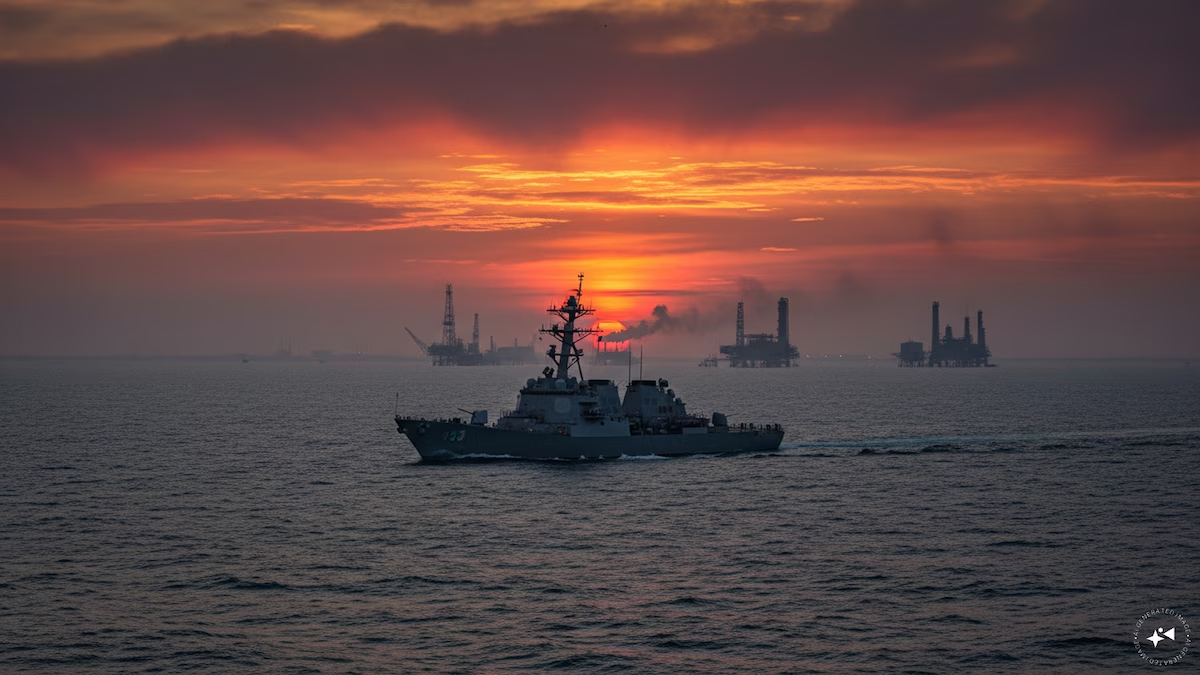
US Central Command said in a social media post the strikes were aimed at degrading Iran’s ability to threaten commercial shipping and “swiftly punish Islamic Revolutionary Guard Corps forces who launched attacks against American service members in Jordan last night.”
Friday’s strike also left four troops wounded and one missing. The total US death toll now stands at 16 since the US and Israeli war with Iran began on Feb. 28.
Tehran announced Saturday it would no longer adhere to the terms of the interim peace deal after unleashing heavy attacks on Gulf neighbors including Kuwait and Jordan in retaliation for the latest US strikes.
Iranian Supreme Leader Mojtaba Khamenei warned of “unforgettable lessons” for the US. He said in a statement published Saturday that US violations of the memorandum — a 60-day ceasefire while the US and Iran negotiated terms for reopening the Strait of Hormuz and curtailing Iran’s nuclear program — “have once again proven to everyone the truth of how worthless and invalid the signature of the US president is.”
Khamenei still has not been seen in public since US attacks killed his father, as well as other family members, and severely injured him in the first days of the war.
A week of back-and-forth strikes by both sides has expanded beyond strictly military targets to include bridges, utilities and port facilities, suggesting little prospect of a return to the fragile ceasefire signed last month.
According to Iranian officials, 50 people have been killed and more than 500 injured in US attacks since June 27.
Kuwait Airways rescheduled most of its flights, while the Ministry of Electricity and Water dealt with a fire at a power and desalination plant struck by Iran.
Kuwait’s Ministry of Foreign Affairs condemned the attacks and said repeated targeting of vital installations “reveals a systemic aggressive approach that targets civilian assets, endangering the lives and safety of civilians,” in flagrant violation of international law.
Iran also struck at US radar and aircraft in Qatar, one of the main mediators between Washington and Tehran, according to the Tasnim news agency.
Central Command earlier said a series of US strikes on Friday hit surveillance sites, military logistics infrastructure, underground weapons storage and maritime capabilities.
The targeting of civilian infrastructure marks an expansion of the post-deal strikes by both sides but the worsening hostilities are still far from the scale seen at the height of the war in March and early April. Then, the US and Israel were bombarding Iranian cities on a mass scale and Tehran was firing thousands of drones and missiles at Gulf Arab states and Israel.
The US State Department urged Americans to reconsider travel through or to the Middle East given the potential for “unforeseen escalation,” and recommended checking with air carriers to ensure that flights were still scheduled for those opting to proceed.
In his statement, Khamenei also urged unity between the Iranian public and its government, an apparent reference to growing criticism from hardliners of the decision to engage in diplomacy.
“Criticism of the performance of officials must not lead to injustice against the innocent or the breakdown of social unity,” he said.
Brent crude surged Friday, rising about 4.6% to settle near $88 per barrel to notch its biggest weekly advance since April. That increase followed an Axios report that the Trump administration notified Israel it’s sending more refueling planes to the country, a possible signal that US military operations could be widened. An Israeli military official on Saturday confirmed the plan for the US to boost its Israel-based aircraft fleet.
Addressing the nation on Thursday night, US President Donald Trump again painted the situation in the Middle East as a success. The US is “winning big in Iran, and you will see the fruits of that labor very, very shortly,” he said, before pivoting to domestic issues.
During the first three weeks of the conflict, 13 service members died in at least three separate attacks. In early July, a Navy pilot died in a helicopter crash in the Arabian Sea.
China and Pakistan expressed concern over the developments, calling on both the US and Iran to cease hostilities and resume dialogue.
Beyond bombing Iran more often, the US is again blockading the country’s ports and has scrapped a waiver for sanctions on its oil exports.
With Iran continuing maritime attacks and insisting that all ships seek its permission before sailing through the strait, there’s a good chance both sides continue to escalate, according to Mehran Kamrava, a professor of political science at Georgetown University’s campus in Qatar.
The attacks are “an ominous sign of more to come, worse to come,” Kamrava told Bloomberg TV on Friday from Doha. “Neither side wants to see this escalation but both have become dependent on the path of an escalatory cycle from which they cannot back out. This tit-for-tat is now very dangerous in the sense of attacks and counterattacks on critical infrastructure.”