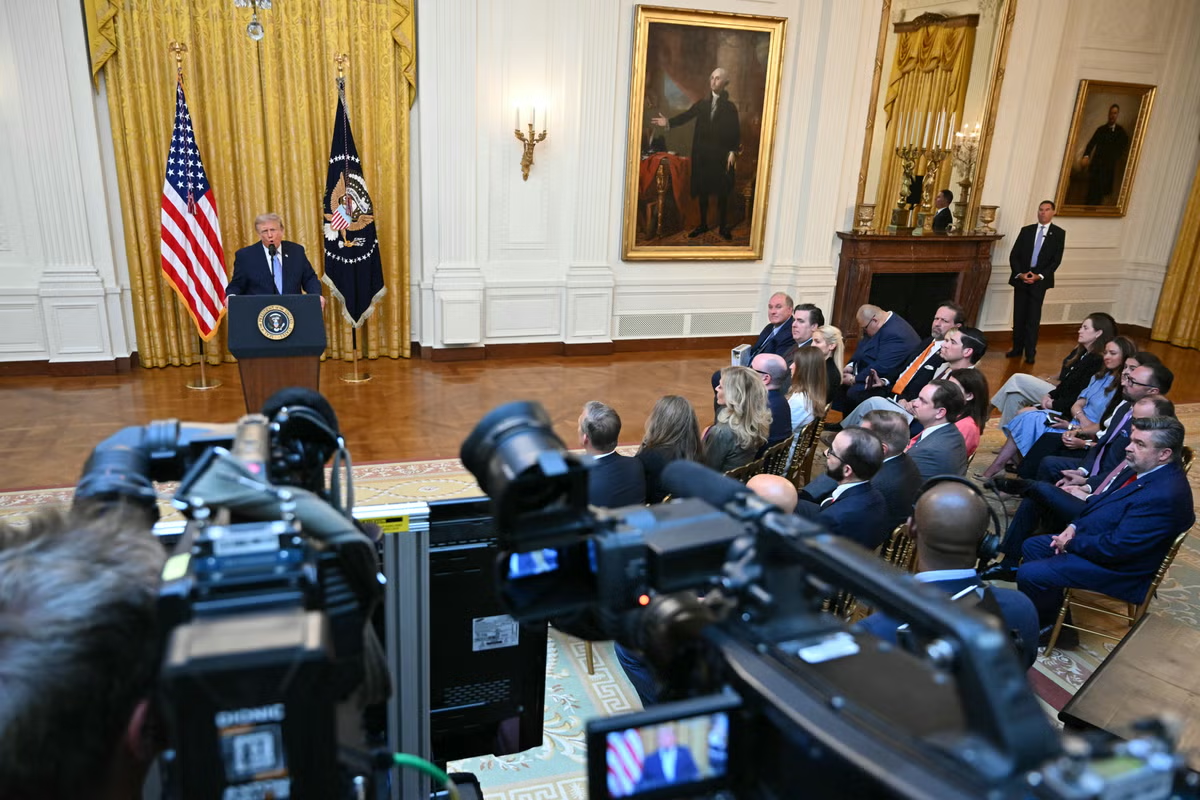
President Donald Trump has spent more than a decade spreading false and inflated claims about election outcomes and how the nation’s elections are run. His primetime address on Thursday was no exception.
The president alleged “shocking vulnerabilities in election infrastructure” and claimed our “election system” is “dangerously” exposed to “hacking, exploitation and foreign interference.”
But it appears much of the newly declassified material he announced Thursday evening echoes or reinterprets previously disclosed information that was already known to intelligence officials, including during his first administration.
Importantly, nothing in the materials supports any allegations that any votes were manipulated by fraud or foreign actors to have changed election outcomes.
Election officials and voting rights advocates fear the president’s remarks, which he says are meant to protect elections, will instead continue to sow deep distrust in their legitimacy to serve his own interests.
“Once again, President Trump is attempting to undermine public confidence in our elections by repeating blatant, outlandish lies,” according to Sophia Lin Lakin, director of the American Civil Liberties Union’s Voting Rights Project. “He promised the nation ‘really big news,’ and instead used a primetime spot to spew the same tired rhetoric to shake Americans’ confidence in their own elections.”
In its declassified report, the White House claims American election infrastructure is vulnerable to interference from five foreign powers.
The nation’s intelligence community determined in January 2020 that China, Iran, Russia and North Korea “have the capability to access and potentially manipulate” U.S. election data, like centralized voter registration databases, but noted that it “would be difficult to manipulate on a wide enough scale to alter the election outcome.”
A long-running thesis among election conspiracy theorists claims election technology companies Dominion and Smartmatic were deployed in the U.S. to rig elections for Democrats. Those claims were also raised during an infamous news conference featuring Trump-allied lawyers Rudy Giuliani and Sidney Powell — which were later at the center of several successful defamation lawsuits brought by the companies.
The Trump administration’s analysis contends that Venezuelan officials have “some capability in manipulating electronic voting systems” to influence election outcomes, but did not determine there is evidence for “large-scale electronic fraud” in the country. The analysis determined that Venezuelan officials did not have the ability to manipulate votes outside the country.
“Neither Smartmatic nor the Venezuelan government had the capability to manipulate the outcome of an election outside Venezuela,” according to the analysis.
Geoff Halte, an election security fellow at the Center for Democracy and Technology who spent 10 years working for the Cybersecurity and Infrastructure Security Agency, stressed that “just because a vulnerability exists doesn’t prove that it’s been exploited, let alone that an exploitation altered something technically during an election.”
“Proving whether voting systems have been exploited in an election requires evidence. But the public should be aware that neither a mountain of documents nor technically complex claims are enough to credibly prove that an election security incident actually occurred,” he said Thursday.
But to date, “no evidence has shown that vulnerabilities in voting systems have been exploited to alter election outcomes in the U.S.”
In his address, Trump claimed Beijing “carried out what is believed to be the largest compromise of election data in history, resulting in China’s illicit acquisition of 220 million U.S. voter files.”
That information includes “names, addresses, phone numbers, political party preferences, and other sensitive data that would be needed to register to vote and engage in other nefarious activities, which is exactly what was happening.”
Virtually anyone can buy up huge swaths of voter data, which is publicly available by many states. It doesn’t appear there is any evidence indicating China used the data to manipulate results, but China has a long and well-documented history and reputation among intelligence agencies of vacuuming up American data.
Trump also said newly declassified intelligence — which was obtained in 2020 but “buried by rogue bureaucrats” while he was president — includes an alleged attempt to “manufacture illegal ballots for Joe Biden.”
The president appeared to misleadingly describe a 2020 memo from the FBI’s Albany, New York office that allegedly discovered China’s plans to send out thousands of fake driver’s licenses. Agents at the time had questioned whether it was a bogus tip or if the source was reliable, and there is no evidence that any votes were fraudulently cast a result.
That memo was released by Republican Senator Chuck Grassley’s office last year.
But Trump’s remarks revived a narrative that has been central to his political career. The president’s persistent claim that the 2020 presidential election was stolen and rigged against him fueled January 6 riots, sustained partisan investigations intended to reverse the outcomes in states he lost, inspired Republican-led legislation in nearly every state to change how elections are run, and formed the basis of his 2024 campaign.
“We have no indications that any foreign actor attempted to alter any technical aspect of the voting process in the 2020 U.S. elections, including voter registration, casting ballots, vote tabulation, or reporting results,” intelligence officials wrote in their 2021 report.
“We assess that it would be difficult for a foreign actor to manipulate election processes at scale without detection by intelligence collection on the actors themselves, through physical and cyber security monitoring around voting systems across the country, or in post-election audits,” they added.
Foreign actors were more successful in their attempts to “spread false or inflated claims about alleged compromises of voting systems to undermine public confidence in election processes and results,” they wrote.
Last year, Trump issued an executive order stating that “there has been no evidence of a foreign power altering the outcome or vote tabulation in any United States election.”