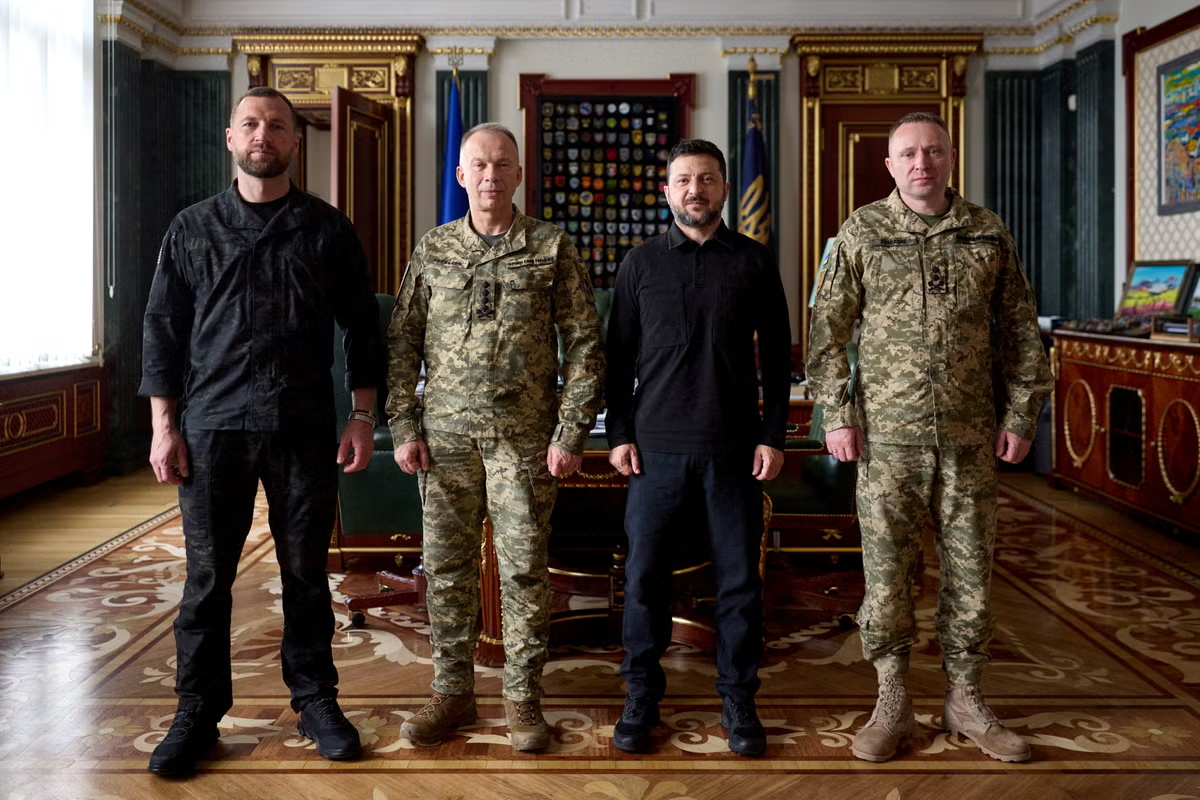
After days of protests, Volodymyr Zelensky acquiesced to demands to sack his military’s commander-in-chief, General Oleksandr Syrskyi, and replaced him with the much younger Major General Mykhailo Drapatyi, who enjoys a formidable battlefield reputation.
Sirskyi, 60, appointed in 2023, was credited with forcing Russian forces to retreat from their attempt to capture the capital, Kyiv, at the start of Moscow’s February 2022 full scale invasion. Later that year, he masterminded a surprise offensive that routed Russians occupying large swathes of territory in Ukraine’s north eastern Kharkiv region.
But many Ukrainians disliked Sirskyi, saying he retained the rigid traits and strict hierarchical attitude from his Soviet-era military training and service. They also accused him of not caring enough about how many of his men lost their lives.
In contrast, 43-year-old Drapatyi’s appointment has met wide approval.
Among those welcoming him was a major with the nom de guerre “Hrizny”, who leads an anti-missile air defence unit protecting Kyiv.
The 26-year-old, who studied law before the war, said Sirskyi alienated many younger officers who had been brought up in Ukraine’s post-independence democracy and had received training from Nato militaries.
Hrizny said Drapatyi is regarded as untainted by Soviet military culture: “He has a reputation as a person who is receptive to new ideas and ready to listen to others, including his subordinates. So I, and other soldiers I’ve spoken to, feel very positive.”
One of the biggest causes of tension within the Ukrainian military is the lack of time off.
Hrizny said: “One reason, of course, is manpower shortages. But old-school officers are often reluctant to allow people leave and prefer to keep them close by, even performing unnecessary tasks.
“I think that Drapatiy understands the importance of regular leave so service people can spend time with their families and maintain personal relationships. That would lift morale enormously.”
Colonel Andriy F, who asked not to use his surname, was formerly a member of the Ukrainian military’s general staff and is now involved in acquiring weapons from around the world.
Unlike Hrizny, the colonel regarded General Sirsky as an able military leader but was quick to praise Drapatiy.
He said the younger man first came to attention in 2014 when Moscow first invaded Ukraine, annexing Crimea and occupying parts of eastern Ukraine’s Donbas region including, for a time, the city of Mariupol.
Drapatyi was the commander of one of two battalions surrounded by Russian forces in Mariupol. One Ukrainian commander agreed to Russian demands to lay down weapons in return for safe passage home, humiliatingly via Russia.
Drapatyi refused to follow suit and instead launched a breakout, spearheaded by armoured vehicles, enabling the battalion to reach Ukrainian-held territory without any losses.
“He is a thoughtful, intelligent person who doesn’t waste his words on bravado or bluster. He is also a considerate person who talked about the importance of listening to others.”
The protests that led to the changes at the top were triggered after Zelensky sacked defence minister, Mykhailo Fedorov after tension between the defence minister and Syrskyi.
Fedorov, 35, a computer expert and formerly IT minister, had been hailed for his innovative drone warfare development which enabled Ukraine to halt, and even reverse, Moscow’s previous advances to take territory.
The colonel said: “I admire Fedorov because he was the first to outline and communicate to the military and public what he regarded as strategic objectives – to kill more Russians soldiers each month than Moscow could replace, to use drones to compensate for artillery and missile ammunition that Ukraine lacks, to diminish Moscow’s war economy by attacks on oil and gas facilities and weapons manufacturing or logistics facilities, and to broaden cooperation with foreign defence industry partners.
“To a great extent he was achieving these objectives. He was also a person our allies and foreign partners respected and found easy to deal with.”
Fedorov was also seen as rooting out corruption in the defence ministry.
However, said the colonel, Fedorov seemed to neglect his promise to devise ways to address the Ukrainian military’s manpower shortages which have become more critical by the month. “And that was, probably, an important reason the president fell out with Fedorov.”
Fedorov, a friend of Drapatyi’s, applauded the change of commander-in-chief.
Zelensky replaced Fedorov with Yevhenii Khmara, who was formerly a senior member of Ukraine’s SBU Security Service.
The president has said he wants to offer Fedorov another important position after the reshuffle but so far Fedorov has not accepted a new job. Zelensky said the two men will have further discussions about a new role.