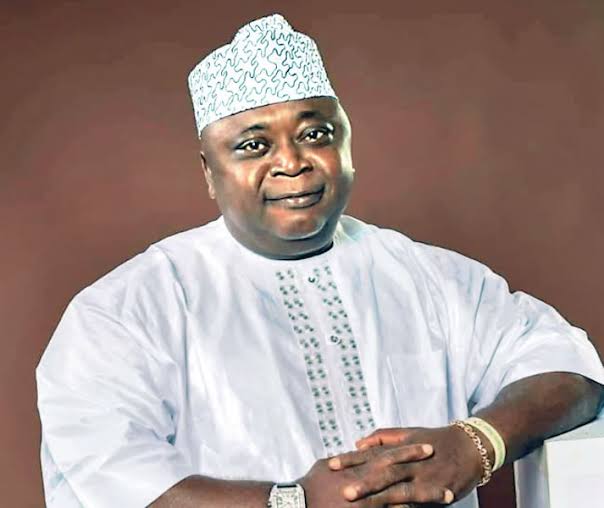
Justice Peter Lifu of the Federal High Court in Abuja has directed the Independent National Electoral Commission to include and publish the name of the Governorship candidate of PDP in Ogun State, Ladi Adebutu in the list of Candidates for the 2027 General Elections. The Federal High Court sitting in……
Justice Peter Lifu of the Federal High Court in Abuja has directed the Independent National Electoral Commission to include and publish the name of the Governorship candidate of PDP in Ogun State, Ladi Adebutu in the list of Candidates for the 2027 General Elections.
The Federal High Court sitting in Abuja has ruled that the Independent National Electoral Commission (INEC) lacks the authority to unilaterally disqualify a candidate from an election.
Consequently, the court ordered the reinstatement of Ladi Adebutu, the governorship candidate of the Peoples Democratic Party (PDP) in Ogun State, on the Commission’s candidates’ list within 24 hours.
Presiding Judge Justice Peter Lifu also found that Mr Adebutu’s right to a fair hearing had been violated.
READ ALSO: Adebutu Tackles INEC Over Omission From Governorship Candidates List
He clarified that the power to disqualify a candidate after their name has been submitted lies with either the Federal High Court or a State High Court.
Justice Lifu declared the exclusion of Adebutu’s name unlawful, unconstitutional, and void.
These rulings followed his earlier dismissal of INEC’s preliminary objection, which sought to dismiss the suit filed by the PDP.
In the substantive suit, the judge addressed the claims of the second plaintiff, Ladi Adebutu.
Mr Adebutu asserted that he had sought the office of Governor of Ogun State in 2019 and was the 2023 governorship candidate.
He further stated that he participated in the primary for the 2027 election and that on August 29, 2026, the party published his name without any challenges.
On October 14th, when INEC published the candidate names, it was discovered that the plaintiff’s name wasn’t included and he hadn’t withdrawn from the race.
The PDP and National Secretary then wrote to INEC to reverse this decision but to no avail.
The judge stated that INEC claimed the Commission was bound by the Electoral Act and asked the court to dismiss the suit.
Umar Bature testified as PW1 and Mustapa Mohammed as DW1.
Mr Bature, the National Organising Secretary of the plaintiff, explained his responsibilities for registering new members and maintaining the party’s register.
He submitted the list of members to INEC within the prescribed time on a flash drive, which included the plaintiff’s name, the Ogun PDP governorship candidate.
Mr Bature also asserted that Adebutu’s PDP membership was undisputed, noting he was the first to register on February 24, 2026.
He argued that removing their candidate was illegal and urged the court to order INEC to publish his name.
Bature further pointed out that the flash drive submitted by the party wasn’t the one presented by the Commission.
The party had submitted the list of all its members on April 22, 2026, with over 30,000 members.
DW1, Mustapha, testified as the programme analyst at INEC and explained that he supervised PW1’s work.
DW1 stated that the PDP submitted the list of its members in both hard copy and a flash drive.
Before the final candidate list was published, the department conducted a search and found that Adebutu’s name wasn’t on the list but his deputy’s was.
Under cross-examination, DW1 admitted he wasn’t the one who received the flash drive from the PDP and wouldn’t know what was submitted.
The issues for determination are:
Whether the plaintiffs’ right to fair hearing was breached; whether the INEC has the power to unilaterally disqualify Adebutu, and whether the defendant can remove the name of the candidate, among others.
On issue one, the judge held that the right to fair hearing was fundamental in Nigeria’s jurisprudence.
“It is a judicial or administrative hearing conducted by due process.
Therefore, before a decision is taken over a person, such person must be afforded the right to fair hearing,” the court said.
The judge held that the plaintiff’s right to fair hearing was breached by INEC.
“When a right is vested in a person, such right cannot be taken away without hearing from the person.
“Adebutu was not accorded the right to be heard before INEC took the decision. Therefore, the right to fair hearing of the plaintiff is breached,” the court ruled.
On the second issue, the judge said the first plaintiff noted that the second plaintiff was duly nominated by the party and his name forwarded to the defendant.
“I have taken a cursory look at the judgment of the Suprem Court.
The Supreme Court did not give INEC the power to start omitting or removing names of members from a party.
“INEC does not have the power to remove names or disqualify any candidate on its own. The power to disqualify a candidate after the name has been forwarded resides with the FHC or State high Court.
“The commission lacks the power to disqualify any candidate. Even if INEC believes that the name of a candidate was omitted, the commission must approach the court that has the power to remove the name.
“The power to nominate a candidate for an election exclusively belongs to a political party, and the exercise of that power is within a party.
“A court has no power to nominate a candidate. That has been the position of the law. The effect of the above is that no authority can nominate a candidate or remove it,” the court said.
The judge said a primary election was held on May 24, where Adebutu was nominated, adding that INEC had a duty to monitor an election to ensure that it complied with the provisions of the law.
He said the facts showed that the primary election was not defective and that Adebutu was validly nominated.
The second issue was therefore also resolved against the defendant, INEC.
Issue 3 was also resolved in favour of the plaintiffs.
The court said, “All issues such as nomination issues, publications, are all pre-election matters. Adebutu was declared the winner of the primary election on May 24. INEC did not raise any issue.
“As far as I know, no person filed any suit to challenge Adebutu 14 days after the conduct of the poll. It was baffling that INEC waited until August.”
“This court has established that INEC lacks the power to disqualify any candidate.
“INEC should have approached the court to disqualify the candidate but it waited until after four months to take the action
This, to me, is an after thought.
“If this is not resolved, there will be a day that INEC will disqualify a candidate a day to election. This must not be allowed. This would be an absurdity.
“I resolve this issue in favour of the plaintiffs,” the judge held.
He stated, “Section 77(6) says a party shall make the list of members available not later than 21 days before the election.
“It is only members whose names are contained that can participate in an election and the plaintiffs said Adebutu participated and that his name is in the list.
“INEC should have raised the issue that Adebutu did not participate in its monitoring reports.
“The action of INEC makes it plausible that the name of the second plaintiff was contained in the list and that his serial number is 1536.
The judge said the court was inclined to quash the decision of the defendant, noting that INEC acted beyond its power.
He said the Commission had failed to do the needful and the court would disregard the evidence of its DW1.
“The evidence of PW1 remains unchallagend, and uncontroverted. PW1 said that the flash drive submitted was not the one INEC brought to court and that he only submitted a soft copy in a flash drive contrary to INEC’s claim.
Justice Lifu noted that the first Defendant’s witness said the name of Adebutu was not in the flash drive and later turned to say he was not the one that received the flash drive.
“The law is trite that failure to call a material or vital witness is fatal to the case of the defendant,” he said.
The court consequently ruled in favour of the plaintiff.
Justice Lifu stated, “Consequently, the case of the plaintiff succeeds and is meritorious. The defendant acted ultra vires. INEC has no power, either administratively or otherwise, to remove a name if a candidate was validly nominated by the owner.
“The removal is unlawful, unconstitutional and of no effect.”
The Court declared that by virtue of the Electoral Act, INEC was bound to publish Adebutu’s name.
It ordered INEC to rectify the list published on October 10, 2026, to reflect Adebutu’s name.
The court also declared that INEC could not pronounce the result of the 2027 governorship election without the participation of the plaintiffs, or “the election shall be of no effect and unconstitutional.”

