CYRIACUS IZUEKWE
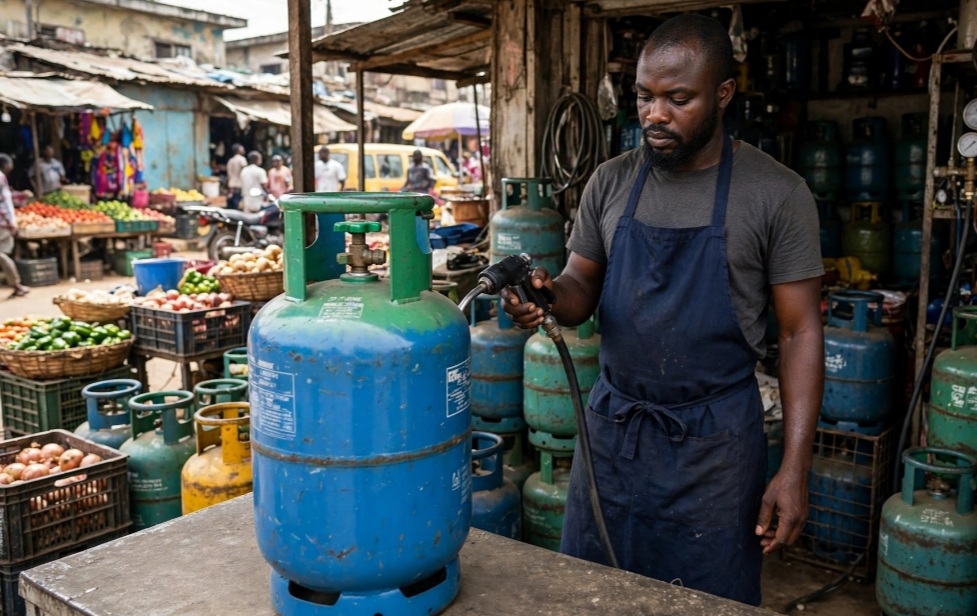
Cooking gas, which many Lagos families depend on for daily cooking, has climbed again this week, leaving market women, food vendors and housewives struggling to keep their kitchens running.
In Lagos, a kilogramme of Liquefied Petroleum Gas, LPG, is now selling for between ₦1,650 and ₦1,700 in many retail shops, while in Abuja the same quantity is selling for between ₦1,800 and ₦1,900, according to market checks and reports circulating on social media on Sunday.
A 12.5kg cylinder, which is the most common size used by families in Lagos, now costs between ₦20,600 and ₦21,250 to refill, up from about ₦18,000 a few weeks ago, while a 6kg cylinder now costs between ₦9,900 and ₦10,200. Traders in Surulere, Ikeja, and Lekki told PM Express that the price has been changing almost every week since October, and many customers now buy in smaller quantities because they cannot afford a full refill at once.
Mrs. Funke Adebayo, a food vendor in Surulere who sells rice and beans, said she now spends more on gas than on rice and pepper combined, and she has been forced to increase the price of a plate of rice from ₦1,500 to ₦1,800 to stay in business. Mr. Chinedu Okoro, a gas retailer in Ikeja, said his supplier increased the wholesale price three times in November alone, and he blamed the increase on the cost of diesel for transportation, the devaluation of the naira, and the high cost of importing LPG. Mrs. Aisha Bello, a housewife in Oshodi, said her family now cooks once a day instead of twice and uses firewood on weekends to save gas, while Mr. Tunde Bakare, a resident of Lekki, said he paid ₦1,700 per kilogramme on Saturday and was told the price may go up again before the end of the month.
The complaints are not limited to Lagos and Abuja. In Owerri, Imo State, residents reported buying gas at ₦1,600 per kilogramme, while in Port Harcourt, Rivers State, some retailers are selling at ₦1,550 per kilogramme, showing that the increase is nationwide and not limited to one city. The National Bureau of Statistics, NBS, in its latest LPG price watch, has consistently reported that the average price of refilling a 12.5kg cylinder has been rising, and energy analysts say Nigeria, despite being a major producer of gas, still depends heavily on imports for LPG because local refineries and gas plants cannot meet local demand.
The Nigerian Midstream and Downstream Petroleum Regulatory Authority, NMDPRA, and the Ministry of Petroleum Resources, under President Bola Ahmed Tinubu, have in the past promised to increase local supply and stabilise prices, but consumers say they have not felt any relief.
For many families, the increase means a choice between food and gas, and some market women in Lagos, like Mrs. Yetunde Alabi of Mile 12 Market, said they now use charcoal and kerosene stoves as an alternative, even though they know the smoke is bad for their health. Civil society groups and consumer advocates, including the Consumer Protection Council, have called on the Federal Government to remove Value Added Tax on LPG and to provide subsidies for local gas producers to bring the price down. Until that happens, Lagosians say they will continue to pay more for cooking gas, with many now asking the government a simple question: how much is gas in your own area, and when will it come down? The latest figures from the National Bureau of Statistics, NBS, confirm the hardship families are describing. According to the NBS LPG Price Watch, the average price of refilling a 12.5kg cylinder rose from about ₦16,500 in September to over ₦19,800 in October, and market checks in November show it has now crossed ₦20,600 in Lagos and ₦22,500 in parts of Abuja. In Abuja, Mr. Ibrahim Musa, a gas retailer in Gwagwalada, said customers now come with ₦5,000 and ask for whatever quantity it can buy, instead of refilling their full cylinder, while Mrs. Grace Eze, a caterer in Wuse 2, said she has increased her price for a pot of jollof rice by ₦10,000 because of the cost of gas alone. Both sellers called on President Bola Ahmed Tinubu and the Minister of State for Petroleum Resources, Gas, Mr. Ekperikpe Ekpo, to urgently intervene before the festive season.