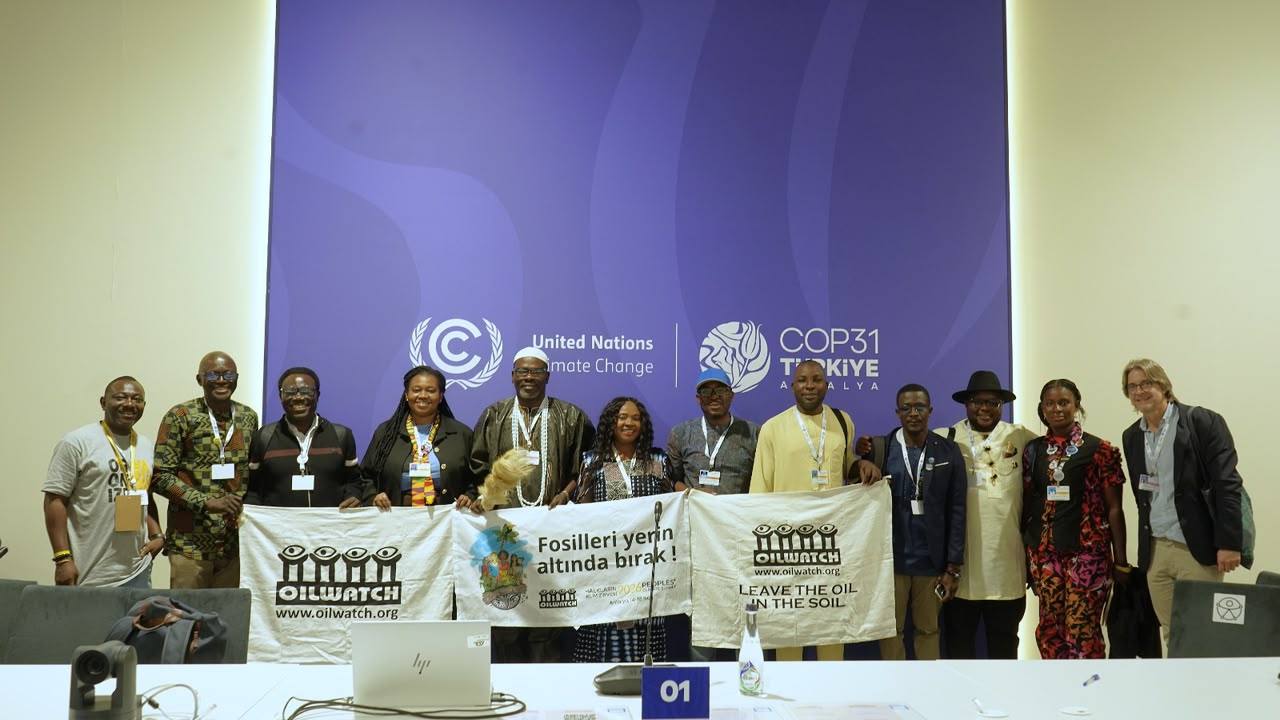
The activists called for climate negotiations to focus on actual emissions reductions rather than concepts that could distract from the need to reduce fossil fuel consumption.
As the 31st session of the United Nations Climate Change Conference (COP31) in Turkey approaches its conclusion, African civil society activists have raised concerns about the framing of just transition in ongoing climate negotiations, warning that proposed approaches could reinforce existing inequalities and exclude communities most affected by climate change.
The activists also questioned some of the languages in an initial draft text published on Monday, arguing that the transition from fossil fuels to cleaner energy must go beyond decarbonisation to address historical environmental damage, livelihood losses, land rights and the disproportionate impacts of the climate crisis on women and vulnerable communities.
They made the observations during discussions on the sidelines of the ongoing conference on Tuesday, highlighting concerns that climate policies and financing mechanisms could create new forms of exclusion if affected communities are not meaningfully involved in decision-making.
Similarly, some African climate campaigners demonstrated at the corridors of the COP31 venue with chants and placards bearing different slogans and messages.
They challenged the proposed global electrification target and warned that its current formulation could allow countries to expand fossil fuel-powered electricity generation while claiming progress toward the energy transition.
The concerns and frustrations were triggered by an initial draft text published on Monday. The activists argued that some of the proposals in the draft were vague, ambiguous and deceptive.
PREMIUM TIMES reported on Monday that the presidencies of the ongoing COP31 in Türkiye published the first draft of a proposed “cover decision” as negotiations enter their final stretch.
The text has drawn concerns from climate observers over its provisions on fossil fuels, renewable energy, adaptation finance and the resolution to strengthen the UNFCCC process.
Emem Okon, Executive Director of Kebetkache Women Development, said a just transition must address gender inequality and recognise the experiences of women, persons with disabilities and marginalised communities affected by extractive activities.
She questioned whether the transition would address existing inequalities or merely reproduce them under a different economic arrangement.
“Does the transition reinforce existing inequalities, or does it address them?” she asked.
Mrs Okon said communities affected by extractive activities were often excluded from decisions involving the transfer of oil and gas assets, particularly in Nigeria, where major corporations have divested their assets and liabilities to local companies.
 She questioned whether host communities were consulted before such transactions and who would take responsibility for environmental liabilities arising from years of extraction.
“If we are talking about transition, it means community members, not just traditional rulers, community leaders or individuals favoured by the corporations, must be consulted,” she said.
According to her, changing the names of companies does not necessarily translate into a change in their activities or address the environmental damage suffered by host communities.
She said a just transition must also consider land rights, particularly the implications of land acquisition for women whose livelihoods depend on farming, fishing and other community-based economic activities.
Mrs Okon warned against replacing fossil fuel projects with large-scale renewable energy or other economic projects that could reproduce the same patterns of environmental destruction and community displacement.
“Will a just transition come with mega-projects that continue the same pattern of destruction? Will it be another destructive process, or will it address and remediate the damage we have suffered over the years?” she asked.
She also called for the recognition of women’s contributions to the extractive economy, including their roles in the informal economy and the care sector, arguing that these contributions are often overlooked in discussions about economic transition.
According to her, the transition must address women’s health, food security, water security and other livelihood concerns in communities affected by extraction.
“If these issues are not addressed, then the transition is not just. We are simply looking at transitioning from one business model to another,” she said.
Mrs Okon further called for meaningful participation of grassroots women in climate negotiations, saying the language used at international conferences often makes it difficult for community members to understand or connect with the discussions.
She said women in the Niger Delta, who experience the effects of environmental pollution and climate change, are rarely given the opportunity or financial support to participate directly in the negotiations.
Citing research conducted in Otuo, she said her organisation had documented the effects of extractive activities on women, including concerns about hydrocarbon contamination.
She also referred to concerns raised by women in Bille, Rivers State, about the presence of hydrocarbons in their bodies.
“Even as we sit here and speak, women in Bille are singing about the presence of hydrocarbons in their bodies. We carry hydrocarbons; we carry gas in our bodies,” she said.
Mrs Okon questioned how COP31 would influence the Nigerian government to address the health implications of environmental pollution on women.
She also challenged climate finance mechanisms, including the Loss and Damage Fund and the Adaptation Fund, to demonstrate how they would support communities affected by environmental degradation.
She asked how grassroots women’s organisations could access the funds and whether climate finance would address non-economic losses, including health complications, trauma and mental health challenges.
Similarly, Ken Henshaw, Executive Director of WeThePeople, said discussions about energy transition must extend beyond moving from fossil fuels to cleaner energy sources to address the damage caused by decades of extraction.