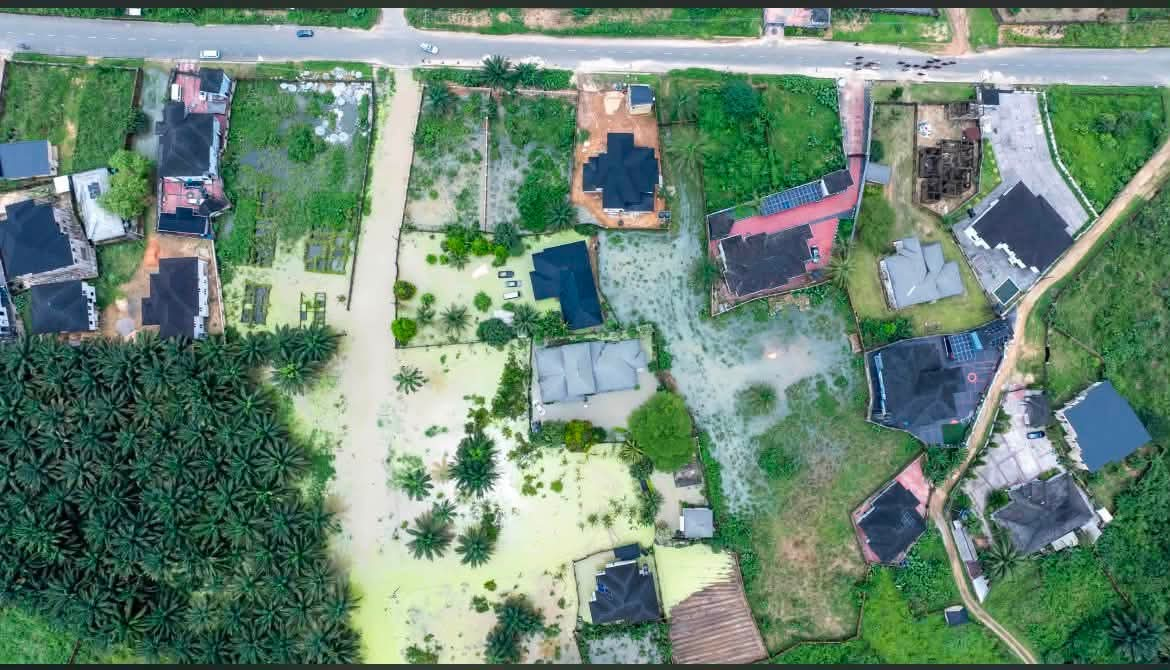
Families in an upscale Uyo estate have fled their homes after weeks of flooding, raising questions about drainage infrastructure, building approvals and the implementation of billions of naira budgeted for flood control and emergency response.
Every day, Mfon Ndanyongmong’s children ask her the same question: “Mummy, when are we going back home?”
For weeks, she has struggled to answer.
Her family’s home at Ifa Ikot Akpabio, Shelter Afrique Extension, Uyo, the Akwa Ibom State capital, has been overwhelmed by floodwater. Her car remains in the compound, where she says it is sinking into the ground, while her family has been forced to live in a hotel.
What should be the comfort of home has become a place she cannot reach.
“I have passed through severe loss, emotional stress, mental trauma,” Ms Ndanyongmong told PREMIUM TIMES, tears dripping from her eyes.
She said the situation became unbearable on 22 September when officials of the National Emergency Management Agency visited the community and ordered residents to evacuate.
That day, she said, the water rose to her waist as she navigated her compound with her husband and three children to safety.
Since then, she has been unable to return home.
“It breaks my heart that every day my kids ask me, ‘Mummy, when are we going back home?’ And I do not have an answer to that question,” she said.
Her family is among those affected by severe flooding at Ifa Ikot Akpabio, near Professor Nse Essien Avenue and Grace Land School in Shelter Afrique Extension, an upscale residential estate in Uyo.
Five households have been forced to abandon their homes, according to residents, while other families, particularly those living in storey buildings, remain in the flooded area because they have nowhere else to go.
PREMIUM TIMES visited the community and observed that the floodwater remained too high for the newspaper to access the affected homes. Because of the water level and associated risks, the newspaper could not independently assess the full extent of the damage inside the compounds.
Residents blamed the disaster on an abandoned road construction project, incomplete drainage channels and the concentration of runoff water from adjoining streets in their low-lying neighbourhood.
However, the state environmental protection agency said the affected area was historically a brook and that some buildings might have been constructed on a natural waterway.
The competing accounts raise questions about building approvals, urban planning, drainage design, the supervision of public infrastructure projects and the government’s response to residents who say they have repeatedly sought help.
Residents said the state government awarded the construction of the road to Blagadat Construction Limited, but the contractor abandoned the project around October 2025.
PREMIUM TIMES could not independently verify the contractor’s engagement or the circumstances surrounding the reported abandonment. The road had no visible project signboard identifying the contractor, and the state government had not responded to enquiries about the project at the time of publication.
During its visit, PREMIUM TIMES observed that drainage channels constructed along the road connected with drains from other streets but terminated abruptly about halfway along the flooded street.
Residents said the unfinished drainage works had left the area receiving water from adjoining roads without an adequate outlet.
They identified runoff from Rev. Amaowo Road, constructed by Hensek Construction Company, and other adjoining streets as major contributors to the flooding.
They said that the problem went beyond the volume of rainfall to how water from several directions was channelled into their neighbourhood.
Ms Ndanyongmong said drainage channels from four directions now converge on the area, which she described as lower than its surroundings.
She said the drains along Professor Nse Essien Avenue and Rev. Amaowo Road did not discharge adequately into a suitable outlet, leaving water to accumulate in the community.
“After the attempt at road construction, drainage on both sides were done, but it stopped halfway,” she said.
“All the waters from neighbouring communities coming into Shelter Afrique Extension drain into this point. And this point happens to be low.”
She said the flooding had also affected the household water supply. “In my compound, if you turn on the tap from the borehole, you see dirty water. Our soakaway has been filled with water,” she said.
PREMIUM TIMES could not independently prove the precise engineering cause of the flooding or determine whether the drainage designs were approved, properly executed or subsequently altered.
The Ministry of Works had not responded to questions about the project by the time of publication.
The Chairman of the Akwa Ibom State Environmental Protection and Waste Management Agency, Prince Ikim when contacted by PREMIUM TIMES, said the government sympathised with the affected residents but argued that the flooding was not necessarily caused by clogged or inadequate drains.
He said the government had established an Emergency Flood Response Committee headed by the Deputy Governor to address such situations.