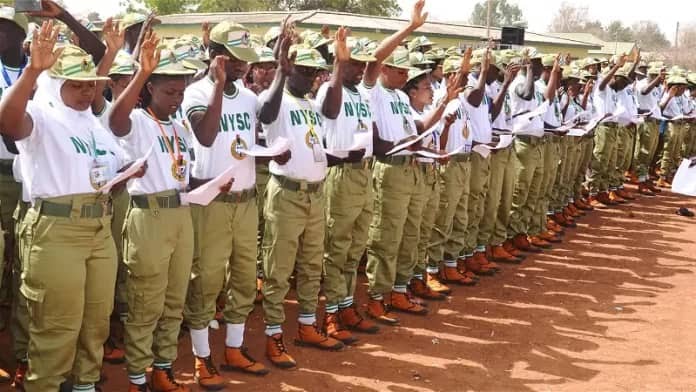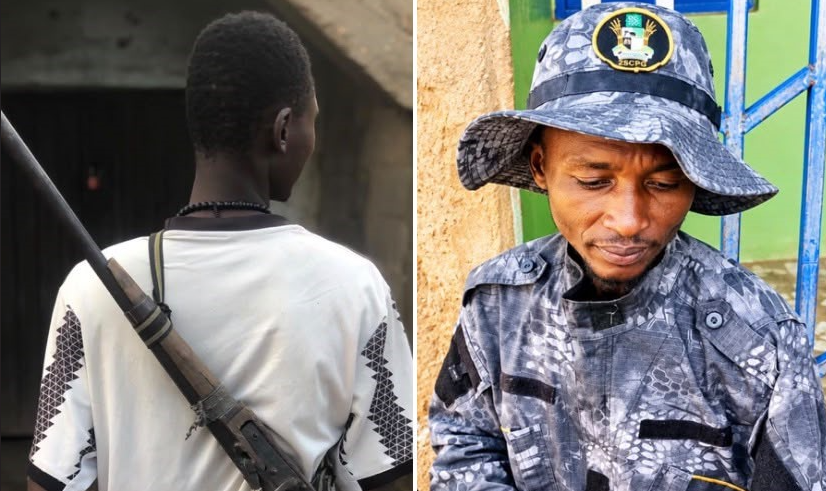
An investigation by The ICIR in Zamfara, Niger, and Kogi states reveals the welfare challenges facing these volunteers, including the absence of adequate medical care, insurance and compensation for families of those killed in service.
Abdullahi Ibrahim still carries a gun. But he now holds it with one hand.
His left hand was amputated after he sustained a gunshot injury in 2024 while defending his village, Gima, in Anka Local Government Area (LGA) of Zamfara State.
Sitting on a wooden bench and hardly making any effort to conceal the worries that seemed to weigh on him, Mr Ibrahim said that in 2020, bandit attacks became incessant, and he became worried about the recurring attacks on Gima, his village.
In the same year, the armed men stormed his community and kidnapped two people. One of them, who was pregnant, was later released, while the other regained her freedom after a ransom of ₦1 million was paid. But as the attacks continued, local volunteers like Mr Ibrahim took up arms to defend their communities.
Like many, Mr Ibrahim understood the risks of joining a vigilante group to protect his community. But he probably never imagined that a single encounter with the attackers would cost him one of his hands.
Although he still carries a gun and remains committed to defending his community, Mr Ibrahim now faces that fight with one hand. The injury not only changed his life physically, but also placed a heavy financial burden on him. He said he spent more than ₦250,000 on medical treatment and care and did not receive any assistance from the government or any of its agencies.
Across Nigeria, civilian vigilante groups have increasingly become part of community security arrangements, particularly in areas where residents face persistent attacks by armed groups. Some work within government-backed community protection arrangements while others operate independently, raising money among themselves to buy equipment, support their activities, and in many cases, assist injured colleagues.
For instance, in Zamfara, Niger and Kogi states, government-backed vigilante groups are known as the Community Protection Guards (CPGs), the Niger State Vigilante Corps (NSVC) and the Kogi State Vigilante Service, respectively. The independently organised community vigilantes are commonly referred to as ‘Yan sa-kai’ (volunteers).
Their activities have included helping security agencies to rescue kidnapped victims, protecting farmers and farmlands, and handing suspects over to the police.
They have also participated in joint security operations with the police and military to rescue abducted residents and confront armed groups.
But interviews with both the government and community-backed vigilantes, their leaders and bereaved families in Zamfara, Niger and Kogi states, showed that there are still little or limited measures to protect and support officers who sustain injury discharging their work, widows and parents, who oftentimes received no financial assistance after losing relatives.
Some groups say they have no life insurance or formal compensation arrangements for members killed or permanently disabled while substituting for Nigeria’s security forces.
Although Nigeria’s Employees’ Compensation Act 2010 provides compensation for eligible employees who sustain work-related injuries, disabilities or diseases, and benefits for dependants of those who die from employment-related injuries, it does not establish a dedicated protection framework for independently organised community vigilantes who operate outside formal employment arrangements.
Similarly, the International Labour Organisation’s Employment Injury Benefits Convention (No. 121), which outlines international standards for medical care, rehabilitation and compensation for work-related injuries and deaths, has not been ratified by Nigeria.
Consequently, community vigilantes such as independently organised volunteers and members of the Vigilante Group of Nigeria, who are not necessarily employed or paid by government, have no automatic entitlement to compensation under the existing employment-based scheme.
The vigilantes protecting communities in Zamfara, Niger and Kogi states do not all operate under the same arrangement. While some of those recruited by state or local governments received some form of official support, like vehicles, pump-action guns, and bulletproof vests, others are organised by communities to confront armed groups.
Many of the latter remain unregistered and operate without formal government backing.
In several local governments across Zamfara, particularly in Anka and Bukuyyum, the groups re-emerged about six to eight years ago as attacks on residents became increasingly frequent. According to a commandant of the ‘volunteer’ vigilante group in Anka, Yusuf Sani, his community members repeatedly complained to the authorities and were told that something would be done, but the attacks continued.
Yusuf Sani sits with a locally acquired firearm used by his vigilante group to confront armed bandits in Anka, Zamfara State. Photo: Mustapha Usman/The ICIR
“We contribute to security. We assist in security and sacrifice our time, including staying awake at night, especially when there are security challenges like the ones that have affected our people,” he said.
The group has members drawn from different occupations, including farming, livestock rearing, manual labour and trading. Rather than receive government funding, members contribute from their personal earnings to sustain their activities.
Some sell their harvested grain, livestock and other belongings to raise money for equipment and ammunition.
“Whatever we earn money from our labour, we use it to support our activities. Even when it comes to obtaining our guns or ammunition,” Mr Sani said.
He estimated that the group has more than 200 members under his command, although its wider network across Anka could be larger. He also said between 28 and 30 members had been killed, while about 20 others had sustained injuries since 2020.
The group is not registered, although its members have repeatedly approached government authorities and security agencies for recognition and support.
Another vigilante leader in the area, Sani Garba, described a similar arrangement. He said his group, which had existed for more than 20 years, originated from the traditional Yan Banga (community protection) system, a Hausa community-based security arrangement whose members helped maintain order and protect residents.
According to him, the group was revived about six years ago. Although local government officials and traditional authorities are aware of its activities, he said it is neither formally registered nor officially recognised.
“We handle everything. No government agency can say, ‘Here is some assistance,’ or provide us with financial support for the medical treatment of our injured members or for the burial of our members who have died,” he said.
Meanwhile, the situation is sometimes different for some government-backed vigilante officers. The CPG commandant of Anka, Lauwali Anka, who oversees 175 personnel, said they were recruited by Governor Dauda Lawal in January 2024 to help protect lives and property and provide security in their communities.
Unlike the community-backed groups, these personnel receive government payment.