By Eyimofe Atake, SAN, PhD
What the word means, what R v Bentley decided, and why his case against the charge answers itself
Mr Stephen Kola-Balogun has written that, “On the material in the public domain,” the charge against Mr Kalu Kalu “cannot be reasonably sustained, for three reasons: ambiguity, context, and perception.” Each of the three fails, largely on his own material. The plainest evidence of what the words meant is in his own account of the broadcast: the presenter asked for them to be withdrawn. Even the African Democratic Congress (ADC), defending Mr Kalu, measured them against the Court of Appeal’s condemnation of the judge. Along the way, his article misstates the defence in the very case on which it relies, cites the wrong Blackburn, shortens the question it borrows from the ADC, and gets its own chronology wrong. I take his points in his order.
The facts
On 11 November 2026, on Channels Television’s Politics Today, Mr Kalu, a lawyer for former Vice President Atiku Abubakar, was discussing the judgment of 5 November in which Justice Peter Lifu of the Federal High Court nullified the leadership of the ADC under David Mark. In the course of that discussion he called Justice Lifu, as Mr Kola-Balogun himself reports, a “coconut judge”. The presenter, Mr Seun Okinbaloye, objected. According to TheNigeriaLawyer’s report of the programme, he said that he would not let Mr Kalu “use this platform to disparage a sitting judge”, and he asked more than once for the remark to be withdrawn. According to the same report, Mr Kalu at first appeared to defend the remark by referring to what, he said, the Court of Appeal had stated about the judge in an earlier case. Then he said: “Because of time, I do withdraw it.” On 13 November, the President of the Nigerian Bar Association (NBA) forwarded a petition, with the broadcast material, to the Legal Practitioners Disciplinary Committee (LPDC), the body that hears complaints of professional misconduct against lawyers. Mr Kalu will answer the petition, and the Committee will decide.
What “coconut” means
Mr Kola-Balogun writes: “In Nigerian speech, a coconut is hard on the outside, hard to crack.” That is half a coconut. A coconut is hard on the outside and hollow on the inside. The Collins English Dictionary (Complete and Unabridged, 2012 digital edition) describes “a thin hard shell” around the meat, and speaks of “the hollow centre”.
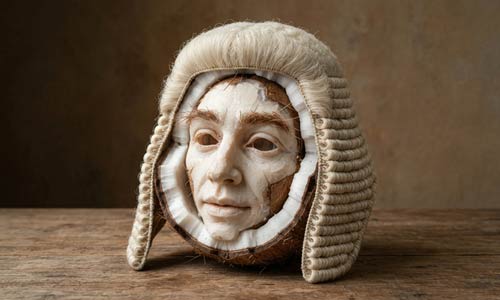
Call a judge a coconut judge and you say two things about him. A judge’s office comes down to two things: to hear, and to decide. He must let in the argument and the evidence of both sides, and he must then weigh them with learning and judgment. The coconut denies him both. Hard on the outside means that nothing gets in: no argument, no evidence, no reason can get through to him, however good the case. That is a judge who cannot be reached, and a judge who cannot be reached cannot hear. Hollow on the inside means that there is nothing in there: no learning, no judgment, no sense. Even what got through would find nothing to weigh it, and a judge with nothing inside cannot decide. Said of anyone, that is a big insult. Said of a judge, it is the gravest insult the image can carry, because it denies him both of the things that make him a judge. That is what “coconut judge” means.
There is a third meaning, and it is not insignificant. The same dictionary defines a “coconut” as “a black or Asian person who conforms to white culture at the expense of his or her ancestral culture, the idea being that, like a coconut, he or she is dark on the outside and white on the inside”. Dictionary.com, defining the same usage, labels it “Disparaging and Offensive”. In plain terms, a sellout: one thing outside and another within. Carried over to a judge, by analogy, the image is of a man who wears the robe of the law and serves something else.
So the word is not ambiguous in any sense that can help Mr Kalu. Said of a person, it has more than one meaning, but every meaning put forward for it, Mr Kola-Balogun’s included, insults the man, and not one of them criticises a judgment. He says that “metaphors are ambiguous”. Many insults are metaphors; that does not make them ambiguous. He says that the petition “appears to proceed on one meaning only: that it is an insult.” But an insult is not one meaning among several. It is what every meaning on offer has in common. A choice between insults is no ambiguity at all, because there is no innocent meaning to choose.
Nor is the ordinary viewer left to guess. The law of libel has a settled way of reading words, and a leading case is Lewis v Daily Telegraph Ltd [1964] AC 234. On 23 December 1958, two British national newspapers reported, under the headlines “Inquiry on Firm by City Police” and “Fraud Squad Probe Firm”, that the police were inquiring into the affairs of a company. The company and its chairman sued for libel, saying that the reports meant they were guilty of fraud. The House of Lords, then Britain’s highest court, held by a majority that an ordinary reader would not have taken the words to mean that, and on that point the newspapers won. The test is neither the harsher meaning nor the kinder one, but the meaning that an ordinary, sensible person would take from the words. As Lord Reid put it, at page 258: “The ordinary man does not live in an ivory tower and he is not inhibited by a knowledge of the rules of construction. So he can and does read between the lines in the light of his general knowledge and experience of worldly affairs.” Mr Kalu is not being sued for libel, but the common sense is the same. A viewer who heard a lawyer for the former Vice President call the judge a “coconut judge”, six days after the judgment, did not need a dictionary.
His own meaning is an insult
Mr Kola-Balogun’s preferred meaning does not rescue the remark. It is itself an insult. He says that if Mr Kalu meant that Justice Lifu is “a judge who, once he has taken a view, will not shift”, then “that is not a personal insult. That is criticism of judicial temperament and reasoning.” But temperament is the man. A judge who will not shift once he has taken a view is a judge who will not listen, and a judge who will not listen has failed the first duty of his office, which is to hear both sides. To call him that is to attack him, not his judgment. And it says nothing at all about the reasoning: not a word about what the judgment decided, or why.
The Constitution makes the point for me. By his own account, a “hard nut to crack” means “stubborn, unyielding, unmovable, difficult to persuade”. Section 36(1) provides that “a person shall be entitled to a fair hearing” before a court “constituted in such manner as to secure its independence and impartiality”. A hearing before a judge who is “unmovable” is no hearing at all. And under section 290(1), no judge may begin to perform the functions of his office until he has taken the Judicial Oath set out in the Seventh Schedule. By that oath he swears: “I will discharge my duties, and perform my functions honestly, to the best of my ability and faithfully in accordance with the Constitution of the Federal Republic of Nigeria and the law”. And he swears: “I will preserve, protect and defend the Constitution of the Federal Republic of Nigeria”. To call a judge a hard nut to crack, in Mr Kola-Balogun’s own sense, is therefore to say two things: that he denies litigants the hearing the Constitution guarantees, and that he has broken the oath he swore. That is not criticism of temperament. It is an accusation of breach of the Constitution, made against the man. Mr Kola-Balogun’s kindest meaning is itself a charge of judicial misconduct.
His conclusion gives the point away. “If ‘coconut’ means hard, unyielding, a hard nut to crack,” he writes, “then Kalu was criticising a judgment.” On his own gloss, to be hard, unyielding and a hard nut to crack is to be “a judge who, once he has taken a view, will not shift”: a man, not a judgment. On his own premise, Mr Kalu was criticising the judge.
The grammar points the same way. On Mr Kola-Balogun’s own account of the words, Mr Kalu did not say “coconut judgment”. He said “coconut judge”. The word attaches to the man.
Mr Kola-Balogun adds: “Lawyers criticise judgments in strong language every day. That is not misconduct. That is advocacy.” Advocacy, in a lawyer’s sense, is argument addressed to a court. An epithet, addressed to the public, about a judge, is something else. The Rules of Professional Conduct for Legal Practitioners 2023, which bind every lawyer in Nigeria, speak to exactly this. Rule 31(1) provides: “A lawyer shall always treat the court with respect, dignity and honour.” Rule 31(2) provides that a lawyer who has a proper ground for complaint against a judicial officer “shall make his complaint to the appropriate authorities.”
How the words were heard
Mr Kola-Balogun himself records that the presenter “interrupted him and asked him to withdraw the remark”. That is the most telling fact in the whole affair, and his article never asks why. The answer is plain. If “coconut judge” were not an insult, the presenter would not have asked Mr Kalu to withdraw it. A presenter does not ask a guest to withdraw praise. He does not ask him to withdraw a fair comment on a judge’s temperament. He asks him to withdraw an insult. Mr Seun Okinbaloye heard an insult, and he said so in terms: by TheNigeriaLawyer’s report, he would not let Mr Kalu “use this platform to disparage a sitting judge”. Nor did he ask only once. “Please, I will appreciate if you withdraw that statement,” he said, and he asked: “Can we withdraw that statement?”
And Mr Kalu withdrew it. Had the words been a compliment, or the harmless meaning that Mr Kola-Balogun now offers for them, the answer was short and ready to hand: that there was nothing to withdraw, that he meant only that the judge was firm, and that he would not take it back. That answer needed no time at all. A man does not withdraw a compliment; he repeats it. “Because of time” was the reason Mr Kalu gave, but a compliment takes no time to defend. Mr Kola-Balogun, who argues his case, does not suggest that he gave that answer; his account is that Mr Kalu was saying “I do not have time to explain what I meant”. And according to TheNigeriaLawyer’s report, the one defence Mr Kalu did offer before he withdrew pointed not to praise, and not to temperament, but to what, he said, the Court of Appeal had stated about the judge in an earlier case. Then, pressed again, he said: “Because of time, I do withdraw it.”
The ADC conceded as much, in the very act of defending him. In its statement of 14 November, issued by its National Publicity Secretary, Mr Bolaji Abdullahi, the party played the remark down as “something that some people find uncomfortable”. But look at how it defended it. It asked: “What has Kalu Kalu said about Justice Peter Lifu that the Court of Appeal has not already said?” And it pointed, as Arise reported, to the Court of Appeal’s ruling of June, which, it said, had described the judge’s conduct as the “highest form of judicial impertinence” and had cited a Supreme Court precedent characterising such conduct as judicial rascality. Consider what that question concedes. The ADC did not say that “coconut judge” was praise. It did not say that it was a comment on temperament, or “a hard nut to crack”. It compared Mr Kalu’s words with the harshest things the Court of Appeal had said about Justice Lifu, and suggested that Mr Kalu had added nothing to them. Nobody defends a compliment by pointing out that a higher court has said worse. The ADC’s defence was not that Mr Kalu had said nothing insulting. It was that the judge had been condemned already.
The statement then went further. “We agree that lawyers must exercise restraint,” it said. “But there is no respectful way to address evil, and the NBA cannot teach us one.” That is not a claim that the remark was respectful. It is an admission that it was not, coupled with a plea that it need not have been. In other words, the ADC defended the remark as deserved, not as respectful.
So the meaning was settled in the studio, and confirmed by the party that defended him. The presenter heard an insult and asked for it to be withdrawn. The speaker did not call it praise; he withdrew it. The ADC, defending him, measured his words against the Court of Appeal’s condemnation of the judge, and said that there is no respectful way to address evil. Not one of them treated “coconut judge” as praise, or as a harmless remark about temperament. That meaning was given to the words by none of the three. It is Mr Kola-Balogun’s own.
What Bentley decided
Mr Kola-Balogun says that his point “is the lesson of R v. Bentley (Deceased) [1998] EWCA Crim 2516”. His citation is right; the judgment is also reported at [2001] 1 Cr App R 307. His account of the defence at the trial is not right, and the judgment, read in full, does not carry him as far as he needs.
The facts of Bentley are these. On the evening of 2 November 1952, two young men, Derek Bentley and Christopher Craig, were on the roof of a warehouse in Croydon, in England, when the police came. Craig had a gun. Detective Constable Fairfax grabbed Bentley. On the police evidence, Bentley broke away from him and, as he did so, shouted “Let him have it, Chris”. Craig fired, and the shot wounded Fairfax in the shoulder. Fairfax seized Bentley again and held him. Later, as Police Constable Sidney Miles came out onto the roof, Craig shot him dead. Both young men were convicted of murder on 11 December 1952. Craig, because of his age, was ordered to be detained; Bentley was sentenced to death, although the jury recommended mercy, and he was hanged on 28 January 1953. In 1998, 45 years later, the Court of Appeal quashed his conviction.
First, the defence. He writes: “The defence said it could mean: ‘Give him the gun, Chris’ surrender it.” Not at the trial. Bentley’s case was that he never said the words at all: the Court of Appeal recorded that “Both the appellant and Craig denied that it had been said.” In his final speech, Bentley’s counsel did put to the jury “that there could be some interpretation of the words other than that put upon them by the prosecution and that the words were not capable of that strong meaning.” But, said the Court, “He did not, however, spell out what that other meaning could be, perhaps because he realised the difficulty he was in having regard to the appellant’s denial that the words had been used at all.” The innocent reading, “an encouragement by the appellant to Craig to hand over his weapon”, is the Court of Appeal’s own description, in 1998, of what the words could bear. The defence never told the jury what else the words could mean.
Secondly, the ambiguity. The Court said of “Let him have it, Chris” that “it was on any showing ambiguous”, and that “It could bear an innocent meaning”. That is the whole difference between the two cases. The words could mean shoot him, or they could mean hand it over: one meaning was guilty, the other innocent. “Coconut judge” has no innocent meaning. Every meaning offered for it is an insult. Bentley is authority about words that can be innocent. It has nothing to say about words that cannot.
Thirdly, the lesson he draws. He concludes: “when words can bear two meanings, the law must not choose the worse one and punish the speaker for it.” Bentley lays down no such rule. He is right that the Court of Appeal faulted the trial judge for failing to put the defence fairly to the jury, and right that among the points made for Bentley which the jury were never fairly invited to consider was “the possible ambiguity of ‘Let him have it, Chris’, if that was ever said”. In the Court’s words, “the jury were never fairly invited by the trial judge to consider the points which had been made on the appellant’s behalf.” But what the Court required was that those points, which it called points “good or bad”, be fairly put. It did not require that they be accepted. The Court framed the question in two parts: “Did the appellant shout out ‘Let him have it, Chris’? If he did, what did he intend by the words he used?” That is a question to be answered on the evidence, not a rule that the answer must be the innocent one. And the Court itself described the innocent reading, if the words were said when Bentley moved away from Detective Constable Fairfax, as “admittedly an improbable construction”. A tribunal that fairly considers an innocent meaning may still reject it. Context can make the worse meaning the probable one. Bentley itself says so.
Fourthly, intention. Mr Kola-Balogun writes that “The LPDC must prove what Kalu intended, and that the words could only bear an insulting meaning.” The Committee proves nothing; it is the tribunal, and it decides. Nor does Bentley supply his test. The Court of Appeal said that “what was important was what the appellant intended to convey by whatever he said, not what others, and particularly Craig, understood by the words.” That was because the charge was murder: the jury had to decide whether the words, if Bentley spoke them, “showed that he had been participating in an agreement to use violence to resist arrest or encouraging Craig to shoot at the officer and so to kill P.C. Miles”. Rule 31(1) is framed differently. It requires a lawyer to “always treat the court with respect, dignity and honour”, and whether he did so depends on what he said and how it would be heard, as well as on what he says he meant. Nothing in Bentley says that a tribunal may act on words only if they can bear no other meaning. I do not presume to say what Mr Kalu privately meant; he will tell the Committee. I say what his words mean, and what an ordinary viewer would take them to mean.
Fifthly, the facts. In Bentley it was disputed whether the words were spoken at all. Mr Kola-Balogun does not dispute that Mr Kalu spoke his; he reports them himself. The recording went to the Committee with the petition, and Mr Kalu withdrew the remark.
Finally, why the conviction was quashed. It was not quashed because the words were ambiguous. It was quashed because the trial judge’s directions to the jury failed Bentley in several respects, one of which was that the points made on his behalf, the possible ambiguity of the words among them, were never fairly put. Of the summing up, the judge’s directions to the jury at the end of the trial, the Court of Appeal said: “In our judgment the summing up in this case was such as to deny the appellant that fair trial which is the birthright of every British citizen.” The lesson of Bentley is that every accused person must have a fair hearing, at which the innocent explanation is fairly considered. That is exactly what the referral gives Mr Kalu. Bentley is an argument for the hearing. It is not an argument that the charge must fail.
Context and the withdrawal
“Second is context everything ?”, asks Mr Kola-Balogun. It is, and the context is against him, beginning with Bentley. He writes that “Bentley was already under arrest when the words were allegedly spoken”. On the police evidence, the words were shouted as Bentley broke away from the detective who had seized him, and the Court of Appeal read that moment against the innocent meaning, not for it: said then, the innocent reading was “admittedly an improbable construction”.
Now Mr Kalu’s context. He was, as Mr Kola-Balogun says, “in the middle of a legal argument about what the 5th November judgment actually decided”. That is the point. A lawyer in the middle of a legal argument about a judgment has every means of criticising the judgment, and no need of an epithet for the judge. He was speaking as a lawyer to the former Vice President, on national television, about a judgment that had gone against his client’s side. That is the setting in which the presenter heard an insult, and in which Mr Kalu withdrew it.
As for the withdrawal, I have said what it shows. Mr Kola-Balogun tells us to “Read it literally”. Read literally, “Because of time, I do withdraw it” is a withdrawal. Everything else is his gloss: that Mr Kalu was saying “I do not have time to explain what I meant”. But by TheNigeriaLawyer’s report, before he withdrew, Mr Kalu “initially appeared to defend his comments by referring to what he said the Court of Appeal had stated about the judge in an earlier case.” If that report is right, he had time enough to explain, and the explanation he reached for was the Court of Appeal’s. The Court of Appeal’s words about Justice Lifu on which Mr Kola-Balogun himself relies went far beyond stubbornness. They were “judicial impertinence” and “judicial rascality”, and, as I show next, they came with a holding, drawn from the Supreme Court, that a judge who acted as he had done “is unfit for the bench”. So the one explanation Mr Kalu appears to have offered on air pointed to the Court of Appeal’s condemnation, not merely to stubbornness. The “hard nut to crack” is Mr Kola-Balogun’s suggestion, not Mr Kalu’s.
He says that the Committee “must allow Kalu to do what television did not: explain in full what he meant.” It will. That is what a referral is.
The Court of Appeal’s words
Mr Kola-Balogun says that the Court of Appeal’s words, “judicial impertinence” and “judicial rascality”, are “far stronger words than ‘coconut.’”, and that “Kalu is entitled to argue his comment was of the same order: criticism of a judgment, not an attack on the man.”
He gives the Court of Appeal’s words only in part. On 16 June, the Court of Appeal suspended the judgment in which Justice Lifu had ordered the deregistration of the ADC and four other parties, a judgment he had delivered after the Court of Appeal had stayed the proceedings before him. The panel called his conduct “the highest form of judicial impertinence”. And Justice Abba Mohammed, as ThisDay and Arise reported, citing earlier decisions of the Supreme Court, held that a judge who acted in that manner “is unfit for the bench as it amounts to judicial rascality”. That is not criticism of a judgment alone. It speaks of the judge as well as the judgment. I am no apologist for Justice Lifu’s conduct. I condemned it as judicial rascality, and relied on that very holding, in print on 23 June, in ThisDay and in Vanguard, more than four months before Mr Kalu reached for his coconut. My article in ThisDay began: “The administration of justice in any constitutional democracy rests upon a foundation of hierarchy, discipline, and the unqualified obligation of every court to obey the orders of the court above it.”
So the difference does not lie in the strength of the words. It lies in who spoke them, how, and with what authority. The Court of Appeal is the court that hears appeals from Justice Lifu’s decisions. It spoke in a decision, in the exercise of that jurisdiction, and it gave its reasons: what he had done, why it was wrong, and what the Supreme Court had said of such conduct. Its decision can itself be taken on appeal. “Coconut judge” is an epithet, not a reason, and it was said on television, by a lawyer, of a judge who cannot reply. Rule 31 binds Mr Kalu. It does not bind the Court of Appeal. A lawyer who believes a judge unfit for the bench has a course open to him, and Rule 31(2) names it: he “shall make his complaint to the appropriate authorities.”
He also borrows the ADC’s question, and shortens it. His version, “What has Kalu said that the Court of Appeal has not already said?”, leaves out the words “about Justice Peter Lifu”, and they matter: even the ADC, speaking in Mr Kalu’s defence, framed the question as one about what was said of the judge, not of the judgment. And the answer to it is the one word the Court of Appeal never used.
Perception
Mr Kola-Balogun’s third reason is that the history of the case “creates the perception of bias”. Before the argument, the facts, because his are wrong.
He writes of the deregistration case: “He delivered judgment in it three days after the Court of Appeal stayed it.” The Court of Appeal stayed further proceedings on 22 May 2026. Justice Lifu delivered judgment on 15 June, more than three weeks later.
He writes that on 1 June Ogbeni Rauf Aregbesola “wrote objecting to the reassignment and expressing lack of confidence in Lifu. The case was assigned to Lifu the next day.” It was not. The case had already been reassigned to Justice Lifu by the Chief Judge, after Justice Emeka Nwite was nominated for elevation to the Court of Appeal, and Justice Lifu had already fixed 3 June for hearing. Ogbeni Aregbesola’s motion, dated 1 June and filed on 2 June, asked Justice Lifu himself to withdraw and to send the file back to the Chief Judge for reassignment. The sequence on which Mr Kola-Balogun builds his perception did not happen in the order he gives it.
Now take the perception at its highest. What does the law do with it? Mr Kola-Balogun cites R v Sussex Justices, ex parte McCarthy [1923] All ER Rep 233, also reported at [1924] 1 KB 256. The case is easily told. A motorcyclist named McCarthy collided with a motorcycle and sidecar driven by a man named Whitworth, and it was alleged that Whitworth and his wife were injured. McCarthy was prosecuted before the local magistrates, called justices, for driving in a manner dangerous to the public, and they convicted him. When the justices withdrew to decide the case, their deputy clerk went with them. He was a partner in the firm of solicitors acting for Whitworth in a claim for damages against McCarthy over the same collision. The justices swore that they had not consulted him, and the Lord Chief Justice, Lord Hewart, accepted their word: “Speaking for myself, I accept the statements contained in the justices’ affidavit”. Yet the conviction was quashed, because the clerk “was connected with the case in a capacity which made it right that he should scrupulously abstain from referring to the matter in any way”. In that case Lord Hewart said (at page 259 of the 1924 report) that “it is not merely of some importance but is of fundamental importance that justice should not only be done, but should manifestly and undoubtedly be seen to be done.”
Two things follow. Sussex Justices was about a connection: the clerk’s firm was acting against the defendant in a civil claim over the same collision. Mr Kola-Balogun alleges nothing of that kind against Justice Lifu. And look at what the law did with the appearance of bias. It did not condemn the justices; Lord Hewart accepted their word. It set the decision aside. That is the law’s answer to an appearance of bias. It does not call the judge names.
The remedies for a perception of bias are known, and they were used. The ADC and Ogbeni Aregbesola asked Justice Lifu to step aside from the case, which lawyers call an application for recusal. On 16 June, he refused, holding that “Whoever alleges bias must provide clear evidence”. A refusal can be appealed. A judge’s conduct can be reported to the National Judicial Council (NJC), the body that disciplines judges, which Mr Kola-Balogun himself names: he says that “questions about assignment and perception” remain unanswered by it. That is where Rule 31(2) sends a lawyer with a proper complaint. None of it is a licence to call the judge a coconut on television.
Nor do the article’s own accounts of the remark help him, for the two it offers after “a hard nut to crack” are graver than the first. Under “Context”, Mr Kalu is “entitled to argue his comment was of the same order” as the Court of Appeal’s words, and those words, as we have seen, included a holding, drawn from the Supreme Court, that such a judge “is unfit for the bench”. Under “Perception”, we are told plainly that “Kalu was commenting on that sequence”, the sequence which, Mr Kola-Balogun says, “creates the perception of bias”. If that is right, “coconut judge” was a comment on the judge’s apparent partiality. That is a far graver thing to say of a judge than that he is stubborn, and it is exactly the kind of complaint that Rule 31(2) directs a lawyer to take to the appropriate authorities. The more accounts the article offers, the worse the remark becomes.
As for his “second perception”, that “the Bar is quicker to punish the lawyer who complains about the process than to investigate the process itself”: I have said before that the Bar’s defence of judges persuades only when it is even handed, and I hold to it. But the Bar does not investigate judges; the NJC does. A lawyer who complains about the process by motion, by appeal, or by petition to the appropriate authority commits no offence; Rule 31(2) points him there. The petition against Mr Kalu concerns an epithet, not a complaint.
Blackburn
He ends: “criticising a judgment, even in strong language, is not misconduct. It is the duty of a lawyer”, citing “R v. Commissioner of Police of the Metropolis, ex p. Blackburn [1968] 2 QB 118.” That is the wrong case. There is more than one Blackburn case, and the difference matters. In the one he cites, decided by the Court of Appeal in England on 29 January 1968, Mr Raymond Blackburn went to court to make the Commissioner of Police of the Metropolis, the head of London’s Metropolitan Police, enforce the gaming laws against London gaming clubs. It is a case about whether the courts can compel the police to enforce the law. It is not about criticising judges.
After that case was decided, Mr Quintin Hogg, then a Queen’s Counsel and a Member of Parliament, and later Lord Chancellor, attacked the Court of Appeal’s judgment in an article in Punch magazine dated 14 February 1968. It began: “The recent judgment of the Court of Appeal is a strange example of the blindness which sometimes descends on the best of judges.” Mr Blackburn asked the court to punish Mr Hogg for contempt of court, the offence of undermining the authority of the courts. The court refused. That is the second case, R v Commissioner of Police of the Metropolis, ex parte Blackburn (No 2) [1968] 2 QB 150, and it is the case on which my own article, “The Judge Cannot Answer Back”, rested.
It does not say what he says. First, it speaks of a right, not a duty. Lord Denning said: “It is the right of every man, in Parliament or out of it, in the Press or over the broadcast, to make fair comment, even outspoken comment, on matters of public interest.” Even that right is a right to fair comment.
Secondly, it is about criticism of a judgment, and it sets limits. Lord Justice Salmon said: “It follows that no criticism of a judgment, however vigorous, can amount to contempt of court, providing it keeps within the limits of reasonable courtesy and good faith.” He went on: “The criticism here complained of, however rumbustious, however wide of the mark, whether expressed in good taste or in bad taste, seems to me to be well within those limits.” So bad taste in criticising a judgment is allowed. But Mr Hogg was criticising a judgment, and even as he did so he spoke of “the best of judges”. Blindness that “sometimes descends on the best of judges” is a lapse in one decision. A coconut is what a man is.
Thirdly, and decisively, Blackburn (No 2) is about contempt of court, an offence that anyone can commit. It marks how far “every man” may go before he breaks the law. The court was not asked whether Mr Hogg had broken the rules of his profession; the only question was contempt. The duty a lawyer owes under the rules of his profession is a different thing: to “always treat the court with respect, dignity and honour”. A remark can stop short of contempt and still fall short of that duty.
And Lord Denning, in the same judgment, asked one thing of critics: “All we would ask is that those who criticise us will remember that, from the nature of our office, we cannot reply to their criticisms.” The judge cannot answer back. That is why a lawyer’s quarrel must be with the judgment, not with the judge.
The article answers itself
Put the article together and it answers itself. It says that the petition “appears to proceed on one meaning only”, and then gives the word one meaning only, and only half of that. It records that the presenter “interrupted him and asked him to withdraw the remark”, and never asks why a presenter would ask a guest to withdraw anything but an insult. It says that “the speaker must be heard on what he meant”, and then, without hearing him, tells us what he was doing: “Kalu was commenting on that sequence”. It says that “The LPDC must prove what Kalu intended”, when the Committee is the tribunal and proves nothing. It offers “criticism of a judgment, not an attack on the man” as Mr Kalu’s argument, when the word was “judge”. It says that the NBA and the ADC are both right, and that “The way to reconcile them is not to punish ambiguity. It is to hear the explanation.” That is precisely what the referral does.
I have called this rejoinder “Half a Coconut”, and the phrase sums up his article. A coconut is two things at once: a hard shell, and a hollow within. Mr Kola-Balogun kept the shell and left out the hollow. The half he left out says that there is nothing inside the judge to weigh what he hears. The half he kept is no kinder: as the Constitution shows, a judge who is “unmovable” denies the fair hearing it guarantees and breaks the oath he swore. His argument needs the coconut cut in half, and even half of it cannot be defended.
He warns against taking “a fragment of speech”, stripping it “of context”, and giving it “the worst possible meaning”. His article does exactly that in reverse. It takes half the coconut, strips it of what the presenter heard in it, and gives it the kindest meaning it can find. Neither the man who spoke the words, nor the man to whom they were spoken, nor the party that defended them, gave them that meaning, and it is an insult even so. He has cut his authorities in the same way. He gives us half of Bentley: the ambiguity of the words, without the Court’s own remark that, said as Bentley broke away, the innocent reading was “admittedly an improbable construction”, and without the defence as it was actually run. And he gives us the wrong Blackburn, a case about the police, when the right one speaks of a right, not a duty, and sets limits. His chronology is wrong twice over.
These are not slips at the edges of his argument. They are its foundations. In Macfoy v United Africa Co Ltd [1962] AC 152, a Privy Council appeal from Sierra Leone, a statement of claim, the document that sets out a claimant’s case, had been delivered during the court’s long vacation. Lord Denning drew the line between an irregularity and a nullity. An irregularity, he explained, is good until a court sets it aside; that was all the defect in that case was, and the judgment built on it stood. But of an act that is void, he said at page 160 that “every proceeding which is founded on it is also bad and incurably bad. You cannot put something on nothing and expect it to stay there. It will collapse.” What is true of a proceeding is true of an argument.
Mr Kola-Balogun’s foundations are not irregular. They are not there. His case on ambiguity is founded on an innocent meaning that the word does not have, and on a rule that Bentley does not lay down. His case on context is founded on a gloss on the withdrawal that is his, not Mr Kalu’s. His case on perception is founded on a sequence of events that did not happen in the order he gives it. And his last word, that criticising a judgment is “the duty of a lawyer”, is founded on a case about the police. He has put three reasons on nothing, and expected them to stay there. They have collapsed.
What is at stake is not a debate between two lawyers. It is whether a lawyer may call a judge a “coconut judge” on national television, and have another lawyer explain the insult away in print, while the judge, from the nature of his office, cannot reply. Mr Kola-Balogun has tried to explain it away. His own article shows why he cannot. It began well: “Kalu will have a chance to respond. The LPDC will decide.” He should have left it there.
Eyimofe Atake, SAN, PhD (Cantab)
The post Half A Coconut: A Rejoinder To Stephen Kola-Balogun appeared first on TheNigeriaLawyer.