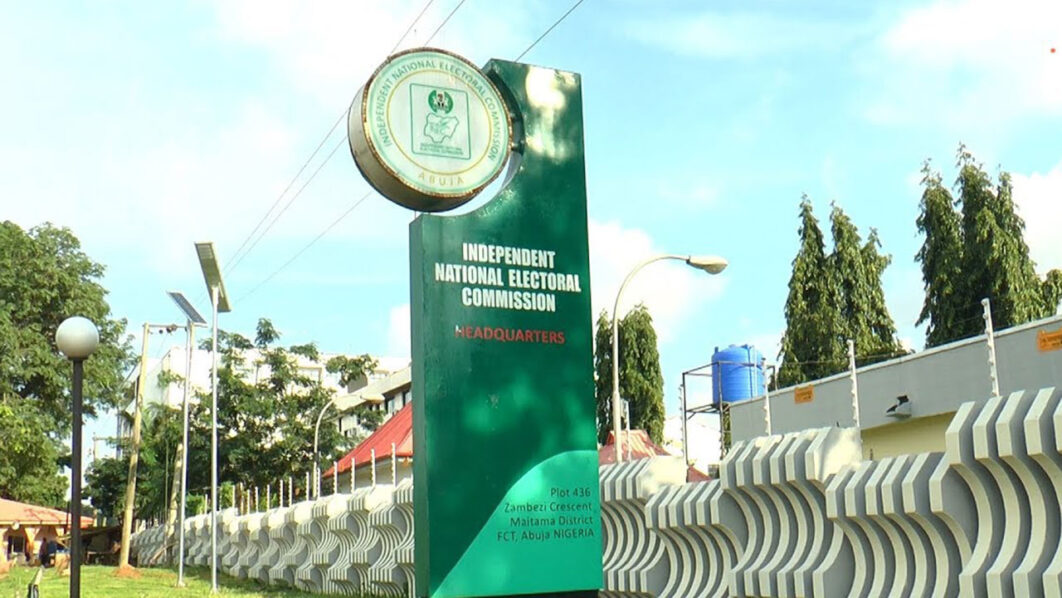
INEC says the website, identified as the Nigeria Election Intelligence System (NEIS), is neither affiliated with nor authorised to publish information on its behalf, describing the figures attributed to the mock exercise as false and misleading.
The Independent National Electoral Commission (INEC) has disowned a website publishing purported results of its nationwide mock accreditation and election exercise, warning Nigerians against treating the figures as genuine election results.
The commission said the website, identified as the Nigeria Election Intelligence System (NEIS), was neither affiliated with nor authorised to publish information on its behalf, describing the figures attributed to the mock exercise as false and misleading.
INEC’s position followed the publication of purported results by NEIS, which reportedly showed a presidential candidate leading with more than five million votes from the exercise conducted on Saturday.
In a statement on Sunday, Adedayo Oketola, media aide to the INEC Chairman, Joash Amupitan, said the mock exercise was designed to test the commission’s technology, processes and logistics ahead of the 2027 general elections, not to generate results for political parties or candidates.
He explained that the exercise did not feature actual political parties or candidates, as the dummy ballot papers used pseudo names generated solely for testing purposes.
“The exercise was designed to test the Commission’s technology, processes and logistics, not to produce results for any candidate,” Mr Oketola said.
He added that any claim that a candidate or political party won, led or trailed in the exercise was baseless.
The commission urged political parties, candidates, Nigerians and the media to disregard the figures published on the website and refrain from sharing them.
It also said it was reviewing the matter and reserved the right to take appropriate action against those responsible for spreading what it described as false election information.
Similarly, the All Progressives Congress (APC) Presidential Campaign Council condemned the publication, describing the figures attributed to NEIS as fictitious and an attempt to mislead Nigerians ahead of the 2027 elections.
In a separate statement on Sunday, Dele Alake, spokesperson for the APC Presidential Campaign Council, alleged that the figures were fabricated, questioning how the platform arrived at results for political parties that were not represented on the ballot papers.
Mr Alake said INEC conducted the mock exercise in two polling units in each of the country’s 8,809 wards, covering 17,618 polling units out of the 176,846 nationwide.
This represents approximately 10 per cent of the country’s polling units, according to him.
He explained that the ballot papers used during the exercise did not contain the names or logos of political parties but instead featured dummy options, including AQUA, BLUE, COAL, CYAN and GOLD.
According to him, INEC neither declared winners nor losers nor announced results at polling unit, ward, local government, state or national levels.
The APC spokesperson questioned how NEIS arrived at figures for the APC, the National Democratic Congress (NDC), the African Democratic Congress (ADC) and other political parties when none of them featured on the ballot papers.
He also questioned how the organisation generated more than 17 million votes from an exercise that covered only about 10 per cent of the country’s polling units.
“How did NEIS arrive at more than 17 million votes from an exercise that covered only about 10 per cent of the country’s polling units?” he asked.
Mr Alake further alleged that NEIS was politically aligned with the NDC and the supporters of Peter Obi, accusing it of presenting simulated figures as though they were actual election results.
“In a surprising turn, the Nigeria Election Intelligence System (NEIS), a pro-National Democratic Congress (NDC) and pro-Peter Obi organisation, published figures purportedly from INEC claiming that Peter Obi led the mock poll with more than five million votes,” the statement read.
He did not provide evidence for his claim linking NDC with the platform. Premium Times could not immediately get a reaction from the NDC.
He also said the organisation reportedly described the process on its website as a simulation, arguing that its figures should not be interpreted as a genuine reflection of voters’ preferences.
The APC campaign spokesperson urged Nigerians to disregard the purported results, warning against interpreting them as an indication of the likely outcome of the 2027 general elections.
He also accused opposition elements of attempting to manipulate public opinion through fake news and artificial intelligence-generated images, as well as efforts to discredit the electoral process and undermine public confidence in INEC.
INEC conducted the nationwide mock accreditation and election exercise on Saturday as part of preparations for the 2027 general elections.
The exercise was designed to assess the performance of the Bimodal Voter Accreditation System (BVAS) and the commission’s election result transmission infrastructure ahead of the polls.
It also provided an opportunity to test the commission’s technological systems, operational procedures and logistics before the general elections.
However, the emergence of purported results attributed to the exercise has triggered reactions from the electoral commission and the ruling party, both of which have cautioned Nigerians against treating the figures as an indication of electoral support for any political party or presidential aspirant.
INEC maintained that only information published through its official website, and verified social media accounts should be regarded as authentic communication from the commission.