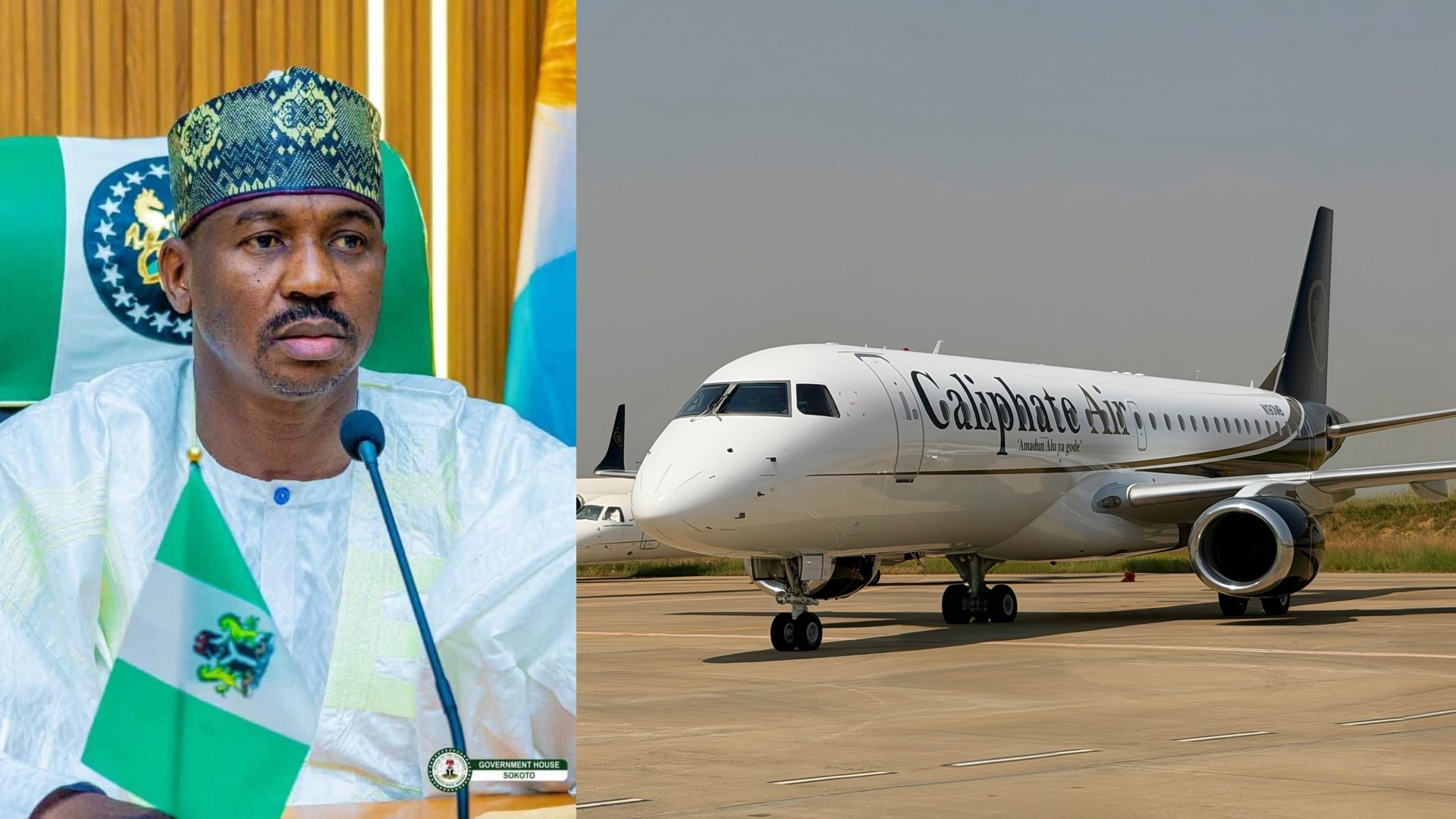
N36,004,593,844.15. That is what the Sokoto State Government of Governor Ahmed Aliyu has spent, by its own books, on the road to owning an airline, and the greater part of it went on three small secondhand jets that the open market prices, all three together, at no more than N20 Billion on the kindest possible valuation.
The airline is Caliphate Air, wholly owned by the Sokoto State Government and founded by it in 2025. It has an Air Transport Licence. It does not yet have the Air Operator Certificate that would let it carry a single paying passenger, and it has begun no scheduled service. What it has is five secondhand aeroplanes — the fifth touched down in Abuja only on 22 November 2026, still wearing an American registration — and a trail of public money that began, in the approved budget the Sokoto State House of Assembly passed for 2025, at exactly nothing. There was no kobo for air transport in that budget. The money was created inside the year, under the Ministry of Transport, on a line first dressed as the purchase of aeroplane spares and maintenance, swollen from zero to N38.4 Billion by amendment, and N24,706,676,732.48 of it was gone by the end of 2025. In 2026 a second line, this one named for the purchase of aeroplane, opened at N36 Billion approved, was trimmed to N33 Billion, and paid out N11,297,917,111.67 in the first six months alone. N21,702,082,888.33 still sits on that line, unspent and waiting.
The jets and the lives they lived before Sokoto
None of the jets the state parades was bought from any factory, and each carries a past life that this investigation has reconstructed registration by registration. The first two jets landed at Kano in July 2026 to drumming and official celebration. One, registered 5N-SOL and painted with the name Sir Ahmadu Bello Sardaunan Sokoto, was built in November 2004. It spent its working life in America flying for Chautauqua Airlines and Shuttle America, crossed to India in 2020 to fly for Star Air, and was parked in storage from June 2025 until Sokoto took it. Its sister, 5N-SOM, was built in September 2004, flew the same American years and the same Indian years, sat in storage in two separate stretches, and reached Nigeria on 3 September 2026 only after a heavy overhaul at Mbombela in South Africa and a delivery flight routed through Windhoek and Luanda. The third, 5N-SOK, painted Sultan Abubakar III, was built in China in 2008 and came out of Chinese airline service. The fourth is the biggest of them, an Embraer E190 registered 5N-ALU and painted Aliyu Magatakarda Wamakko, built in 2013, flown by China Southern, passed to a leasing house, flown in Vietnam by Bamboo Airways, parked in storage in Canada from April 2024, and resurrected through a dealer in Miami before it was ferried into Abuja on 28 August 2026.
Two of them, then, did not come to Sokoto from any working route. They came out of long storage and heavy foreign overhaul, woken up and put back together by other hands in other countries, and it is on precisely that road that this family of aircraft carries its most terrifying document. On 11 November 2018 an Embraer E190 of Air Astana, the same type as the jet Sokoto has named for Wamakko, took off from Alverca in Portugal after a heavy maintenance check and very nearly fell out of the sky. Its aileron control cables had been cross-rigged in the hangar, connected the wrong way round, so that the pilots’ commands rolled the aircraft against their intent. The crew fought a machine that answered them backwards, over a populated country, until they brought it down at Beja under military escort. The aeroplane never flew again. That is the documented price of one mistake in the resurrection trade, and it is the trade Sokoto has bought into twice over. The state chose the riskiest door through which an old aeroplane returns to the sky, and paid a king’s ransom to walk through it.
What the money bought, and what it should have cost
In the state’s own budget papers, which NGBreakingnews has now read line by line, the aircraft money never once travels under the airline’s name. It moves inside the Ministry of Transport, and its own conclusion page names the destination without decoration: the purchase of three ERJ-145 aircraft for Caliphate Air Ltd. For those three jets the state has, across 2025 and the first half of 2026, spent the N36,004,593,844.15 totalled above, roughly 24 million dollars at the prevailing rate. The aircraft themselves are fifty-seat regional jets built in 2004 and 2008. On the open market, aeroplanes of their type and years are offered between two million and four and a half million dollars apiece; the three of them, priced generously at the very top of every asking range, come to about fifteen million dollars, and priced ordinarily they come to far less. Heavy overhaul in South Africa costs money, and ferrying aeroplanes across the world costs money. Neither begins to close the distance between what these jets are worth and what Sokoto has paid, and no document made public by the state even attempts the arithmetic.
No document names who was paid. The seller or broker who supplied the three ERJ-145s appears in no announcement, no trade report and no state publication; the money leaves the budget in billions and the counterparty is a blank. For the E190s the airline points to Regional One, an American aircraft trading firm, yet no price, and no statement of whether the state bought or leased the jets, has been placed on any record, and no budget line produced so far ties a single naira to them. The state’s Executive Council has in the meantime approved a further N178.30 Million for an office complex and three shops for the airline at the Sokoto airport, an airline that has not sold one ticket. A body of Sokoto lawyers, the Sokoto Lawyers Forum for Transparency, Accountability and Good Governance, has since written to the Ministry of Finance under the Freedom of Information Act demanding the contracts, the payment vouchers, the ownership and registration records and any lease agreements behind the aircraft spending, and citing in the same letter financial consultancy payments of N6,465,394,821.92 in 2024 and N9,027,352,699.57 in 2025 that it also wants explained. No answer to that letter has been made public.
The fifth jet, and the empty chair
The airline speaks of a launch fleet of five aircraft, and for most of 2026 there were four. The second E190 the market had tracked for the airline, a 2012 jet flown by China Southern and then by Myanmar Airways International, was still flying passengers in Myanmar colours in June 2026, and American registry records in November 2026 still carried it in the name of a trustee bank in Utah. Then, on 22 November 2026, an E190 in Caliphate Air’s own colours completed a delivery run out of Miami through Paramaribo and Sal in Cape Verde and touched down in Abuja wearing a different American registration, N190MB, and the airline declared its first wave complete. The jet that landed is not the jet that was expected. It is an earlier sister of the Myanmar aeroplane off the same production line: built for China Southern, where it flew as B-3137, later flown in Vietnam by Bamboo Airways as VN-A260 — the same two airlines that had already supplied the first E190 — then passed through leasing registrations in Europe and Canada and through Regional One, the same American trading house behind the Wamakko jet, before a trustee bank in Utah took its registration in August 2026. The Myanmar jet itself never came, and where it now sits no record says. The substitute has never worn a Nigerian registration, and no price or terms for it exist anywhere a citizen can read. Around the five jets, the airline itself is a shell of titles: its website names no managing director, no chief executive and no board. A managing director’s name exists in exactly one place, a thank-you caption on the airline’s own Instagram page on 22 November 2026, naming Capt. Abioye Abdulkareem Babatunde as Managing Director and Accountable Manager, after the billions were already spent. The young media entrepreneur who fronted the delivery celebrations as the airline’s founder holds no documented office in the company at all. The state has built an airline with N36 Billion of public money, and the names on the door are a caption and a blank.
On safety, no delivered Caliphate jet that this investigation could trace has an accident or a reportable incident anywhere in its past. It followed the jets through the registrations that are public, the American and Indian years of the two 2004 jets and the Chinese, Vietnamese and Canadian years of the first E190, and found the record clean; the fifty-seat ERJ-145 family, across its entire history, has never killed a passenger. The danger in this story was never a crash in these aeroplanes’ past. It is a governor who took aircraft aged up to twenty-two years, two of them straight out of storage and foreign overhaul of the very kind that once cross-rigged a sister jet’s controls and nearly put it into the ground, paid for them at multiples of their worth through a budget line that did not exist when his own Assembly passed the year’s budget, and cannot yet say, because no certificate has issued, when or whether a single Sokoto citizen will ever be carried in them.
Follow NGBreakingnews on WhatsApp: join the channel for every exclusive the moment it publishes.