..Healthcare Budget Performance Drops From 44.95% To 40.48% in One Year.
…Poor Funding Execution Threatens Primary Healthcare, Maternal Services, Access To Essential Medicine
….Out-Of-Pocket Payments Deepen Hardship As Poor Nigerians Struggle To Access Treatment.
Daud Olatunji
A fresh assessment of healthcare expenditure across Nigerian states has exposed a worrying disconnect between increasing budgetary allocations and actual spending, raising concerns about the commitment of subnational governments to improving access to affordable and quality healthcare.
Despite approving a combined N3.07tn for the health sector in 2026, Nigerian states covered in a new report by BudgIT collectively spent N621.34bn in the first half of the year, representing a 31.61 per cent nominal increase over the N472.09bn recorded during the corresponding period of 2025.
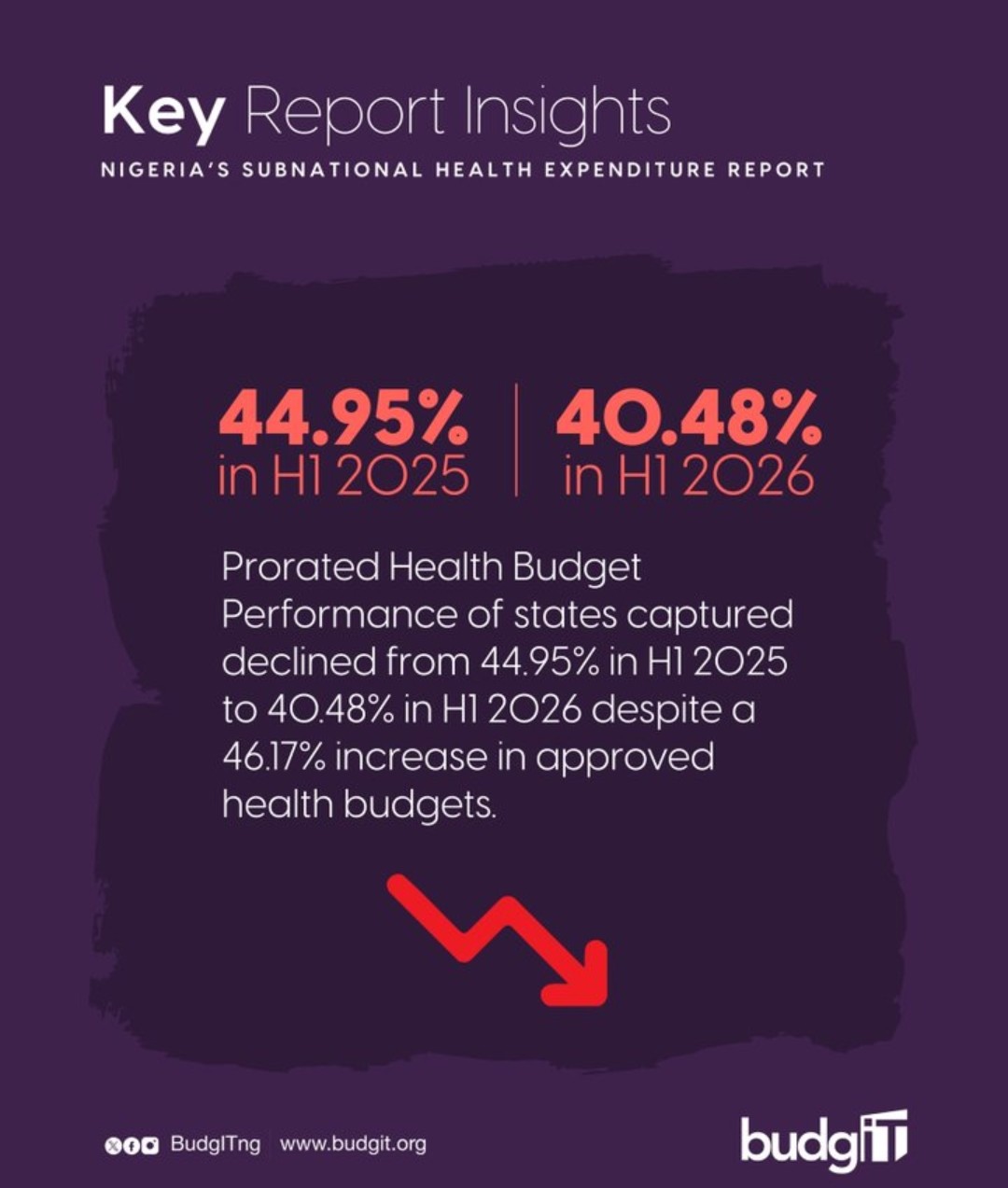
However, the increase in actual expenditure has failed to match the growth in approved health budgets, with budget performance declining from 44.95 per cent in the first half of 2025 to 40.48 per cent in the corresponding period of 2026.
The development means that, although state governments approved 46.17 per cent more money for healthcare, their performance in translating the allocations into actual expenditure deteriorated by 4.47 percentage points.
The findings, contained in BudgIT’s Nigeria’s Subnational Health Expenditure Report, H1 2026, provide fresh evidence of the challenges confronting Nigeria’s healthcare system, where millions of citizens continue to struggle with inadequate medical facilities, rising treatment costs, shortages of healthcare professionals and limited access to essential services.
A closer examination of the figures also raises questions about the ability of state governments to convert increased fiscal resources into improved healthcare delivery.
Rising Budgets, Declining Performanc
The report’s figures reveal that Nigeria’s subnational governments are yet to demonstrate the level of budget execution required to address the country’s longstanding healthcare challenges.
Although the combined approved health budgets increased by 46.17 per cent, expenditure performance declined within the same period.
The 40.48 per cent performance recorded in H1 2026 represents expenditure against the prorated budget expected to have been implemented by the end of June.
In practical terms, this means that states achieved only about 40 kobo of every N1 expected to have been spent on healthcare by the halfway point of the year.
Consequently, approximately 59.52 per cent of the expected half-year expenditure had not been executed by the end of June.
While the N621.34bn spent represents a significant nominal increase over the previous year’s expenditure, the declining execution rate suggests that increasing budgetary provisions alone may not translate into improved healthcare services without effective implementation.