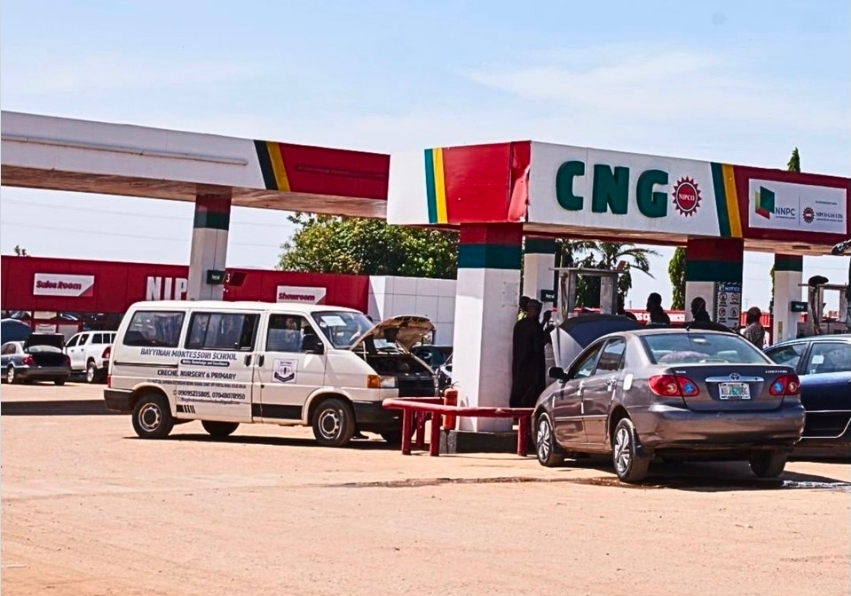
The Federal Government has commenced the deployment of Compressed Natural Gas (CNG) refuelling stations and vehicle conversion centres in 20 federal universities across the country as part of efforts to reduce transportation costs for students and university staff.
The initiative, known as the Special Palliative Relief on University Transportation (Project SPROUT), is designed to make campus transportation more affordable by encouraging university shuttle operators to switch from petrol-powered vehicles to cheaper Compressed Natural Gas (CNG).
The Minister of Education, Dr Tunji Alausa, disclosed this on Friday during the commissioning of CNG facilities at the University of Lagos (UNILAG), alongside similar ceremonies at the University of Ibadan (UI), Federal University of Technology, Akure (FUTA), and Federal University Oye-Ekiti (FUOYE).
Alausa explained that the programme would initially cover 20 federal universities, beginning with a pilot scheme involving one tertiary institution from each of the country’s six geopolitical zones.
He said the commissioning of the four facilities represented significant progress towards achieving the Federal Government’s target, adding that the initiative would be extended to more universities beyond the initial 20 institutions.
According to the minister, the high cost of transportation remains one of the major concerns raised by students, many of whom make several daily trips between their hostels, lecture halls and laboratories.
He noted that even modest reductions in transportation fares could significantly ease the financial burden on students, particularly those who depend on campus shuttle services for their daily movements.
Alausa therefore urged university managements and transport operators to ensure that the savings realised from switching to CNG were reflected in affordable fares and reliable transportation services for students.
He also emphasised the importance of strict safety standards, regular equipment maintenance, adequate staff training and clearly defined emergency procedures, stressing that commercial operations must not commence until all necessary regulatory approvals had been obtained.
Beyond reducing transportation costs, the minister said the vehicle conversion centres would provide valuable opportunities for practical learning and skills development.
He encouraged universities to collaborate with transport operators to expose engineering students and other relevant disciplines to vehicle conversion, equipment maintenance and gas infrastructure management.
Speaking at the event, the Executive Director of the Midstream and Downstream Gas Infrastructure Fund (MDGIF), Mr Oluwole Adama, said the commissioning demonstrated the Federal Government’s commitment to translating Nigeria’s abundant natural gas resources into tangible economic benefits for citizens.
Adama disclosed that the fund’s portfolio had grown to 31 projects, comprising 205 infrastructure assets nationwide. He added that MDGIF had supported the delivery of 25 fully operational CNG stations over the past two years.
He described the UNILAG facility as the 11th CNG station commissioned in Lagos State, noting that the expansion of gas infrastructure was making cleaner and more affordable fuel increasingly accessible to motorists and transport operators.
According to him, the four universities commissioned on Friday had joined other institutions already operating CNG facilities under the partnership between MDGIF and FEMADEC Energy Limited.
The previously commissioned institutions include Yakubu Gowon University, Abuja; Federal University of Technology, Owerri; Obafemi Awolowo University, Ile-Ife; University of Uyo; University of Calabar; Federal University of Petroleum Resources, Effurun; and University of Nigeria, Enugu Campus.
Adama further disclosed that nine additional CNG stations, mostly located in northern Nigeria, were expected to be commissioned within the coming weeks.
He commended President Bola Ahmed Tinubu for providing the policy direction through the Renewed Hope Agenda and the Presidential CNG Initiative, while acknowledging the contributions of the Ministers of State for Petroleum Resources (Gas) and Education to the implementation of the programme.
He particularly praised Alausa for mobilising vice-chancellors and facilitating the allocation of land for the facilities, describing the effort as instrumental to the successful execution of the project.
Also speaking, the Chief Executive Officer of FEMADEC Energy Limited, Engr. Fola Akinnola, said the latest commissioning had increased the company’s CNG infrastructure footprint in tertiary institutions to 11 nationwide.
Akinnola revealed that engineering teams were putting finishing touches to facilities in six additional universities scheduled for commissioning before the end of the year, while the remaining three institutions under the initial 20-university rollout were expected to be completed early next year.
He explained that the facilities were designed not only to provide cheaper fuel for campus transportation but also to serve as practical training centres where students could acquire relevant skills in gas infrastructure management, vehicle conversion, maintenance and safety operations.
The FEMADEC chief executive said the initiative highlighted the importance of collaboration between government institutions and private-sector operators in accelerating Nigeria’s transition to cleaner and more affordable energy.
He assured that the company would prioritise operational efficiency, uninterrupted gas supply and strict compliance with international safety standards across all the facilities.
The commissioning ceremony was attended by senior government officials, university administrators and industry stakeholders, with the facilities in Lagos, Ibadan, Akure and Oye-Ekiti formally unveiled as part of the Federal Government’s broader intervention to reduce campus transportation costs and expand access to cleaner energy.