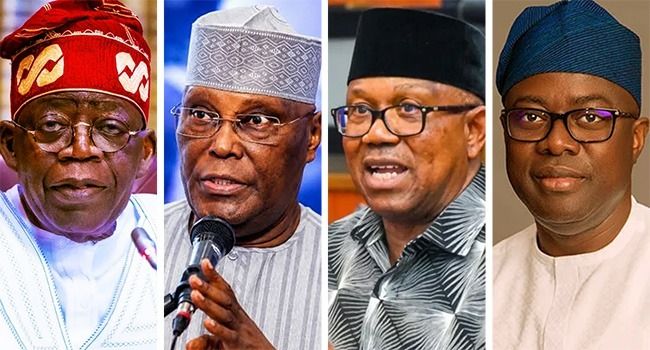
The government wants economic improvement to reach voters. The opposition wants negotiations to produce cooperation. Both are running against time.
Two clocks are ticking towards Nigeria’s presidential election.
One measures how quickly economic improvement becomes visible in people’s lives. The other measures how quickly opposition leaders can turn discussions into an arrangement that strengthens their challenge.
This week has brought movement on both. Figures released on Monday put October’s annual headline inflation at 14.06 per cent, down from 14.63 per cent in September.
Meanwhile, opposition parties have announced a November 23 summit in Abuja to adopt cooperation documents.
These developments give the governing party and its challengers something concrete to discuss. Neither, by itself, settles the electoral argument.
For President Bola Tinubu, the task is to demonstrate that reform is improving living standards. For the opposition, it is to demonstrate that cooperation can survive competing ambitions.

Inflation Falls. The Household Test Remains. The latest inflation figures offer the government evidence for its argument that economic stabilisation is progressing.
Food inflation also moderated, to 19.13 per cent year on year from 19.59 per cent.
The political meaning requires care. A lower annual inflation rate means prices are rising more slowly than a year earlier.
It does not mean that the general price level has returned to where it stood before the cost of living shock.
Families judge affordability through income, food, transport, rent and other recurring expenses.
A household can recognise an improving economic indicator while remaining under considerable pressure. The government therefore has an opening, accompanied by a demanding question: how much improvement will citizens experience before they vote?
Its strongest argument would connect stabilisation with changes people can identify: more reliable services, stronger earnings, affordable essentials and business opportunities.
The opposition also needs to respond seriously to improving data. It can question the distribution and adequacy of recovery while explaining how its own policies would improve purchasing power.
The emerging debate should concern the route from economic stability to household security.
November 23: Cooperation Acquires a Date

The Coalition for Democracy says participating opposition parties will meet at the NAF Conference Centre in Abuja on Monday, November 23.
The proposed business includes a National Covenant for Democratic Renewal, a Framework for Opposition Unity and a National Reform Programme.
That is a clearer next step than another general declaration of willingness to work together.
But several forms of cooperation remain possible.
Parties can coordinate election monitoring, defend campaign freedoms and agree on institutional reforms while continuing to field competing presidential candidates.
The latest announcement does not identify a common candidate. Questions about the earlier proposed roadmap towards one ticket remain unresolved in the material examined.
The summit should therefore be judged by what participants actually authorise. Who signs? In what capacity? What obligations follow? Who implements the decisions?
What happens when national cooperation conflicts with a local candidate’s ambition?
Those details will determine whether the meeting strengthens the opposition’s ability to compete.
An endorsement can encourage supporters to back another candidate. Whether they follow depends on trust, local interests, and their assessment of the candidate receiving that support.
Political leaders cannot assume that their voters will move with them.
ADC Seeks Protection for Its Candidates

The ADC’s legal position remains a consequential uncertainty.
The party is reported to be asking the Court of Appeal to overturn the judgment against its David Mark-led leadership and restrain INEC from changing leadership records or candidate nomination details while the appeal is determined.
These are requests for relief; the report does not establish that the orders have been granted.
The distinction is essential.
Atiku’s campaign needs to sustain confidence while the courts address questions affecting participation. Its candidates elsewhere need clarity too.
For INEC, uncertainty complicates administration. For voters, it can make an already complex contest harder to follow.
The immediate indicator to watch is an authoritative court order or formal commission action. Statements of confidence from interested parties cannot provide the same certainty.
Kano Adds Urgency to Campaign Safety

Sunday’s violence in Bichi has produced competing accounts.
Kwankwaso’s camp reported an attack on his convoy.
The Kano information commissioner disputed that account. Police subsequently reported eight arrests following a political clash involving APC and NDC supporters.
Investigation must establish the sequence of events and individual responsibility.
The immediate duty is to protect lawful political activity and preserve evidence. Rival explanations should be examined against witness accounts, footage, medical records and other verifiable material.
Campaign intimidation can alter participation well beyond the scene of an incident.
People may avoid meetings, volunteers may withdraw, and organisers may find access to communities more difficult. Equal protection is therefore part of electoral fairness. It must apply regardless of party, candidate or location.
Obi Puts His Record Forward

Peter Obi has announced a ten-day presentation of his record as Anambra governor, following renewed criticism from Tinubu.
He argues that his approach to governance can be applied nationally. Those are claims now offered for public scrutiny.
This creates an opportunity for a more useful campaign exchange.
Records can be examined through budgets, completed projects, institutional changes, outcomes and the responsibilities held by each officeholder.
For Obi, the question extends beyond what happened in Anambra to how his proposed methods would work at federal scale.
The same scrutiny belongs across the field: Tinubu’s presidency, Atiku’s public service and Makinde’s governorship should all be examined with comparable rigour.

APC/Tinubu: The new inflation release strengthens the stabilisation argument. Its electoral value depends on whether voters connect it with improving circumstances.
ADC/Atiku: The reported appellate requests seek protection against consequential changes while the dispute continues. Legal certainty remains the most immediate issue.
NDC/Obi–Kwankwaso: Obi is advancing a defence of his governing record, while the Bichi incident places campaign safety and Kano’s political competition under closer scrutiny.
APM/Makinde and the wider opposition: The November 23 summit offers a defined opportunity to establish cooperation. Its announcement does not establish a completed common ticket.
The participating platforms listed by the coalition include the ADC, NDC, APM, PRP, SDP and the Kabiru Turaki-led PDP faction.
Describing the last participant precisely matters: factional involvement should not automatically be presented as a commitment by every part of the PDP.
State-level analysis should now focus on implementation: shared campaign activity, local agreements, functioning organisations and polling-agent preparation.
Recent local and off-cycle elections can inform that assessment when turnout, competitiveness and local circumstances are considered. They provide indicators rather than a ready-made presidential forecast.
Election Watch assessment: There is fresh economic evidence and a firmer date for opposition cooperation. Neither establishes a measurable national swing.
Affordability and the Decision to Participate

For younger Nigerians, the economic test often begins with the cost of reaching an opportunity. Can a graduate afford transport to work? Can a small business cover electricity and rent?
Does a training programme lead to paid employment?
Can someone without connections obtain enterprise support? Slower inflation can help create better conditions. Its practical value depends on earnings, access and the costs young people actually face.
The opposition summit offers another test. Young participants should have a voice in policy choices, organisational responsibilities and implementation, not merely a role in mobilising attendance.
Campaign safety matters here too. The possibility of intimidation raises the personal cost of volunteering, reporting and attending meetings.
Youth Metre assessment: Affordability, opportunity and confidence in participation remain the key measures. No fresh, credible age-specific polling reviewed for this edition establishes a shift in candidate preference.

- Any appellate order or formal INEC action concerning the ADC.
- Confirmation of participants and proposed commitments for November 23.
- Investigative findings following the Bichi violence.
- Responses to the inflation figures that explain practical policy choices.
- Evidence supporting claims made in the candidates’ records of service.
The government’s opportunity is to make improving indicators meaningful at home. The opposition’s opportunity is to make cooperation useful at the polling unit.
Voters will ultimately judge both by what they can deliver and by whether they can be trusted to deliver.
EDITORIAL NOTE
Political Signals is an independent weekly political analysis produced for Channels Television. It examines political developments, personalities and electoral trends without endorsement of any political party or candidate. Its assessments are based on publicly available evidence and may change as events and evidence develop.