Foreign-agent disclosures reveal that consultant Diana London’s firm received $662,000 through a public-relations contract aimed at promoting Nigeria’s security and religious-freedom narrative in Washington.
ABUJA, Nigeria — U.S. federal disclosure records show that Diana London, the American consultant who conducted a widely publicized interview with President Bola Tinubu in Abuja, was part of a paid communications effort on behalf of the Nigerian government. Documents filed under the U.S. Foreign Agents Registration Act (FARA) indicate that London’s firm received $662,000 in retainers and expenses through a lobbying and public-relations contract designed to promote Nigeria’s security policies and maintain support in Washington.
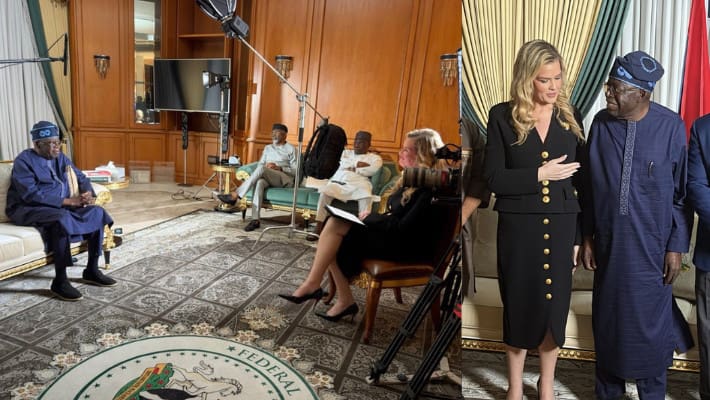
On November 17, 2026, London, CEO of the Florida-based firm London Global Strategies met with Tinubu at the Presidential Villa in Abuja, Nigeria’s capital. Photographs circulated afterward by presidential supporters and media aides presented London as an independent American journalist praising Tinubu’s economic record and security partnership with Washington.
Viral reports circulating in Nigeria claimed that London personally received $4.5 million from the Nigerian government. However, a TruthNigeria review of Foreign Agents Registration Act (FARA) filings shows that the $4.5 million figure refers to an installment payment under a broader $9 million contract between Nigeria and DCI Group. The filings document $662,000 in payments and expenses associated with London Global Strategies.
U.S. Department of Justice records filed under the Foreign Agents Registration Act (FARA) provide more clarity.
In her December 18, 2025 registration, London identified herself as a consultant to DCI Group AZ, LLC, working on behalf of the Republic of Nigeria through Aster Legal, a law firm in Kaduna state representing Nigeria’s National Security Adviser Nuhu Ribadu.
“Consultant shall assist the Nigerian government through Aster Legal in communicating its actions to protect Nigerian Christian communities and maintaining U.S support in countering West African jihadist groups and other destabilizing elements,” London stated in her filing.
“The U.S-Nigeria security partnership is delivering results. Peace through strength. None of this happens without the ongoing partnership between President Trump and President Tinubu, their steadfast commitment to eliminating terrorists, and Nigeria’s willingness to work closely with the U.S. government,” London wrote in a social media post that she later deleted after reports surfaced on the filings.
Separating the $662,000 Payout from the Wider Contract
A review of DCI Group’s May 31, 2026 supplemental FARA statement and its subsequent October 31, 2026 filing clarifies the exact subcontracting chain.
The $4.5 million figure represents the initial six-month installment of Nigeria’s wider $9 million contract with DCI Group, executed through Aster Legal.
The agreement states that “the client {Nigeria} will pay DCI Group a monthly retainer of $750,000, with payments made in two six-month installments of $4.5 million each.”
Supplemental FARA statements filed by DCI Group on May 31, 2026, and October 31, 2026, show $662,000 disbursed to London Global Strategies across three entries: $75,000 for a retainer on December 23, 2025; $375,000 for a January–May 2026 retainer on December 23, 2025; and $212,000 for expenses on August 4, 2026.
“I unequivocally deny the claim that Nigeria’s government nor anyone else in Nigeria paid me $4.5 million. I went to Nigeria to interview President Tinubu for parts of a documentary and see Nigeria for myself,” London wrote on X after the disclosures drew scrutiny.
“The toxic narrative and mis-narrative that Nigeria is trying to counter in Washington is generated here at home by our own errors, our own lack of enforcement of rules, and your lack of effectiveness in securing citizens,” Sam Amadi, a Nigerian thought leader, told TruthNigeria.
“Even if it’s in good faith, even if there’s no money laundering or corruption involved—value for value, you didn’t need to pay that much to DCI Group to help you do things that your own internal politics generate.”
Amadi has filed a formal Freedom of Information request demanding that Ribadu’s office disclose the bank transfers, procurement approvals, and selection process behind Aster Legal, the little-known Kaduna law firm used as an intermediary.
“In a true democracy, citizens would be the first to know, they wouldn’t have to pry into American disclosure filings to discover that the Nigerian government is a client of DCI Group.”
Questions over Security Spending and Legislative Oversight
Critics and legal observers argue that routing foreign lobbying through the Office of the National Security Adviser rather than the Ministry of Foreign Affairs bypasses normal public expenditure scrutiny while armed militia raids and terrorist violence continue across Nigeria’s agricultural heartland.
“We have a National Assembly that, since 1999, has largely been referred to as a rubber stamp,” Tohwo Oseruvwoja, a legal expert, told TruthNigeria.
“Those in power are being ‘smart by half,’” Oseruvwoja added.
“Why didn’t they use the Ministry of Foreign Affairs? Because they wanted to classify the contract as a security issue, knowing that whenever citizens request details on security spending, officials hide behind ‘national interest.’”
“Paying that huge amount of money to push a narrative to the United States government and other developed countries which already gather real-time intelligence through modern technology, the internet, and international organizations means nothing,” Oseruvwoja said.
Washington Scrutiny and Unanswered Requests
Nigeria’s lobbying push, which also includes a separate $120,000-per-month contract with Valcour Consulting followed Washington’s redesignation of Nigeria as a Country of Particular Concern over religious freedom abuses. During a November 12, 2026 congressional hearing on religious freedom in Nigeria, U.S. lawmakers and policy experts challenged lobbying narratives paid for by foreign governments.
“How do you {lobbyists} know this {truth}? What’s your source? Are you just parroting and putting on your letterhead with bullet points what you get from the Nigerian government and from their propaganda office, or do you go there?” Representative Chris Smith (R-NJ), said at the hearing.
“It’s so unbalanced… because they’re getting paid millions to lie, and it also is very counterproductive,” Nina Shea, director of the Center for Religious Freedom at the Hudson Institute, said.
“For too long, the Nigerian government has paid high-priced lobbyists in Washington to cover up the persecution of Christians while doing little to stop it. This bill will end that,” Representative Barry Moore said in introducing legislation to bar paid lobbying for Nigeria while it holds the CPC designation.
Civil society advocates say they are preparing federal court action to force public disclosure of how millions in security funds were diverted to foreign image-makers while rural communities remain under siege.
Mary Kiara reports on Religious Freedom Policy for TruthNigeria.