Chinedu Eze
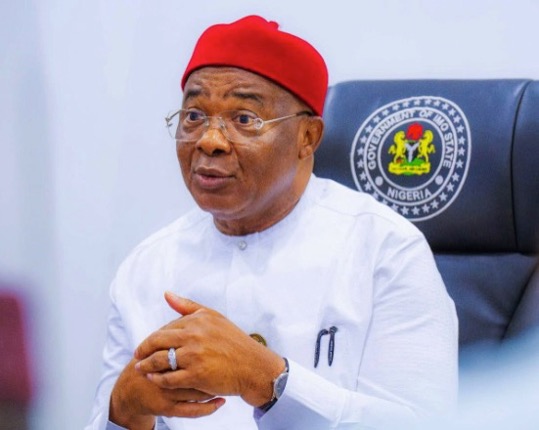
The Governor of Imo State, Hope Uzodimma, has said that reducing mass poverty in Nigeria requires the creation of jobs in rural communities, which are home to 80 per cent of the country’s poor.
The governor made this known yesterday in Lagos while speaking as the guest speaker at the Lagos Country Club’s “Policy Dialogue with Government Leaders”.
Speaking on the theme, “The Future Is Local: Stimulating Grassroots Economies for Inclusive Growth”, Uzodimma said while government could not create enough jobs for the people, it must provide an enabling environment to attract private sector investment and create the jobs needed.
He noted that Nigerian cities had become saturated as people continued to leave rural communities for urban centres, which lacked the capacity to create enough jobs to meet the growing demand.
“Things get complicated when people move faster than cities can create jobs, and when the places they leave are abandoned rather than developed,” he said.
The governor said the solution was to create an enabling environment in rural communities where small and medium-scale businesses could thrive. He warned that this had become imperative given the continuous growth in the population of young Nigerians in need of jobs.
“In our own country, neglected places have expressed their frustration at the ballot box and through far more dangerous means. A local economy that gives young people a stake in peace is among the best security investments a government can make.
“Rural areas hold 80 per cent of the country’s poor. When local economies sit idle, the consequences do not stay local. Young people leave for the big cities or stay behind with nothing productive to do. That idleness has a way of finding the wrong employers. Crime and insecurity feed on it,” Uzodimma emphasised.
He noted that a poor state had little to tax and, therefore, relied increasingly on allocations from Abuja and the few cities capable of generating sufficient revenue to sustain themselves.
Uzodimma said government must provide the necessary infrastructure to enable small business operators to succeed in rural communities, noting that this would help address unemployment in the country.
“The most recent national survey of micro, small and medium enterprises, carried out by the Small and Medium Enterprises Development Agency of Nigeria (SMEDAN) and the National Bureau of Statistics (NBS), found close to 40 million such businesses. Together they account for nearly half of GDP and create close to nine in every ten jobs. Most are small, informal and far from Lagos, held back by unreliable power, scarce and expensive finance, poor roads, multiple taxation and the high cost of dealing with government. Every improvement to the foundations goes straight to their bottom line.
“Foundations matter only when someone builds on them, and in a market economy that someone is the private investor. Government should not try to pick winners. It should lower the cost and risk of doing business and then make it easy for capital to find opportunities that already exist. That is the purpose of the Orashi Special Energy Free Zone in Ohaji/Egbema (created by the state government), which holds a ten-year operating licence from the Oil and Gas Free Zones Authority and an approved master plan, so that investors in gas and energy can process and add value close to the resource,” he said.
The governor also said his administration had sought to make local economies work by laying the necessary foundations, supporting local enterprises and investing in the people, but acknowledged that much remained to be done.
He reiterated that private capital would not flow into areas where basic infrastructure was lacking, stressing that the first responsibility of any state seeking grassroots economic growth was to provide such infrastructure.
“Power is the constraint every business in Nigeria knows best. The constitutional and legal reforms of 2023 allowed states to regulate their own electricity markets, and we decided not to wait. In February, as part of our Imo State at 50 celebrations, we commissioned the first phase of the Orashi Power Project under our Light Up Imo programme. It is run by our indigenous Orashi Electricity Company with its technical partner, Madkour Holding of Egypt, and includes a 15 MVA injection substation and a new distribution network on the Owerri axis,” he added.