FUNSHO AROGUNDADE
The Federal Ministry of Agriculture and Food Security has dismissed as false and misleading a viral claim that Nigeria is losing ₦5 trillion annually in agriculture.
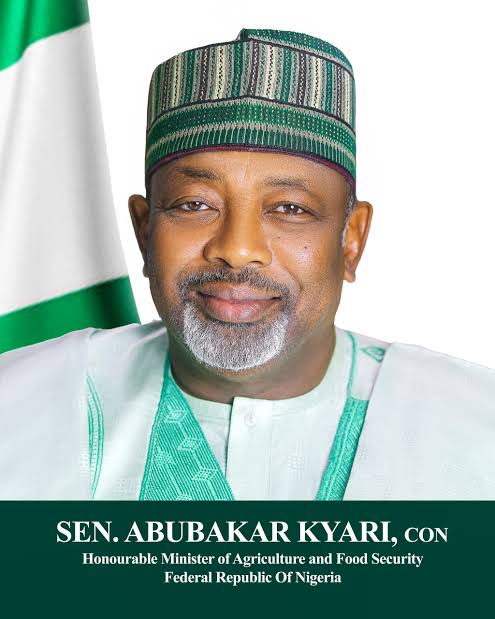
In a statement issued on Thursday, the Minister of Agriculture and Food Security, Senator Abubakar Kyari, CON, described the report circulating online as fictitious and mischievous.
The report had claimed an annual ₦2.5 trillion loss in agriculture and another projected ₦10 trillion additional loss.
Kyari said any serious stakeholder knowledgeable about Nigeria’s agricultural ecosystem would know the claims were too wild to be true.
He said the claims were only possible in the figment of the opposition’s imagination just to discredit the administration of President Bola Ahmed Tinubu.
“Typical of such false claims there is nowhere the accusations were supported with credible evidence,” Kyari said.
The Minister pointed to the 2026 Wet Season Agricultural Performance Survey, conducted by NAERLS, Ahmadu Bello University, Zaria, as evidence that the sector is not in collapse.
According to the survey, national cereal production stands at 29.393 million metric tonnes — 1.84 per cent higher than 2025 production. Rice production alone capped a whopping 9.626 million metric tonnes.
“The unbiased facts puts to lie the narrative that our agricultural sector is in total collapse,” Kyari said.
For clarity, Kyari explained that the 150-day duty-free food import window introduced in 2024 was a temporary measure to bridge supply gap, increase availability and stabilise market prices.
He said the measure served its immediate purpose of easing supply pressures and preventing inflation from further rising.
“The window expired on 31st December 2024. It has not been renewed or reintroduced in any way since then. It was a stop-gap measure that was never intended to replace domestic production,” he said.
Kyari said the Tinubu administration has supported farmers and expanded the country’s food production capacity.
He listed interventions including financing from the Bank of Agriculture, strategic interventions through the National Agricultural Development Fund, mechanisation partnerships, and Special Agro-Industrial Processing Zones, amongst others.
According to him, the administration has distributed 2.150 million bags of fertiliser free of charge to farmers across the country, aside from other inputs and support programmes.
More recently, funding has been approved for accelerated production and supply of over three million bags of NPK fertiliser ahead of dry season farming, which will strengthen domestic fertiliser manufacturing capacity, increase input availability and boost production.
The Minister said the government is also addressing post-harvest losses through the National Postharvest Systems Transformation Programme (NiPHaST), which focuses on storage warehouses and cold chain infrastructure for processing and preservation.
Kyari also dismissed the claim that over 50% of Nigeria’s rice mills have closed down.
“This does not reflect the full picture of the country’s rice-processing industry. So many rice mills around the country are still operating, and the Federal Government continue to support local processors in different ways,” he said.
He added that if any mills suspended production, it would be unfair and mischievous to blame it on the 150-day duty-free window which expired way back in December 2024.
“As a government, our policy direction is to increase domestic production and decrease dependence on imported food. President Tinubu’s charge to us at all times is that we must produce what we consume and consume what we produce,” Kyari said.
The Minister then turned to politics, warning that what should actually worry farmers is former Vice President Atiku Abubakar’s promise to reopen borders.
“It is one policy that is capable of annihilating our agricultural sector through indiscriminate food imports which will expose our farmers to unfair competition,” he said.
“Our commitment at the Federal Ministry of Agriculture and Food Security remains to support farmers, strengthen local industries, increase food production, reduce post-harvest losses and make food cheaper,” Kyari said.
“It is sad and unfortunate that some unscrupulous elements are trying to turn our agricultural sector into a fodder for political propaganda to mislead Nigerians. Nigeria’s progress in agriculture must be measured by evidence not political propaganda.”