The lawmakers say the INEC chairman has lost the confidence of key political stakeholders and could no longer guarantee a credible electoral process, accusing him of actions that “raise concerns regarding his transparency, integrity and trustworthiness.”
The African Democratic Congress (ADC) caucus in the House of Representatives has called for the removal and prosecution of the Chairman of the Independent National Electoral Commission (INEC), Joash Amupitan, over allegations of partisanship and interference in political parties’ internal affairs.
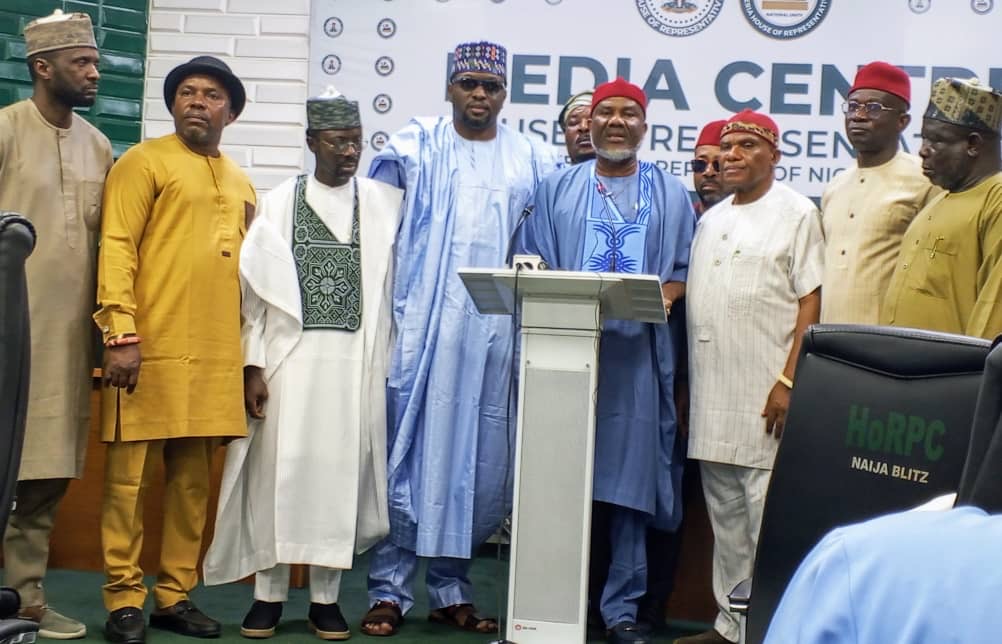
Alam Ogene (ADC, Anambra), who spoke on behalf of the caucus at a press conference in Abuja on Monday, said its position followed its inaugural meeting held on Sunday, 12 April, during which members reviewed recent political developments ahead of the 2027 general elections.
Mr Ogene alleged that the INEC chairman had lost the confidence of key political stakeholders and could no longer guarantee a credible electoral process, accusing him of actions that “raise concerns regarding his transparency, integrity and trustworthiness.”
According to him, concerns within the caucus were anchored in claims that Mr Amupitan had previously expressed partisan sentiments on a personal X account allegedly linked to him, including support for the ruling All Progressives Congress (APC) and comments on alleged religious tensions in the country.
He said that although INEC had denied Mr Amupitan’s ownership of the account, members of the caucus maintained that digital traces and other online indicators had intensified public suspicion, insisting that the controversy undermined confidence in the electoral body.
Mr Ogene further alleged that the commission, under Mr Amupitan’s leadership, was enabling “undemocratic practices” in the internal affairs of the ADC by recognising what he described as a disputed faction within the party leadership crisis, contrary to earlier positions allegedly taken by the commission.
“Specifically, the commission seems to be recognising an illegitimate leadership faction, contrary to the authentic leadership of Senator David Mark, which had previously been acknowledged and certified by INEC itself, having met the requisite criteria, as evidenced by a recent affidavit issued by the commission,” he said.
He claimed that the development had placed the party at risk of exclusion from the 2027 elections, warning that such actions could erode public trust in the electoral process.
The lawmaker also accused unnamed actors within the electoral body and the judiciary of attempting to influence an impending court decision scheduled for Tuesday, 14 April, relating to the ADC leadership dispute.
“Credible information at our disposal suggest that certain individuals within the judiciary and INEC are collaborating to influence the outcome of a case coming up on Tuesday, April 14, 2026 regarding the leadership question in the ADC, potentially impacting the recognition of a discredited faction,” he said.
Citing provisions of the Electoral Act 2026, Mr Ogene argued that disputes arising from internal party congresses fall within the purview of limited judicial intervention, warning against what he described as judicial overreach and procedural manipulation.
He said the caucus would petition the National Judicial Council (NJC) over alleged political interference by judicial officers, aligning with recent concerns raised by the Nigerian Bar Association (NBA) leadership on judicial independence and integrity.
Mr Ogene also referenced past judicial figures, including Justices Chukwudifu Oputa, Kayode Eso, Niki Tobi and Mohammed Uwais, saying their legacy underscored the need to protect the judiciary from declining public confidence.
He added that the ADC caucus remained committed to defending democratic institutions, insisting that INEC must demonstrate impartiality in both conduct and perception ahead of the 2027 polls.
The leadership crisis within the ADC has deepened over the past months, with multiple court rulings, competing factions, and regulatory actions by INEC shaping the dispute.
The crisis can be traced to July 2025, when a coalition of opposition figures led by Atiku Abubakar, adopted the ADC as a platform for the 2027 elections, leading to the emergence of a caretaker leadership headed by former Senate President David Mark, alongside former Osun State governor Rauf Aregbesola as national secretary, following the resignation of the previous party executives led by Ralph Nwosu.
INEC subsequently recognised this leadership in September 2025 and published its details on its official portal.
However, the arrangement was challenged by a rival faction led by Nafiu Bala, a former national vice chairman of the party, who approached the Federal High Court in Abuja, arguing that he was the rightful leader in line with the party’s constitution.
The dispute triggered a series of legal battles. In a key development, the Court of Appeal, in a ruling delivered on 12 March, dismissed an interlocutory appeal filed by the Mark-led faction and ordered all parties, including INEC, to “maintain the status quo ante bellum” pending the determination of the substantive suit before the Federal High Court.
Following the ruling, INEC took a controversial step by withdrawing recognition from all factions claiming the party’s leadership. The commission also removed the names of the Mark-led National Working Committee from its portal. It announced it would no longer deal with any faction or monitor party activities until the court delivers a final judgment.
This decision effectively left the party without a recognised national leadership, sparking protests from both the Mark and Bala factions, each insisting on its legitimacy and accusing the electoral body of bias.
Amid the stalemate, a bloc of state chairpersons announced a new interim leadership, distancing itself from both the Mark-led and Bala-led groups, and declaring that it had assumed control of the party’s structure. The group, loyal to the 2023 ADC presidential candidate, Dumebi Kachikwu, justified its action by citing what it described as a leadership vacuum created by INEC’s derecognition of existing factions.
The crisis has therefore evolved into a multi-layered power struggle involving at least three blocs: the David Mark-led National Working Committee, the Nafiu Bala faction, and a coalition of state chairpersons (alongside other claimants such as the Kachikwu-aligned group).
At the core of the crisis is a growing confrontation between the ADC and INEC. Party leaders, particularly from the Mark-led faction, have accused the electoral body of misinterpreting court orders and undermining the party’s ability to function, while INEC insists its actions are guided strictly by judicial directives to avoid prejudicing ongoing litigation.