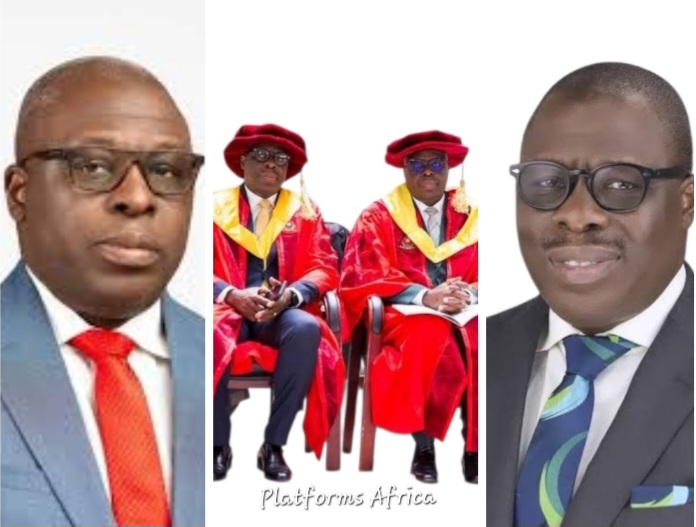
From Ibadan to the driver seats at Nigeria’s oil and gas most influential Boardrooms: Seven things you hitherto don’t know about Leye, CEO of NLNG; and Gbite, CEO of Aradel Holdings – the Falade’s identical twins and their blueprint for destiny +PHOTOS
In the high-stakes corridors of Nigeria’s energy sector, one story reads like a blueprint for destiny: identical twins, same engineering class, same first job at Shell in 1996, and now, 30 years later, the two most strategic levers of the country’s hydrocarbon future sit in their hands.
Meet Leye Falade, incoming CEO of Nigeria LNG, and Gbite Falade, MD/CEO of Aradel Holdings. One anchors Nigeria’s global gas ambitions. The other is rewriting the playbook for indigenous oil independence. Together, they’ve been dubbed “the power twins of Nigerian energy.”
1. Same Birth, Same Blueprint: Ibadan to Shell
Both born in Ibadan and trained as electrical and electronic engineers at the University of Ibadan, Leye and Gbite entered Shell Nigeria in 1996. From there, their careers mirrored each other across upstream and midstream assets in seven countries, spanning Europe, Asia, the Middle East, Russia, and Africa. Two CVs, one DNA — and a shared obsession with operational excellence.
2. Leye Falade: The Global Gasman Coming Home to NLNG
A 28-year Shell veteran, Leye is the classic “company man” with a global footprint. He’s currently MD/CEO of Brunei LNG, the world’s longest-running liquefaction plant, a JV between Brunei, Shell, and Mitsubishi. Before Brunei, he was Shell’s country chairman in Namibia during one of the decade’s biggest offshore exploration booms.
In April 2026, he returns to Nigeria as CEO of Nigeria LNG Limited. It’s a homecoming with history: Leye previously spent 8+ years at NLNG as general manager of production and operations manager. His mission now is Train 7 — the $7bn expansion set to push NLNG’s output from 22mtpa to 30mtpa. If gas is Nigeria’s transition fuel, Leye just became its chief engineer.
3. Gbite Falade: The Indigenous Oil Insurgent at Aradel
While Leye went global with gas, Gbite bet on Nigerian oil, and won. As MD of Aradel Holdings Plc, he’s turned a marginal field operator into Nigeria’s most watched indigenous integrated energy firm.
Aradel’s Ogbele Field in Rivers State just marked 20 years of continuous production. The company pioneered Nigeria’s first marginal field farm-out with NNPC/Chevron in 2000, built the first mini-refinery at Ogbele in 2010, and commissioned the first indigenous gas processing plant in 2012. It eliminated routine gas flaring at Ogbele in 2012 and became the first non-JV gas supplier to NLNG.

Today Aradel has 11,000 bbls/d refining capacity, supplies gas to NLNG under new GSAs, and is part of the Renaissance Africa consortium that acquired Shell’s onshore SPDC assets. In October 2024, Aradel listed on the NGX Main Board, instantly qualifying for the NGX 30 Index. 3c63b9bf3eda
4. Twin Strategies, One Energy Transition
The symmetry is strategic. Nigeria’s “Decade of Gas” needs bankable LNG expansion and credible domestic supply. Leye runs the liquefaction giant that monetizes gas for export. Gbite runs the indigenous firm that proves Nigerians can produce, process, and supply gas at scale. Aradel is literally NLNG’s only non-NLNG gas supplier partner. 4b053c63
5. The Shell Pipeline That Built Two CEOs
After NOP NIGERIA Report, Oil Ministry Director Queried, Minister Disowns Claim
Adeola Yusuf, PhD: Profile of A Prolific Pen-Pusher
ExxonMobil’s ERHA Produces 800 Million Barrels, Generates $70 Billion In 20 Years
‘NOP NIGERIA Said It A Week Ago,’ Petrol Hits N1,200 Per Litre
Negotiation To Confrontation: Oil Rockets Past $100pb As US, Iran Peace Talks Falter
‘Not Children,’ Real Owners of Your Breasts Are Your Husbands — Pastor To Wives
Both twins credit Shell’s talent system, but they’ve taken different lessons from it. Leye embodies process, scale, and international best practice — Brunei LNG, Namibia, The Hague. Gbite embodies indigenous risk-taking and cash discipline. His message to local oil firms: “Remove the above-ground challenges that limit cash generation”. Between technical allowable capacity of 2.2m bpd and actual 1.7m bpd, he argues, the gap is politics and theft, not geology.
6. Why This Moment Matters
For the first time, the CEOs of Nigeria’s premier gas exporter and its fastest-growing indigenous integrated player are brothers who finished each other’s engineering equations in 1996. One will decide how 30mtpa of LNG flows to world markets. The other is showing how to unlock stranded onshore barrels, refine locally, and feed gas into that same system.
They’re 53, at peak influence, and hold complementary chokepoints: NLNG’s global contracts and Aradel’s host-community model and modular refining.
7. The Road Ahead: Collaboration or Collision?
Twins don’t always agree. But here, Nigeria needs them aligned. NLNG needs more domestic gas to keep Trains 1-7 fed. Aradel wants to grow production and reserves “to become the leading African energy company”. If Leye’s Train 7 needs feedstock and Gbite’s Ogbele and OML 34 gas can supply it, the twins become a closed loop of Nigerian value retention.
From shared beginnings at Shell to the center of national strategy, the Falade brothers didn’t just climb the ladder. They built two of them — one for gas, one for oil. And now Nigeria’s energy transition is running up both.
What to watch next: Leye formally takes NLNG in April 2026. Aradel’s next acquisition target, and whether the “power twins” coordinate on gas commercialization as Nigeria races to replace crude receipts with LNG cash flow.
NOP NIGERIA