4 min readApr 22, 2026 07:29 PM IST
As the Iran war entered its Day 54, US President Donald Trump extended the ceasefire just hours before its expiry. However, several developments throughout Wednesday show a conflict still on edge, with maritime attacks, diplomatic deadlock, and sharp rhetoric unfolding simultaneously.
In a Truth Social statement early Wednesday, Trump said the truce would continue “until such time as their leaders and representatives can come up with a unified proposal”, adding that US forces would “continue the Blockade and, in all other respects, remain ready and able”. The move followed a last-minute intervention “upon the request of Field Marshal Asim Munir, and Prime Minister Shehbaz Sharif, of Pakistan”, Trump said, with Sharif thanking him for accepting the request to extend the ceasefire.
On my personal behalf and on behalf of Field Marshal Syed Asim Munir, I sincerely thank President Trump for graciously accepting our request to extend the ceasefire to allow ongoing diplomatic efforts to take their course.
With the trust and confidence reposed in, Pakistan…
— Shehbaz Sharif (@CMShehbaz) April 21, 2026
The move is observed to boost Islamabad’s diplomatic profile as a key mediator in the conflict, on its economic as well as diplomatic fronts. Pakistan sees both an Israeli-led hegemony in West Asia as a threat to itself, as well as an Iranian hold on the Gulf dynamics to Saudi Arabia, its strategic regional partner, with which it also holds a defence pact.
But even as ceasefire holds, conflict intensified at sea
At least three cargo ships were attacked in the Strait of Hormuz on Wednesday, with the UK Maritime Trade Operations and BBC reporting IRGC involvement. Earlier in the day, an IRGC gunboat had “fired upon the vessel”, causing heavy damage, while Iran’s semi-official Tasnim news agency described it as enforcing maritime law.
Iran also seized two ships, warning “disrupting order and safety in the Strait of Hormuz is our red line,” according to Tasnim news agency. The ships, which were identified as MSC Francesca and Epaminondas, were allegedly sent near Iranian coasts because they were “operating without the required authorisation and for manipulating navigation systems”.
The escalation comes even as Washington maintains pressure. US Central Command said it is ‘rearming’ and ‘retooling’ during the ceasefire, signalling preparedness for renewed conflict.
Diplomacy remains stalled despite the extension
Iran has refused to attend the next round of talks in Islamabad, calling it a ‘final decision’ unless the US lifts its naval blockade. Iran’s UN envoy Amir Saeid Iravani said negotiations would resume only after Washington halts its naval blockade, which, he stated, is a violation of the ceasefire.
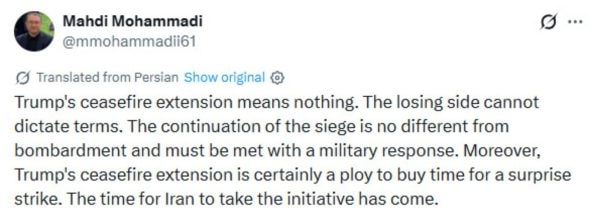
Senior Iranian figures have gone further. Mahdi Mohammadi, adviser to speaker Mohammad Bagher Ghalibaf, called Trump’s move ‘meaningless’ and “a ploy to buy time for a surprise strike”. Moreover, he took a serious jibe at the US, saying, “the losing side cannot dictate terms” in the war.
Story continues below this ad
Trump continues mix of pressure and optimism
US President Donald Trump claimed Iran is “collapsing financially” and losing “$500 million a day” due to the blockade, while insisting the US is negotiating from a position of ‘strength’. Just a day earlier, he had warned of possible military escalation within 48 hours before reversing course and extending the ceasefire.
Global and economic ripples already visible
Oil prices fluctuated sharply before easing after the ceasefire extension, while the UK reported inflation rising to 3.3% amid early war impact. Greece has announced €500 million in aid to cushion households from the crisis.
Meanwhile, the UN has called the ceasefire extension “an important step toward de-escalation”, urging all sides to avoid actions that could undermine talks.
The bottom line
Day 54 reflects a fragile pause rather than a turning point: a ceasefire extended on paper, but contested in practice, with attacks at sea, stalled diplomacy, and both sides signalling readiness for either negotiation or escalation.