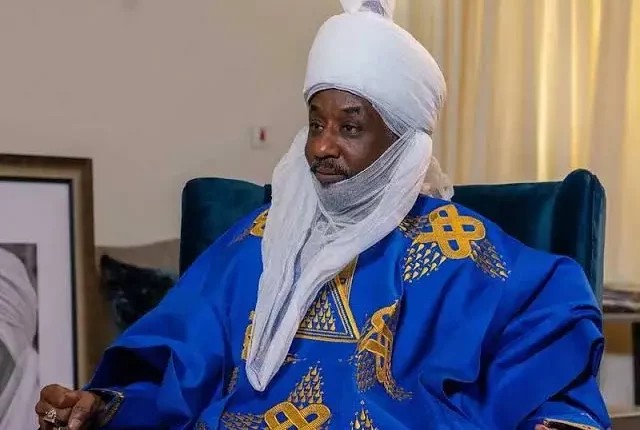
The 16th Emir of Kano, Muhammadu Sanusi II, has raised concerns over the Federal Government’s continued borrowing despite the removal of petrol subsidy, warning that the gains of recent economic reforms may be undermined by weak fiscal discipline.
Sanusi, a former governor of the Central Bank of Nigeria, spoke in an interview aired by News Central TV on Friday, where he acknowledged that the removal of fuel subsidy and the liberalisation of the foreign exchange market were necessary steps but faulted their timing and implementation.
According to him, while the reforms were inevitable, the absence of complementary fiscal measures and tight monetary policies had weakened their intended impact on the economy.
“I have always said the subsidy regime was unsustainable. We cannot continue supporting foreign refineries while neglecting our domestic capacity,” he said.
He noted, however, that recent developments in local refining marked a positive shift, with Nigeria moving from heavy dependence on imported petroleum products to becoming an exporter.
“Today, we have our own domestic refinery. We’re no longer importing petroleum products; we are even exporting to Europe, and that is good for the economy,” Sanusi added.
Despite this progress, the monarch expressed reservations about the sequencing of policy decisions, particularly the liberalisation of the exchange rate in what he described as a “loose monetary environment.”
He warned that such an approach contributed to the sharp depreciation of the naira, stressing that tightening money supply should have preceded exchange rate reforms.
“Artificial exchange rates, especially when you are printing money, cannot work. But if you liberalise in a loose monetary environment, the naira will drop significantly. That was a timing issue,” he said.
Sanusi also questioned why the government continued to accumulate debt after eliminating subsidy payments, arguing that the policy should have created fiscal space and reduced borrowing needs.
“If you’re not paying subsidy and you’ve got the money, why are we still borrowing? What are we borrowing for?” he asked.
He stressed the need for fiscal consolidation, insisting that savings from subsidy removal should translate into reduced deficits rather than increased debt.
The concerns come amid rising public debt levels, with the Federal Government recently increasing its 2026 borrowing plan by N11.31tn to a total of N29.20tn.
President Bola Ahmed Tinubu has also sought legislative approval for additional external loans, including $516m for infrastructure projects such as the Sokoto-Badagry Superhighway.
Sanusi’s remarks add to growing scrutiny from economists and opposition figures over the sustainability of the country’s debt profile and the overall management of post-subsidy economic reforms.
FOLLOW US
FOR MORE HERE