By Daniel Oluwatobiloba Popoola
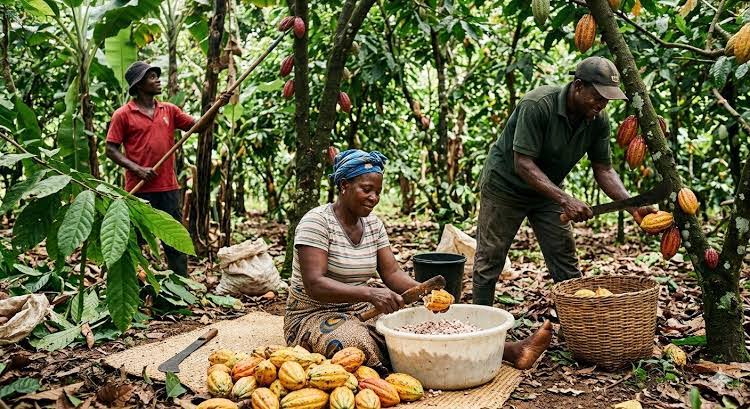
African cocoa farmers have raised fresh concerns over persistently low earnings despite the continent’s dominance in global production, warning that the widening gap between output and profit continues to threaten livelihoods.
Speaking on Wednesday, 8 April, 2026, the Global President of the Cocoa and Coffee Farmers Alliance Association of Africa (COCEFAAA), Adeola Adegoke, said the situation remains dire even as West and Central Africa account for about 70 per cent of global cocoa production.
He noted that many smallholder farmers still earn less than one dollar per day, underscoring deep-rooted structural imbalances in the value chain, while announcing a three-year development plan scheduled for unveiling on Thursday,9 April , 2026.
Adegoke stated that Africa’s contribution to cocoa and coffee production has not translated into fair economic returns, stressing that the continent earns less than 10 per cent of the global cocoa and chocolate market value, while capturing only about three per cent of global coffee revenues.
“Despite Africa’s dominant production, the continent earns less than 10 per cent of the global cocoa and chocolate market value, while the coffee sector captures roughly three per cent of global revenues, even though Africa is the historical birthplace of coffee,” he said.
He attributed the disparity to limited processing capacity, climate-related pressures, and the impact of pests and diseases such as Cacao Swollen Shoot Virus.
Moreover, he noted that strict international compliance requirements continue to constrain farmers’ access to premium markets.
According to him, the alliance’s three-year plan is aimed at reversing the trend by promoting sustainable production, improving yields, strengthening cooperatives, and investing in local processing and value addition.
“The reality is that Africa exports raw cocoa and coffee while most of the value is captured overseas,” Adegoke said. “Our farmers work tirelessly, but the returns remain disproportionately low. This plan is about changing that narrative.”
Meanwhile, he pointed out that some countries are already taking steps to retain more value. Côte d’Ivoire, he said, has emerged as the world’s leading cocoa grinder, processing nearly 800,000 tonnes locally. Similarly, Ghana is targeting the local processing of 50 per cent of its cocoa output while implementing traceability systems.
Furthermore, Adegoke explained that the COCEFAAA plan seeks to scale these efforts across the continent, with a target of increasing Africa’s share of the global coffee market to 20 per cent by 2030.
It also aims to boost domestic consumption and secure sustainable incomes for smallholder farmers.
He maintained that coordinated action among governments, industry players and international partners will be critical to strengthening value retention and ensuring long-term stability in Africa’s cocoa and coffee sectors.