

The federal government, on Thursday, inaugurated a high-level, multi-agency technical committee to rigorously assess the proposed $200 billion Integrated Gas, Power and High-Speed Rail Project.

The ambitious initiative, anchored on President Bola Ahmed Tinubu’s Renewed Hope Agenda, was unveiled in August 2025 as a transformative blueprint aimed at simultaneously overhauling Nigeria’s energy landscape, deepening gas sector industrialisation and revolutionising nationwide transport connectivity.
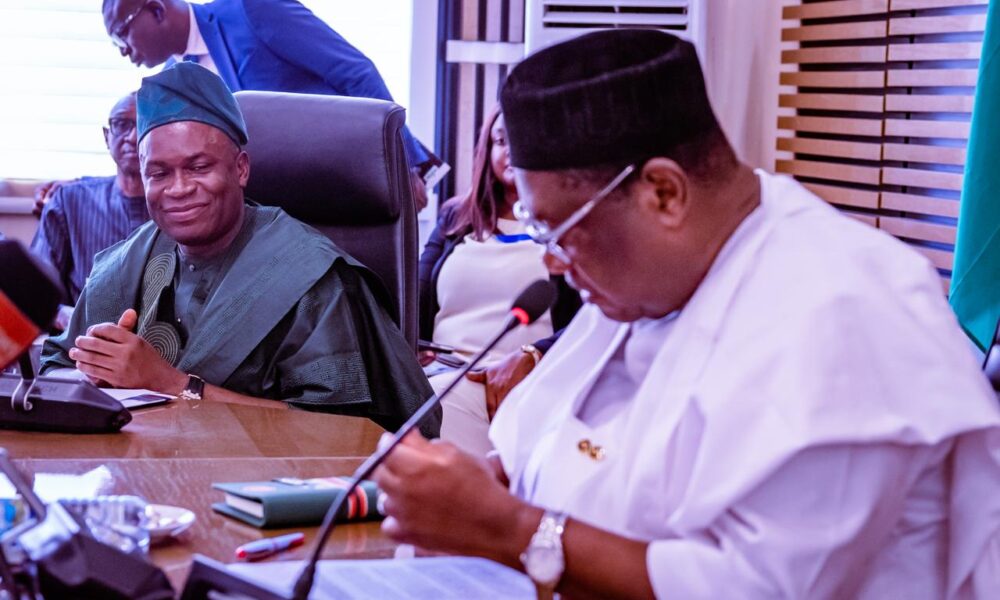
Secretary to the Government of the Federation, Senator George Akume, who inaugurated the committee, described the proposal submitted by De-Sadel (Nig.) Limited in partnership with China Liancai Petroleum Investment Holdings Limited, as “too large and too consequential” to be fast-tracked without due diligence.
He noted that the multi-phase project integrates gas development, power generation and transmission, alongside the construction of a 4,000-kilometre high-speed rail corridor linking major economic hubs including Lagos, Abuja, Kaduna, Kano and Port Harcourt.
“These types of projects can significantly transform transport infrastructure, enhance energy security, stimulate industrial growth and strengthen national cohesion.
“However, they must be carefully interrogated to ensure alignment with national priorities, technical integrity, financial viability, and full compliance with legal and regulatory standards,” he said.
According to him, preliminary inputs from security, financial intelligence and regulatory agencies, particularly regarding the consortium’s financing structure and corporate profile, necessitated a coordinated and comprehensive technical review.
The SGF urged members to discharge their responsibilities with professionalism and patriotism, noting that their findings would guide critical decisions at the highest levels of government.
He said the inauguration marks only the beginning of a broader evaluation process that will culminate in evidence-based recommendations.
Reaffirming the government’s stance, the SGF stressed that while infrastructure development remains a key driver of economic growth, it must be pursued with transparency, accountability and strict due diligence, especially in projects involving complex foreign partnerships.
The committee, chaired by the Permanent Secretary, Political and Economic Affairs Office in the Office of the SGF, draws membership from key ministries and institutions, including transportation, petroleum resources, finance, justice and environment, as well as the Central Bank of Nigeria, Nigeria Financial Intelligence Unit, Economic and Financial Crimes Commission, National Intelligence Agency, Office of the National Security Adviser and the Debt Management Office.
Its mandate includes verifying proof of funds, evaluating financial and sovereign risk exposure and assessing potential contingent liabilities.
It is also tasked with reviewing the proposed oil-and-gas-backed financing model, including any asset divestment plans and conducting detailed technical due diligence on the consortium and its engineering partners, notably China Railway Group Limited and China Railway Engineering Corporation.
The committee is expected to ensure compliance with Public-Private Partnership (PPP) frameworks, particularly in areas of risk allocation, environmental safeguards and resettlement obligations.
Providing an overview of the proposal, Managing Director of De-Sadel Nigeria Limited, Samuel Ukoh, described the initiative as a “national infrastructure reset.”
He disclosed that the first phase of the rail network will cover approximately 1,700 kilometres, linking Lagos, Abuja, Kano and Port Harcourt across more than 20 states.
The system, he said, is designed for speeds of up to 350 kilometres per hour, potentially reducing travel time between Lagos and Abuja to about two and a half hours, while cutting Abuja–Kaduna trips to under 30 minutes.
He explained that much of the rail infrastructure would be constructed on elevated bridges to adapt to Nigeria’s terrain and climate, with integrated fibre-optic and power transmission lines embedded within the same structure, effectively merging transport, energy and digital infrastructure.
He said that the project would generate over two million jobs while significantly boosting both the gas and power sectors.
Emphasising the centrality of gas to the entire framework, Ukoh noted that existing supply constraints remain a major bottleneck, adding that his firm plans to partner with multinational oil companies to ramp up production in the short term.
“Nigeria is richly endowed with gas resources, but availability remains the challenge,” he said, expressing confidence that targeted investments could scale up production within months.
He also revealed that the project has already passed several regulatory milestones, including conditional outline business case approval, gas availability certification and environmental assessments.
He said key approvals such as operational licences, right-of-way access and final concession agreements remain outstanding and will form part of the committee’s review.
Ukoh maintained that the consortium has submitted proof of funds and recently concluded its final investment decision process in China, asserting that regulatory compliance is nearing completion.