Chief executive Sundar Pichai said the company plans to invest between $175 billion and $185 billion in capital expenditures this year, compared with $31 billion in 2022. The investment is aimed at building infrastructure for what he called the “agentic era” of artificial intelligence.
“As we move into the agentic era, we are taking this to the next level,” Pichai said. “We are making big investments now and for the future.”
The move reflects competition with Microsoft, Amazon, and OpenAI, as companies shift from chatbots to autonomous AI agents that can complete tasks with limited human input.
Internal use of agentic AI
Pichai said Google is already using AI agents in its own operations.
“Today, nearly 75% of all new code at Google is AI-generated and approved by engineers, up from 50% last fall,” he said. “We are now shifting to truly agentic workflows.”
He said human engineers still review AI-generated code. Google is also applying AI in cybersecurity operations to process large volumes of threat data and respond faster.
“Each month, our teams receive unstructured threat reports at a scale that will take thousands of hours to review—a nearly impossible task,” he said. “Today, our security operation center agents automatically triage tens of thousands of unstructured threat reports each month by accelerating the extraction of critical intelligence and filtering out the noise. It’s reduced threat mitigation time by over 90%; we are more on the front foot than ever before.”
Launch of agentic platform and ecosystem support
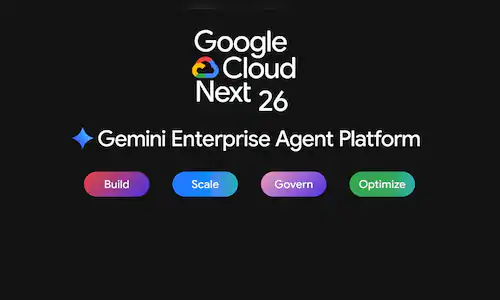
Google introduced the Gemini Enterprise Agent Platform, which it said helps organisations build, deploy, and manage AI agents at scale.
The company also announced a $750 million fund to support its 120,000-member Google Cloud partner ecosystem. The program offers engineering support, early access to Gemini models, and incentives for firms including Accenture, Deloitte, and McKinsey & Company.
At the event, Citigroup introduced “Citi Sky,” an AI-based wealth management assistant for U.S. clients. Thinking Machines Lab said it expanded its use of Google Cloud’s AI Hypercomputer to speed up research and model training.
“One thing that is super clear: We are firmly in the agentic Gemini era,” Pichai said. “The conversation has gone from ‘Can we build an agent?’ to ‘How do we manage thousands of them?’”
Infrastructure and NVIDIA partnership
Google said its long-term collaboration with NVIDIA underpins the platform. The companies co-develop AI systems across hardware, software, and cloud services to support agentic and physical AI.
New infrastructure includes A5X instances powered by NVIDIA Vera Rubin systems, NVIDIA Blackwell and Blackwell Ultra GPUs, and confidential computing features. Google said these systems improve performance and support large-scale AI workloads, including training, inference, and simulations.
The platform supports both proprietary and open models, including Gemini, Gemma, and NVIDIA Nemotron. It also includes managed training tools built with NVIDIA NeMo for reinforcement learning and model customisation.
Adoption and use cases
Google said companies, including OpenAI, are using its infrastructure for large-scale inference workloads. CrowdStrike uses related tools for cybersecurity applications.
The company said the platform also supports industrial and physical AI, including robotics and digital twins. Software providers such as Cadence and Siemens Digital Industries Software offer applications on this infrastructure.
Google said enterprises and startups, including Snap Inc., Schrödinger, and Salesforce, are using the platform to move AI systems into production.
The company added that more than 90,000 developers joined its joint developer community with NVIDIA in just over a year.