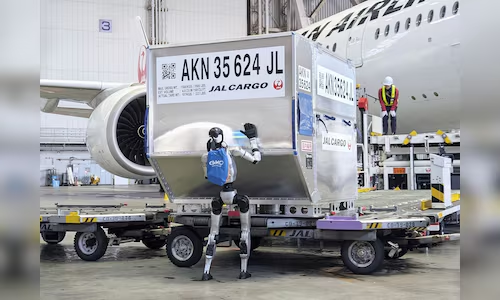
Ground handling includes aircraft towing, baggage and cargo loading and unloading. These operations depend heavily on manual work. Staff must handle different types of Ground Support Equipment (GSE) in tight spaces near aircraft. Existing automated systems and single-purpose robots have struggled to adjust to these conditions and workflows.
The companies say humanoid robots could offer a solution. Their human-like design allows them to operate in the same environments as workers without major changes to airport infrastructure or aircraft.
Japan Airlines will trial humanoid robots for baggage handling and aircraft cleaning at Tokyo’s Haneda Airport starting in May, citing workforce shortages and rising tourist numbers pic.twitter.com/XJ9ImcN3UO
— Reuters (@Reuters) April 29, 2026
Why airports are turning to humanoid robots now
Japan’s aviation sector is facing a labour shortage. This is driven by a rise in inbound tourism and a shrinking working-age population. Ground handling work requires trained staff and involves physical strain.
Data from the Japan National Tourism Organisation shows more than 7 million visitors arrived in the first two months of 2026. The country recorded 42.7 million visitors in the previous year. Estimates suggest Japan may need over 6.5 million foreign workers by 2040 to maintain growth.
Tomohiro Uchida said: “While airports appear highly automated and standardised, their back-end operations still rely heavily on human labour and face serious labor shortages.”
The companies say the trial will examine whether humanoid robots can help reduce labour demand and physical workload while maintaining safety standards.
What the robots will do and how the trial will work
The demonstration will be carried out in phases starting May 2026. First, airport operations will be mapped and analysed to identify where robots can work safely. Then, tests will be conducted in simulated airport environments. Robots will only be introduced into real operations after these steps.
The robots are expected to support tasks such as moving baggage and cargo, cleaning aircraft cabins, and potentially operating GSE in the future.
In a media demonstration, a humanoid robot about 130 cm tall was seen moving cargo onto a conveyor belt and interacting with workers. The machines can operate for two to three hours per charge.
Yoshiteru Suzuki said robots handling physically demanding work would “inevitably reduce the burden on workers and provide significant benefits to employees”. He added that critical tasks such as safety management will remain with human workers.
The bigger picture: Why humanoids are seen as the next AI frontier
Japan Airlines and its partners aim to build a sustainable operating model where robots support human workers. The project combines AI systems with machines designed to move like humans.
The GMO Internet Group has designated 2026 as the “First Year of Humanoids”. The companies say the trial is part of a broader push to expand the use of AI and robotics across industries.
Humanoid robots are being developed as general-purpose machines. Unlike fixed industrial robots, they can adapt to different tasks in human-designed environments. This makes them relevant for sectors such as aviation, where workflows are complex and change frequently.