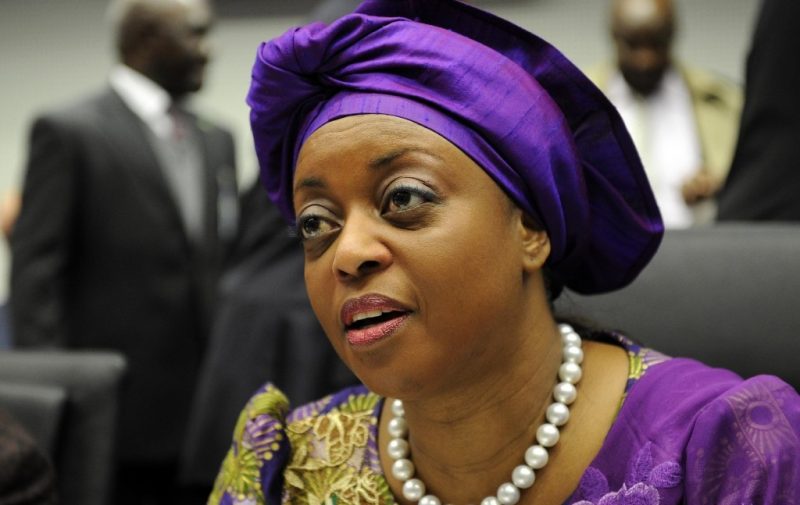
The former minister told the UK court on Wednesday that decisions on contracts were processed through multiple agencies before reaching her desk.
Nigeria’s former Petroleum Minister, Diezani Alison-Madueke, on Wednesday said she had limited direct control over the award of oil contracts during her tenure as minister.
Testifying on Day 18 of her trial, Mrs Alison-Madueke told the Southwark Crown Court that her role was largely procedural within a complex bureaucratic system.
The minister said decisions on contracts were processed through multiple agencies before reaching her, arguing that “the choice had been made” by the time files got to her desk.
According to her, operational authority in the oil sector rested primarily with the Group Managing Director of the Nigerian National Petroleum Corporation (NNPC), while the ministry exercised oversight functions.
Mrs Alison-Madueke said the scale and complexity of Nigeria’s petroleum industry made direct ministerial control impractical, noting that the sector involved thousands of workers, hundreds of oil fields, and multiple agencies operating under different structures.
“It was not a one-man state,” she explained to the court.
The former minister is standing trial over allegations of corruption, having been charged in 2023 with five counts of accepting bribes and one count of conspiracy to commit bribery.
UK prosecutors say the charges are linked to the awarding of oil and gas contracts during her tenure as petroleum minister between 2010 and 2015.
Mrs Alison-Madueke also served as president of the Organisation of the Petroleum Exporting Countries between 2014 and 2015. She relocated to the United Kingdom after the defeat of the Peoples Democratic Party in Nigeria’s 2015 presidential election. She also faces multiple corruption cases in Nigeria, some of which have stalled due to her absence.
Nigerian courts, however, have ordered the forfeiture of assets worth billions of naira linked to her.
In January, PREMIUM TIMES reported how Mrs Alison-Madueke’s lavish UK lifestyle was opulently funded by Nigerian oil contractors.
Prosecutors allege that several Nigerian businessmen funded lavish expenses on her behalf, including more than £2 million spent at Harrods and about £4.6 million used to refurbish properties in London and Buckinghamshire.
According to the prosecution, some of the purchases were made using payment cards linked to Nigerian businessman Kolawole Aluko and his company, Tenka Limited.
The case also includes allegations that she had access to luxury properties, including a £2.8 million home in Marylebone and residences overlooking Regent’s Park, as well as a “grand” home in Buckinghamshire.
During her appearance in court on Tuesday, the former minister denied all allegations. Mrs Alison-Madueke told the court that expenses incurred on her behalf during official engagements were reimbursed by the NNPC.
“I can state categorically that at no point did I ask for, take or receive a bribe of any sort… and did not abuse my office,” she said, according to BBC.
She explained that a logistics company was set up in London to handle official arrangements because of what she described as a disorganised financial structure at the NNPC at the time.
The former minister argued that she rejected only about one to two per cent of contracts during her tenure, adding that it was rare—and often politically sensitive—to interfere with transactions that had already been approved.
She also told the court that in 2014, she uncovered an alleged crude oil lifting arrangement involving multiple firms, which she said was linked to businessman Igho Sanomi.
She said she moved to cancel the contracts following a whistle-blower alert but faced resistance, including complaints to then President Goodluck Jonathan.
Ms Alison-Madueke revisited the $20 billion oil revenue controversy linked to former Central Bank governor Sanusi Lamido Sanusi, telling the court the issue had been misrepresented in public discourse.
She said what was initially described as “missing money” was later clarified through audits and legislative reviews as comprising subsidy payments and operational costs.
She maintained that she was unfairly linked to allegations of theft, describing the media coverage as politically motivated and damaging to her reputation.
On subsidy administration, she said investigations revealed abuses within the system, including “round-tripping,” where marketers allegedly submitted multiple claims for payment.
She told the court she reported the findings to anti-corruption agencies and introduced reforms in the downstream sector, which she said reduced subsidy claims but also exposed her to threats.
In an emotional moment, it was reported that Mrs Alison-Madueke said resistance to her reforms put her family at risk, recounting the abduction of her younger sister in 2013 and a separate incident involving her nephew.
She also said her son required military protection to attend school due to security concerns.
The former minister further alleged that political and business figures frequently sought favours from her office in relation to oil allocations and financial matters, citing a letter from businessman and politician Ifeanyi Ubah as an example. She said she rejected such requests.
On her personal finances, Mrs Alison-Madueke acknowledged using credit cards issued by Nigerian banks, including Zenith Bank and United Bank for Africa, and confirmed that some transactions were carried out abroad during official trips.
She said Nigerian ministers were not permitted to operate foreign accounts, which sometimes created logistical challenges during overseas engagements.