“I believe a Basra–Ceyhan pipeline could be extremely attractive and a very important project for both Iraq and Turkey, as well as for regional supply security—especially from Europe’s perspective,” Birol said in an interview with Hürriyet, published on Sunday. “I also believe the financing issue can be overcome. Now is exactly the right time.”
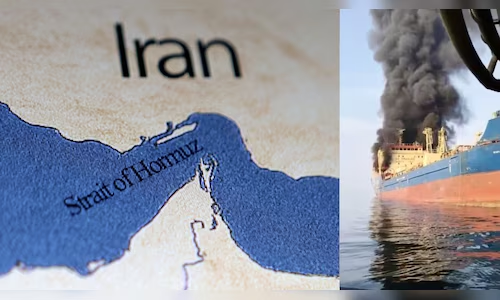
Iran on Saturday reimposed restrictions on vessel traffic in the Strait of Hormuz, less than 24 hours after Tehran declared the waterway open to commercial ships. Several liquefied natural gas tankers reversed course while en route there after Iran warned ship captains that the vital channel was once again closed to maritime traffic.
Iraq relies on Hormuz to export oil from the Gulf port of Basra, which holds one of the world’s largest reserves at around 90 billion barrels and accounts for about 90% of the country’s oil exports, Birol told the newspaper.
“The vase has been broken once, and it’s very difficult to fix,” Birol said, referring to the Strait of Hormuz. A new oil pipeline “is a necessity for Iraq and an opportunity for Turkey. It is also a major opportunity for Europe in terms of supply security. I think this should be considered a strategic project.”
Also Read: Iran doubles down on closing the Strait of Hormuz as the ceasefire inches toward expiration
For such a project, Turkey and Iraq need to reach a political agreement, “which I believe is achievable,” he said, adding that securing financing for the project could also receive support from Europe.
Turkey has already proposed extending a Turkish-Iraqi pipeline between Ceyhan and the Kirkuk oil fields in the north to the south as part of efforts to build a multi-billion-dollar trade route that would stretch from the Faw Port in Iraq’s southern province of Basra to Turkey in the north. Separately, Turkey, Syria and Jordan recently agreed to modernise their railway and highway systems to eventually create a contiguous corridor between southern Europe and the Persian Gulf.
Turkey has emerged as a more viable option after the Israel–Hamas war stalled progress on the India–Middle East–Europe Economic Corridor, a US-backed project to build rail links across the Arabian Peninsula. With Houthi attacks disrupting Red Sea shipping and regional instability rising, the IMEC is effectively on hold.
(Edited by : Juviraj Anchil)