
Former Governor of Kano state and immidiate-past National Chairman of the ruling All Progressives Congress (APC), Dr. Abdullahi Umar Ganduje, has called on governors, development partners and philanthropists to invest more in the Physically Challenged Persons to reduce begging in Northern Nigeria.
Ganduje believe that with more investment in technological gadgets, education is now more easier for those with special needs in the society and they could become more useful to themselves and the society instead of begging.
Speaking Friday in Abuja during the documentary premiere of 10th years of Let’s Talk Humanity (LTH), an organization caring for the education needs of Deaf and Blind, Ganduje decried neglect so many disabled persons in Northern Nigeria, leading to array of beggars.
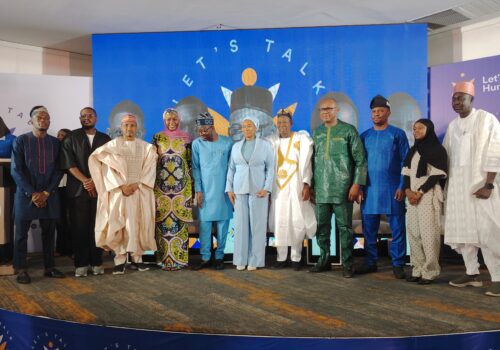
The event brought together experts in disability education, federal and state governments officials, staff, alumni and students of Tudun Maliki Special School, Kano, with a key note speech from the Vice Principal of the School, Ibrahim Abdukabir, on the impact of Let’s Talk Humanity Initiative.
According to the former Governor, in northern part of this country, people with disabilities are so much relegated to the background. That’s why we have an array of beggars across the northern part of this country day and night. Some sleep under bridges, some sleep on the road, this is a sorry story but looking at what we saw this afternoon, you can see that there is a silent revolution if what we have seen could be adopted by our executive governors, development partners and by various philanthropist, there’s no doubt there will be a big change in our society.
“Yes, they are neglected because they are physically challenged. This has affected their psyche, motivation and they cannot even think they are human beings like other beings but unveiling this kind of programme we are making them to be like any other human being in our society.
“Finally, I urge those in authority and development partners to make a great change, t’s fishing.Those physically challenged.Can’t stop begging.They can develop to the extent that they can even be employers of Labour. They can develop to the extent that they can be genius in various fields of endeavors.”
Ganduje, who is the biological father of the founder of Let’s Talk Humanity (LTH), said he knew right from when Fatima was a toddler that she will make impact in the society.
He praised the initiative and called on various government authorities and development partners to invest more in the development of those with special needs in the society.
Also speaking, Minister of Humanitarian Affairs and Disaster Management, Dr. Bernard M. Doro, who commended the initial, emphasised that society must bear in mind that before a programme or device is designed, the People Living with Disabilities should be considered.
According to the minister, inclusion of people with special needs is not an option but an obligation.
“When we develop assisted devices or technology in general this has to be done with People Living with disability in mind.
“You don’t wait until you do it before you begin to adapt it for people to use, and I believe it is an important point to make. We must move towards a future where accessibility is by design, moving away from retrofitting tools towards building universal platforms, digital must be the priority here, technology should empower individuals to navigate the world on their own terms,” the Minister said.
In her speech, the founder of Let’s Talk Humanity, Fatima Ganduje Abiola-Ajumobi, said her organisation has been empowering one thousand beneficiaries every year since 2027.
“Seeing the faces of alumni, members of staff, and supporters of Tudun Maliki here today takes me back to the very beginning 10 years ago—when you trusted me with something so important: the future of your education, and the possibility of change through technology.”
While calling for partners, advocates and people who are willing to move from intention to action, Fatima expressed optimism that the organization will affect more lives positively in the years to come.
She said:” Our projection for the next 19 years is to be able to have a national center, a National Resource Center for those with sensory impairment, to be able to tap into the international knowledge and the international resources that are available in the parts of the world that are much more developed than us when it comes to special needs.”