This is not something that we should treat lightly, because democracy is not destroyed overnight, it is weakened step by step until people begin to feel it no longer works for them,” Governor Makinde said.
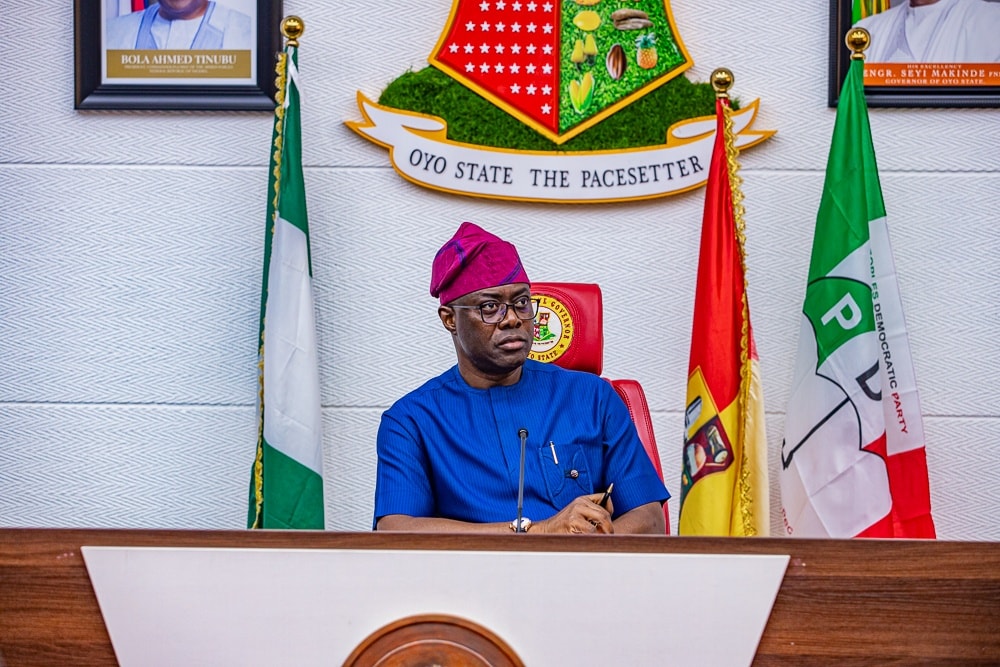
Governor Seyi Makinde has warned that Nigeria risks sliding into a one-party state if opposition parties fail to overcome internal divisions and provide credible alternatives to the ruling government.
Mr Makinde spoke on Saturday in Ibadan while addressing leaders of opposition political parties gathered for a national summit aimed at strengthening collaboration across party lines.
He said recent political developments, including the concentration of power in the hands of the ruling All Progressives Congress (APC), should concern Nigerians, noting that a majority of state governments and legislative structures are now controlled by one party.
“At the same time, opposition parties are increasingly entangled in internal crises and legal battles that raise serious questions about their ability to function effectively. Taken individually, each of these may have its own explanation, but taken together, they point to a pattern where the space for real political competition is disappearing.
“This is not something that we should treat lightly, because democracy is not destroyed overnight, it is weakened step by step until people begin to feel it no longer works for them,” he said.
He also expressed concern over internal crises within opposition parties, which he said have limited their effectiveness and weakened their ability to serve as a check on government.
The governor stressed that democracy thrives on the existence of viable alternatives, adding that the absence of a strong opposition undermines accountability and citizens’ ability to make meaningful political choices.
“Democracy is not defined by the success of one party. It is defined by the existence of real alternatives, by the ability of citizens to choose, and by the confidence that those choices matter. Once that disappears, what we have may still be called democracy, but it will no longer function as one,” he said.
Mr Makinde said the choice of Ibadan as venue for the summit was symbolic, describing the city as a historic centre of political thought and debate in Nigeria. He referenced its role in shaping early constitutional discussions, noting that such engagements remain critical to the country’s democratic development.
The governor dismissed suggestions that the gathering was targeted at any individual or driven by personal ambition. He said it was instead focused on preserving democratic values and ensuring Nigeria remains open, competitive and accountable.
He urged opposition leaders to set aside differences and work collectively to strengthen democratic institutions, warning that weakening opposition, whether by design or neglect, would have consequences for the entire political system.
“It is not a gang up against one man, and it is not about individual ambition to be president. It is about the collective ambition of the Nigerian people to have a democracy that is properly defined.
“This is a gathering about something more fundamental, the survival of a system that allows Nigeria to remain open, competitive, and accountable. Because democracy without opposition is not democracy. It is a slow drift towards a one-party state, and Nigeria must not make that drift. The truth is simple,” he said.
Among those in attendance at the opposition summit are former Minister of Transportation Rotimi Amaechi, former Kano State Governor Rabi Kwankwaso, and former Osun State Governor Rauf Aregbesola.
Also present are Labour Party presidential candidate in the 2023 election Peter Obi, former Senate President David Mark, elder statesman Jerry Gana, a factional chairman of the Peoples Democratic Party (PDP) Saminu Turaki, and political economist Pat Utomi.
Speakers at the summit are expected to address key national issues, including governance, electoral integrity, the economy and security.
Chidi Odinkalu and Usman Bugaje are billed to speak on democratic governance, while Mike Igini will focus on credible elections. Pat Utomi is expected to lead discussions on economic reforms, and Kabir Adamu will examine Nigeria’s security challenges.
Organisers say the sessions are designed to produce coordinated strategies for a more effective opposition.