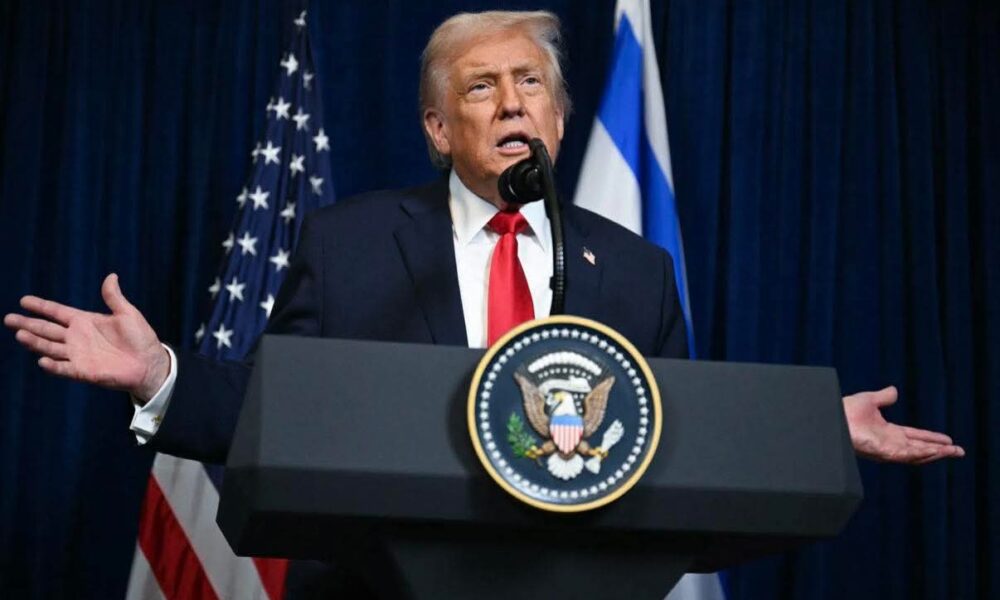

United States President Donald Trump has threatened to destroy critical civilian infrastructure inside Iran, including bridges and power plants, if the Strait of Hormuz is not fully reopened before deadline of Tuesday.
Trump issued the warning in a social media post Sunday, in which he escalated his rhetoric against Tehran with characteristically blunt language.
“Tuesday will be Power Plant Day, and Bridge Day, all wrapped up in one, in Iran. There will be nothing like it!!! Open the…Strait, you crazy bastards or you’ll be living in Hell — JUST WATCH! Praise be to Allah,” he wrote.
The American president later set a specific deadline of 8 pm ET (midnight GMT) on Tuesday, April 7.
The threat marks a significant escalation in the 38-day-old conflict between the United States, Israel, and Iran, which began on 28 February when American and Israeli forces launched their first joint strikes on Iranian territory.
On 26 March, Trump had set a 10-day deadline for Iran to reopen the Strait of Hormuz, the world’s most critical oil shipping corridor, through which traffic has been effectively halted since the outbreak of hostilities.
Iranian officials have firmly rejected the American president’s threats, vowing to retaliate against any strikes on their country’s infrastructure.
“Once again, the US president openly threatens to destroy infrastructure essential to civilian survival in Iran,” Iran’s mission to the United Nations said in a statement on Sunday. “The international community and all states have legal obligations to prevent such atrocious acts of war crimes. They must act now. Tomorrow is too late.”
A senior Iranian official separately told Reuters that Tehran would not reopen the Strait of Hormuz in exchange for a temporary ceasefire, adding that Iran views Washington as not yet genuinely ready to commit to a permanent cessation of hostilities.
The official confirmed that Iran had received Pakistan’s proposal for an immediate ceasefire and was reviewing it, but stressed that Tehran does not accept being pressured into making decisions under externally imposed deadlines.
Despite the bellicose public posturing, Trump told ABC News on Sunday that Iran and the United States were engaged in active negotiations, and that he believed a deal was possible before Tuesday’s deadline.
He warned, however, that military action remained firmly on the table if talks failed.
“If it happens, it happens. And if it doesn’t, we’re blowing up the whole country,” Trump said, adding that he would leave “very little” off the table.
Asked whether he believed American ground troops would be needed, he said: “I don’t think it’s necessary, but I don’t rule anything out.”
The president said he would hold a press conference at the White House on Monday.
A potential diplomatic off-ramp emerged Sunday, with Reuters reporting that Pakistan has submitted a framework to both Iran and the United States aimed at ending hostilities and reopening the Strait of Hormuz.
On the Israeli front, the military said it intercepted a barrage of Iranian missiles that triggered air raid sirens across southern Israel, including in Beersheba.
Israeli news outlet Ynet, stated that a 34-year-old woman sustained serious injuries in Petah Tikvah — in central Israel — when interceptor missiles fell in the area during the latest Iranian strikes.
The IRGC, in a statement reported by Al Jazeera, said Mr Khademi was killed in the early hours of Monday in what it described as a “terrorist attack by the American-Zionist enemy.”
No further details of the operation were provided.
The US lost six aircraft, two planes and four helicopters, in its bid to rescue the pilot of a downed Air Force jet, Reuters reports.
Reuters reported details of the harrowing rescue operation to extract the second crew member of an F-15E Strike Eagle fighter jet shot down over southwestern Iran.
A US official told Reuters that the mission came close to catastrophe when two MC-130 aircraft that had transported approximately 100 special operations forces into rugged terrain south of Tehran suffered a mechanical failure and was unable to take off.
Commanders made the high-stakes decision to send additional aircraft into Iranian airspace to extract the stranded commandos in waves, a choice that left the elite troops waiting in hostile territory for several tense hours. (Premium Times)