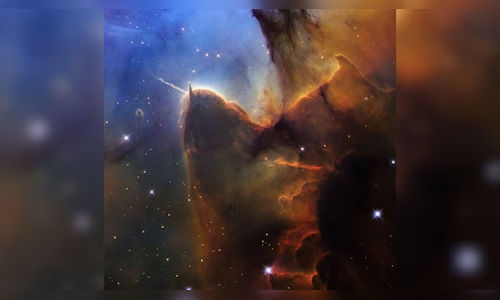
The release coincides with 36 years since Hubble’s launch on 24 April. It highlights a small yet highly active part of the nebula where new stars are currently forming.
What the image shows
The close-up reveals a cloud of gas and dust sculpted by powerful stellar winds from nearby massive stars. Although these stars are not visible in the image, they have shaped the region for approximately 300,000 years. Their energy compresses gas and dust, creating conditions favourable for star formation.
5,000 light-years from Earth, stars are forming in the Trifid Nebula. Our orbiting @NASAHubble telescope is taking a close look: https://t.co/gkoaV8e64M pic.twitter.com/iq7orzmKub
— NASA (@NASA) April 20, 2026
NASA notes that the scene resembles an underwater view, with clouds of material drifting like particles in the ocean.
A “cosmic sea lemon” in space
One feature in the image resembles a sea slug—often referred to as a “sea lemon”. This structure consists of dense gas and dust and is an active site of star formation.
Within it are young, still-forming stars known as protostars. Some of these objects emit jets of material into space, offering scientists valuable insight into how stars develop and interact with their surroundings. One such jet, called Herbig–Haro 399, can be seen extending from a young star.
Changes observed over time
Hubble previously observed this same region in 1997. By comparing past and present images, scientists are now able to track changes within the nebula over time.
This allows them to measure the speed at which material moves and estimate how much energy young stars release. The latest observations also benefit from upgraded instruments installed during later servicing missions, enabling clearer and wider views.
Light, dust and colour
The different colours in the image illustrate how light interacts with gas and dust:
- Blue regions indicate areas cleared by intense radiation
- Yellow and orange show glowing gas influenced by nearby stars
- Dark regions mark dense dust clouds where new stars may still be forming
Some bright orange points represent fully formed stars that have already cleared their immediate surroundings.
What happens next in the nebula
Over millions of years, radiation from stars will gradually disperse the gas and dust within the nebula. What remains will be the stars formed from this material.
Certain regions are so dense that they completely block visible light, meaning stars within them may still be hidden from view.
Hubble’s long mission
The Hubble Space Telescope has been in operation for more than three decades, completing over 1.7 million observations and contributing to thousands of scientific studies.
NASA continues to use Hubble alongside newer observatories such as the James Webb Space Telescope to study the universe in greater detail. Future missions, including the planned Nancy Grace Roman Space Telescope, are expected to expand this work further.
NASA says images like this play a crucial role in helping scientists understand how stars form and how they shape their cosmic environments.