Kano is the only state to meet Nigeria’s 26 per cent education benchmark in 2026, but Katsina and Jigawa stand out for strong Almajiri funding and reforms, signalling a shift in tackling out-of-school children.
An analysis of 2026 budgets across Nigeria’s North-west region shows that Kano State leads overall education allocation, while Jigawa and Katsina emerge as frontrunners in targeted funding and reforms for Almajiri education, locally known as Tsangaya schools.
The review by PREMIUM TIMES also indicates that although most states increased education allocations, uneven 2025 budget performance continues to raise concerns about implementation.
Nigeria’s National Policy on Education prescribes a 26 per cent allocation to education, while the National Policy on Enhancement of Almajiri Education (2025) mandates structured funding for integrating Almajiri children into formal learning systems.
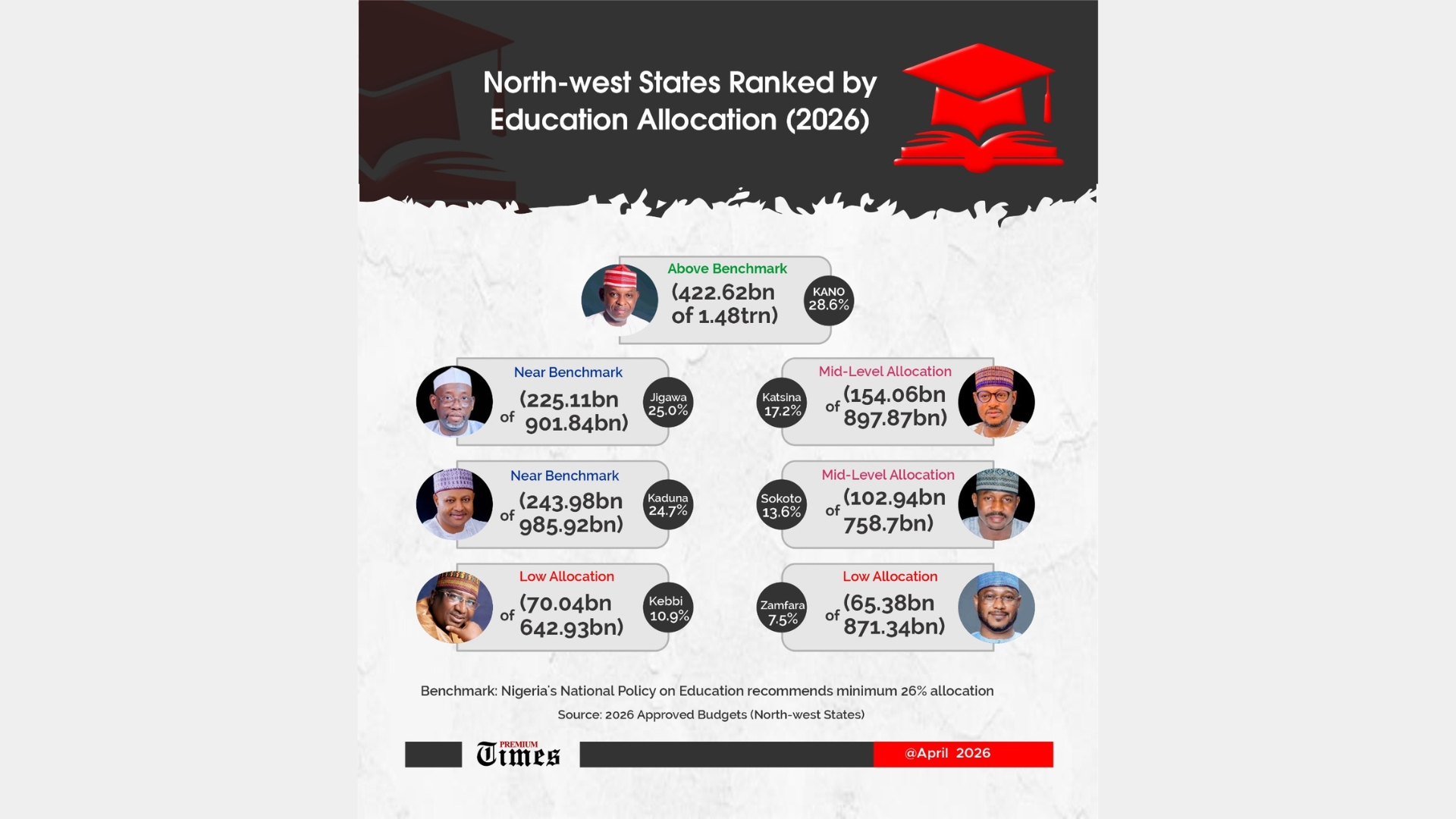
In 2026, Kano, led by Governor Abba Yusuf, allocated 28.6 per cent of its N1.48 trillion budget to education, the only state in the region to meet the national benchmark.
The state also budgeted for multiple Almajiri projects and programmes, including school renovation, feeding initiatives, and teacher training, with a combined allocation of N2.81 billion.
However, its 2025 budget performance is 53.7 percentage points below budget, indicating a gap between budgetary intent and delivery.
Jigawa State, under Governor Umar Namadi, allocated 25 per cent of its N901.84 billion 2026 budget to education. This narrowly missed the benchmark but shows a strong commitment to Almajiri education through the Tsangaya system.
The state provides N3.6 billion in capital allocation for Tsangaya education and maintains a dedicated Tsangaya Education Board to drive reforms.
According to the state’s 2026 budget document, the Namadi administration is committed to making “substantial investments” in Tsangaya and mass education to reduce the number of out-of-school children in the state.
This aligns with ongoing reforms integrating Qur’anic learning with literacy, numeracy, and vocational training, which the administration said over 1.3 million pupils are already within the system.
The government also said it is planning to recruit hundreds of teachers to strengthen Tsangaya education.
A review of its 2025 performance raises optimism over the release of funds for the 2026 projects. The state devoted 25.7 per cent of its N756.3 billion budget to education and achieved an 83.3 per cent spending performance, backed by 83 per cent revenue realisation.
Kaduna State, led by Governor Uba Sani, allocates 24.7 per cent of its N985.92 billion 2026 budget to education and includes targeted Almajiri interventions, such as funding for bilingual and boarding schools.
Still, its 2025 performance stood at 55 per cent, suggesting that even with improved allocations, delivery constraints may persist.
Katsina State, led by Governor Dikko Radda, allocates 17.2 per cent of its N897.87 billion 2026 budget to education.
Notably, the state provides N4.33 billion for Almajiri education, which it tagged as Tsangaya schools in its budget—one of the most substantial allocations in the region.
In 2025, the state recorded 61.8 per cent budget performance, indicating moderate execution capacity.
Kebbi State, under Governor Nasir Idris, allocates just 10.9 per cent of its N642.93 billion 2026 budget to education.
A review of the 2026 budget did not show results for projects or programme interventions specific to Almajiri or Tsangaya education, despite Kebbi being ranked highest in out-of-school children in Nigeria.
Its 2025 data shows 9.6 per cent allocation to education in a N580.33 billion budget, with 66.3 per cent performance from a revenue base of N275.39 billion, reflecting moderate execution.
Sokoto State, under Governor Ahmed Aliyu, allocates 13.6 per cent to education in its N758.7 billion 2026 budget.
Ranked second-highest among states in out-of-school children in Nigeria, the state stands out in 2026 for creating an institutional framework for Almajiri education and introducing new interventions that, if implemented, may address its out-of-school crisis. It established an “Agency for Almajiri Matters” and other projects amounting to N851.5 million.
However, Sokoto’s 2025 budget performance raises red flags. From a 14.5 per cent allocation in the N526.88 billion budget, only 14.7 per cent was spent, despite revenue of N449.84 billion, suggesting severe implementation challenges.
Zamfara State, led by Governor Dauda Lawal, allocates just 7.5 per cent of its N871.34 billion 2026 budget to education, the lowest in the region, but includes N1 billion Almajiri-focused programmes.
In 2025, the state devoted 10.6 per cent of its N498.68 billion budget to education and recorded 50.7 per cent performance, with revenue achieving only 56.7 per cent of projections, pointing to fiscal constraints affecting delivery.
Although Kano State is the only State in the region to have met the education benchmark of 26 per cent, most States in the region have far higher education budgets than their counterparts in the South-South.
PREMIUM TIMES had reported that in South-south, only Delta State exceeded 10 per cent in its education budget.
Almajiri is a system of Islamic education practised in northern Nigeria, where young children leave their homes to live with Islamic scholars and learn about religion.
However, the system has, over the years, been corrupted, with thousands of such children roaming the streets of Northern Nigeria as beggars and without any form of education.
The system is blamed for significantly contributing to the millions of out-of-school children in Northern Nigeria.