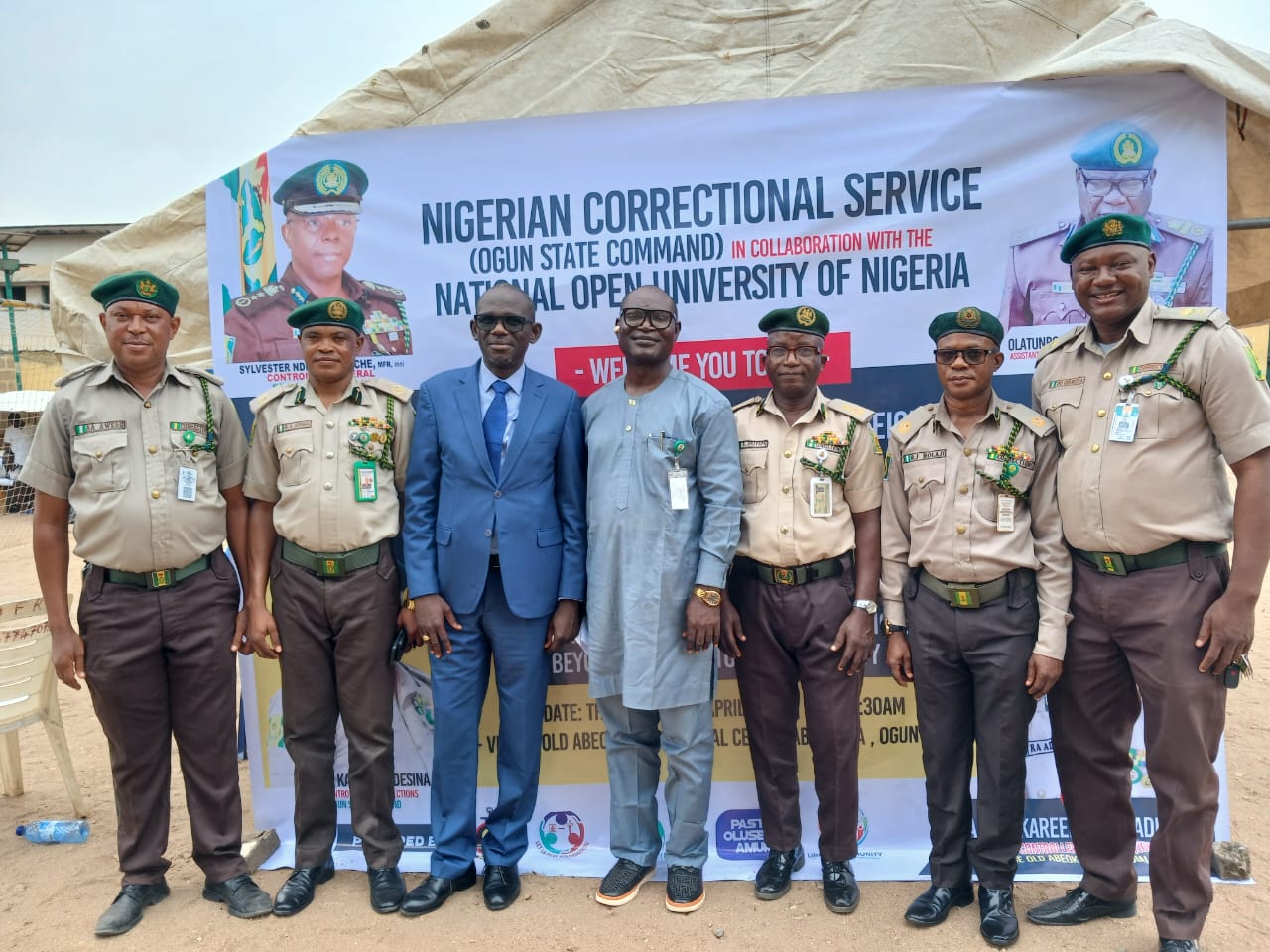
The National Open University of Nigeria has matriculated 58 inmates of the Nigerian Correctional Service, Ogun State Command, as part of efforts to promote rehabilitation and reintegration through education.
The matriculation ceremony, held at the Ibara Custodial Centre in Abeokuta on Thursday, underscored the growing role of open and distance learning in expanding access to education, particularly among underserved populations, including inmates.
Speaking at the event, the Vice-Chancellor of NOUN, Prof. Uduma Oji Uduma, represented by a senior official, described the occasion as “a moment of awakening,” stressing that education remains a powerful tool for overcoming limitations and transforming lives.
Uduma said the university was founded on the principle that education should not be restricted by circumstance, noting that NOUN continues to provide opportunities for diverse groups, including workers, rural dwellers, and persons in correctional facilities.
He urged the newly admitted students to embrace discipline and take full responsibility for their academic journey, adding that open and distance learning has become the future of global education.
“The flexibility of this system demands commitment and self-direction. Success here is earned, not imposed,” he said.
Highlighting the institution’s reach, the Vice-Chancellor disclosed that over 25,000 students were matriculated nationwide in the 2026 academic session across undergraduate and postgraduate programmes, reflecting NOUN’s expanding footprint.
Also speaking, the Ogun State Controller of Corrections, Abioye Adesina, represented by Deputy Controller of Corrections, Oriyemi, described the initiative as a “triumph of the human spirit over circumstance.”
He said the Nigerian Correctional Service had shifted from a punitive system to one focused on rehabilitation, adding that education plays a critical role in reducing recidivism and preparing inmates for life after incarceration.
“By choosing to study while in custody, you have demonstrated that your present situation does not define your future. You have exchanged the bars of limitation for the tools of liberation,” he said.
The controller urged the inmates to remain disciplined and make productive use of the opportunity, noting that many outside the correctional facilities lack access to such educational privileges.
The Ogun State Attorney General and Commissioner for Justice, while speaking with journalists during the event, commended the initiative, describing it as a critical intervention in the justice sector.
He noted that education remains a key pillar in the state’s correctional reforms, stressing that empowering inmates with knowledge and skills would enhance their chances of successful reintegration into society and reduce recidivism.
In a lecture titled “Preparing for Life After Incarceration: Beyond the Bars to Sustainability,” a welfare officer, Awesu Abdulhakeem Ayoola, emphasised the need for early and structured reintegration planning.
Ayoola identified key challenges facing ex-inmates after release, including stigma, unemployment, and psychological trauma, stressing that education and vocational training significantly improve post-release outcomes.
He outlined four pillars for sustainable reintegration: immediate post-release stabilisation, economic empowerment, psychological and social support, and long-term personal development.
According to him, access to housing, employment, mental health services, and supportive social networks are critical to preventing a return to crime.
“Every module completed and every examination passed is a step away from stigma and a move towards societal acceptance,” he told the inmates.
The event highlighted ongoing collaboration between NOUN and the Nigerian Correctional Service to expand educational access within custodial centres, positioning learning as a central strategy for rehabilitation and public safety.
FOLLOW US