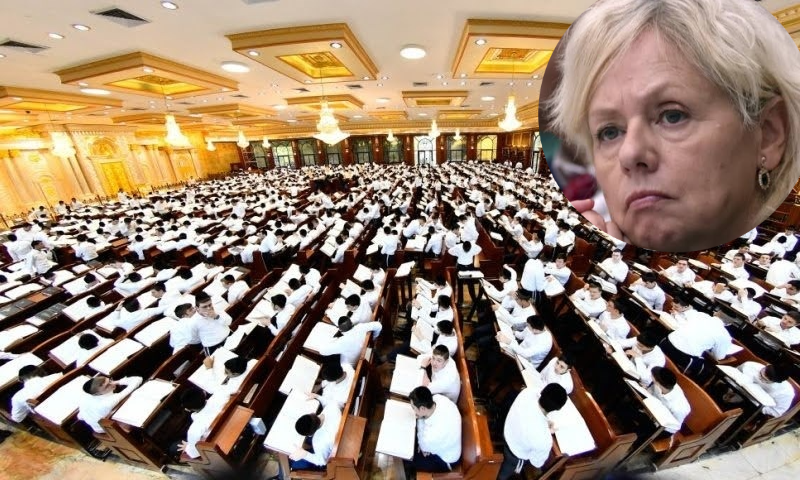
The Emes L’Yaakov B’Yisrael organization filed a petition to the Supreme Court on Thursday, demanding an immediate halt to the “economic punishment campaign” against Chareidi families, which is being advanced by Attorney General Gali Baharav-Miara without any legal basis.
The petition describes what it calls a distorted legal reality: while every citizen in the state is protected by Israeli law, based on the principle that penalties are only implemented after legislation and due process, the Attorney General has assumed the roles of legislator, judge, and executioner regarding the Chareidi public, introducing sanctions without explicit legal authorization.
The main argument in the petition is the fact that the proposed sanctions—some of which are already being implemented—include the removal of daycare subsidies, education funding, property tax discounts, and National Insurance benefits—have no basis in any law passed by the Knesset and amount to “punishment without trial.”
According to the organization, this constitutes imposing economic punishment without legal proceedings by an administrative authority rather than a judicial one. “Her role does not grant her authority to create new punitive norms or instruct government agencies to act contrary to the law,” the petition states.
Moreover, the petition highlighted the “double enforcement” against Chareidim. Under the existing Security Service Law, draft evasion is already subject to criminal proceedings and potential imprisonment, and Baharav-Miara is adding her own harsh system of civil and economic sanctions not formally enacted by the Knesset that she has no authority to impose.
A separate section of the petition focuses on the harm to families as a tool of political pressure, including the revocation of housing benefits such as eligibility for subsidized housing programs and the imposition of heavy taxation on the purchase of an apartment, as well as the cancellation of municipal tax discounts and daycare subsidies—steps described as collective punishment against women and children who have committed no offense.
The petition states that even the families of terrorists and murderers cannot be denied housing or welfare support, referencing a previous Supreme Court ruling that held that the children of terrorists should not be stripped of benefits despite the fact that such measures would provide deterrence for acts of terror. The petition raises the question of whether a Chareidi child could be treated more harshly than the child of a terrorist.
“The Attorney General proposed revoking eligibility for subsidized housing programs and imposing a full capital‑gains tax even on a single qualifying apartment. These punitive recommendations severely harm families, aiming to cause loss of housing for those who committed no offense. Even if the father committed an offense, what did his wife and children do?”
The petition also accuses the Attorney General of intentionally concealing professional assessments from government ministries that concluded that the sanctions are ineffective and even counterproductive, withholding these opinions from the Court to advance a personal agenda against Chareidim.
“The Attorney-General is acting like a political commissar of a re-education campaign, exceeding her authority and imposing collective punishment…while bypassing the legislature.”
The petition also noted that the Attorney General’s decisions violate international conventions to which Israel is a party. “The state and all its branches, including and especially the Attorney General, are bound by international conventions. Article 33 of the Fourth Geneva Convention explicitly prohibits collective punishment. This principle is recognized in case law (HCJ 2056/04) as part of binding international law. The ICCPR requires equality before the law; no punishment may be imposed without a specific trial against an individual, and every person is entitled to the presumption of innocence.”
The petition concluded by asking the Court to issue a conditional order requiring the Attorney General to explain:
• Why she should not be prohibited from adopting an opinion that imposes sanctions not explicitly grounded in legislation passed by the Knesset.
• Why no sanction should be recommended except after an individual conviction grounded in legislation and by a court.
• Why she should not be required to disclose all internal opinions regarding the legality of these sanctions.
• Why she should not be required to stop concealing information regarding the invalidity of the sanctions, if such information exists.
The petitioner argues that this is a constitutional question of the highest order concerning the limits of the Attorney General’s authority.
The organization concluded by noting that in a state governed by the rule of law, punishment is determined by the legislature and the courts, not by the opinion of a government legal official, however senior.
It emphasized that the key question is whether the country operates as a democracy or under a “judicial dictatorship” in which families can be economically harmed and property rights restricted without due process, and that the Supreme Court must clarify the limits of executive legal authority regarding this matter.
(YWN Israel Desk—Jerusalem)