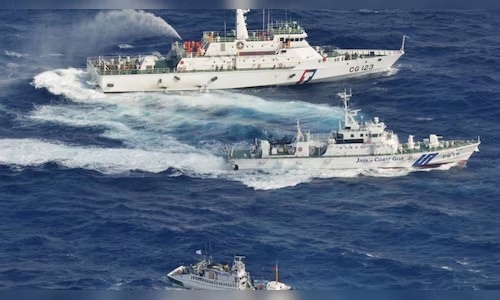
In recent times, tensions have intensified due to increased military activity, diplomatic standoffs and growing concerns over regional security dynamics. Disputes over the Senkaku/Diaoyu Islands, maritime incursions, and defence posturing have further complicated ties.
Here’s a timeline of key developments on the escalating tensions between one of Asia’s most sensitive and closely watched bilateral relationships, whose relations have long been frosty.
What Happened? A timeline of rising China–Japan tensionsNovember 7, 2025 – Trigger in Japanese Parliament | The latest strain in ties began during a parliamentary session, when a Japanese lawmaker questioned Minister Sanae Takaichi about scenarios involving Taiwan. In response, she indicated that the use of force in such a situation could amount to a ‘survival-threatening situation’ for Japan, a legal concept that could justify military action under the country’s 2015 security laws.
November 13, 2025 – Immediate Reaction from Beijing | China reacted strongly to Takaichi’s remarks, with the foreign ministry describing them as ‘egregious’. The ministry asked Takaichi to retract her remarks, warning that otherwise Japan “must bear all consequences” for the comments.
November 14, 2025 – Diplomatic Row Escalates | Tensions intensified when Xue Jian, China’s consul general in Osaka, reposted news of Takaichi’s remarks on social media and added a controversial comment. The statement drew sharp criticism from Tokyo, which called it inappropriate and lodged an official protest. China, in turn, filed its own complaint with Japan over Takaichi’s.
November 14, 2025 – China Steps Up Pressure | Beijing summoned Japan’s ambassador to China Kenji Kanasugi and repeatedly demanded that the remarks be retracted. The dispute began to spill over into economic and cultural spheres. China advised its citizens to reconsider travel to Japan, raising concerns for Japan’s tourism sector.
November 19, 2025 – China suspends seafood imports | China pauses seafood imports from Japan, months after it partly lifted a previous ban issued in 2023.
November 21, 2025 – China scraps concerts | Several concerts with Japanese musicians in Chinese cities were abruptly cancelled in November as diplomatic tensions escalated.
November 25, 2025 – Takaichi rejects China’s demand | Takaichi has declined to retract her remarks, stating, “Regarding a situation threatening Japan’s existence, the government will make a comprehensive judgment based on all available information, taking into account the specific circumstances of each actual situation as it arises.”
December 7, 2025 – Japan accused Chinese jets of directing fire-control radar | Japanese defence minister Shinjiro Koizumi accused Chinese jets of locking fire-control radar on Japanese aircraft. On X, Koizumi stated that Japan has lodged a ‘strong protest’ about the two incidents and made “a stern demand for measures to prevent recurrence”.
December 10, 2025 – S Korea, Japan scramble warplanes | Following a coordinated air patrol by Chinese and Russian military aircraft near both nations, South Korea and Japan separately scrambled fighter fighters. According to the Joint Chiefs of Staff office in Seoul, seven Russian and two Chinese aircraft entered South Korea’s Air Defence Zone Identification Zone (KADIZ).
January 7, 2026 – China bans exports of ‘dual-use’ items | In response to Japan’s ‘erroneous’ and ‘egregious’ statements, China banned dual-use items with military applications.
February 13 – Japan seizes Chinese fishing boat | Seized a Chinese fishing boat and arrested its captain, which further escalated the diplomatic row between Tokyo and Beijing. The seizure reportedly took place about 105 miles (170km) from the south-western port city of Nagasaki.
April 17 – China slams Japan | China’s Foreign Ministry criticised Japan after a Self-Defence Forces (SDF) warship entered the Taiwan Strait, saying that the Taiwan issue is a ‘red line’ that should not be crossed. During a press briefing, Foreign Ministry spokesperson Guo Jiakun stated that the Chinese military had “handled the situation in accordance with laws and regulations”.