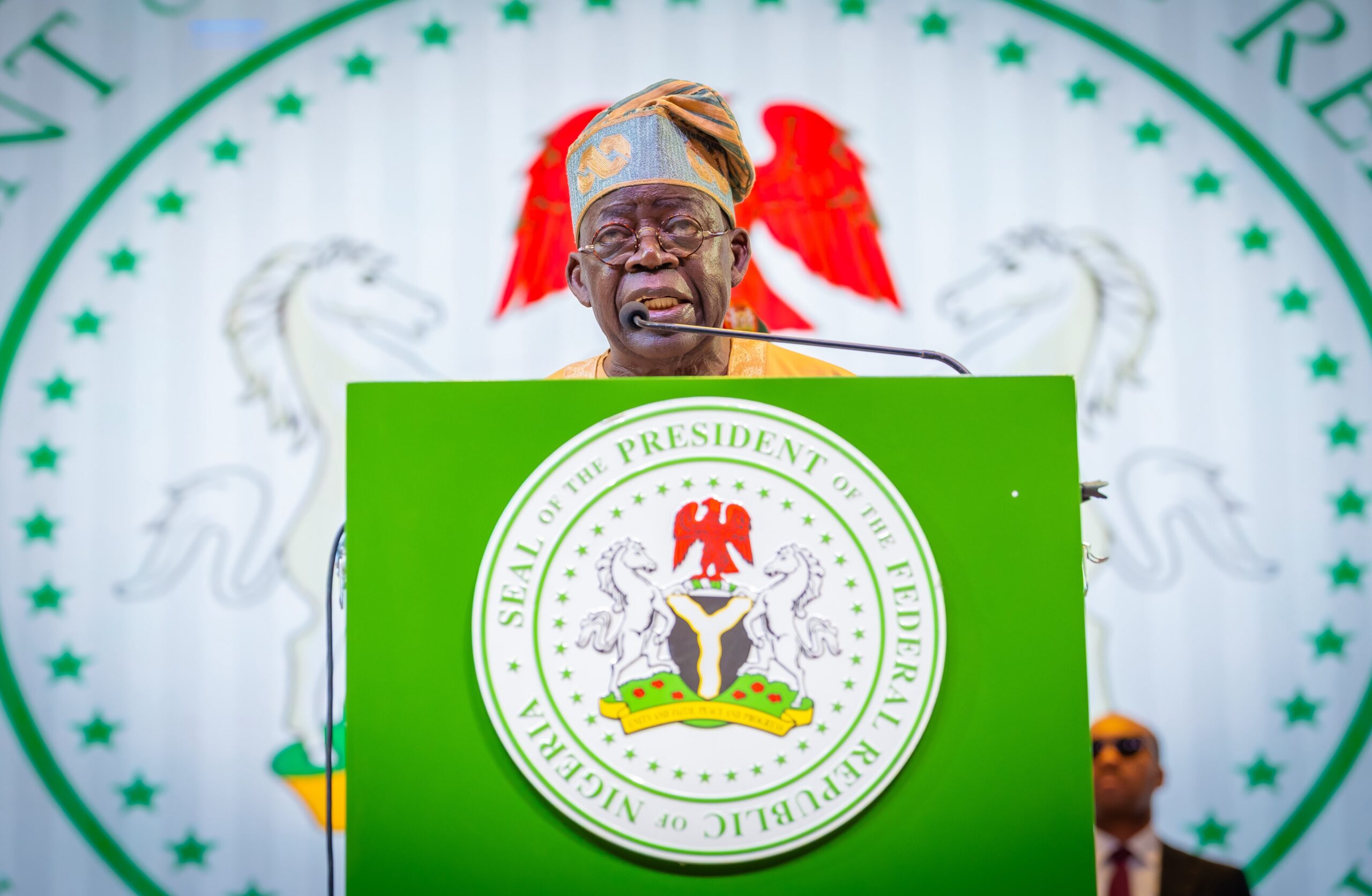
Mr Tinubu said the facility would finance the construction of the Sokoto–Badagry Superhighway, a flagship project under his Renewed Hope Agenda.
President Bola Tinubu on Thursday asked the Senate to approve a proposal to borrow $516.3 million from Deutsche Bank AG, with insurance backing from the Islamic Corporation for the Insurance of Investment and Export Credit, the insurance arm of the Islamic Development Bank.
Deutsche Bank AG is a German multinational investment bank and financial services company headquartered in Frankfurt. It is dual-listed on the Frankfurt Stock Exchange and the New York Stock Exchange.
Mr Tinubu said the facility would finance the construction of the Sokoto–Badagry Superhighway, a flagship project under his Renewed Hope Agenda.
The president’s request was contained in a letter ready by the Senate President, Godswill Akpabio, during the plenary.
The proposed highway is a 1,000-kilometre high-capacity carriageway linking Sokoto, Kebbi, Niger, Kwara, Oyo, Ogun, and Lagos states, stretching from Illela to Badagry.
Mr Tinubu said the project would enhance connectivity between Nigeria’s north-west and south-west, opening up a major economic corridor.
He added that the loan is already captured in the federal government’s borrowing plan earlier approved by the National Assembly.
The request comes barely a month after lawmakers approved another $6 billion external borrowing plan by the administration. Of that amount, $5 billion is to be sourced from First Abu Dhabi Bank to support the national budget, while a $1 billion export finance facility from the United Kingdom, arranged by Citibank is earmarked for the rehabilitation of Tin Can Island Port and the Lagos Port Complex.
The new request comes amid concerns over the country’s rising debt burden and debt servicing pressures.
According to the Debt Management Office, Nigeria’s total public debt stood at over N87 trillion (about $113 billion) as of mid-2023, following the inclusion of Ways and Means advances from the Central Bank of Nigeria. The figure has continued to climb with new borrowings and exchange rate adjustments.
Although Nigeria’s debt-to-GDP ratio remains moderate compared to some peers, analysts have repeatedly flagged the country’s weak revenue base as a major risk. A significant portion of government revenue is spent on servicing debt, raising concerns about fiscal sustainability.
The International Monetary Fund and the World Bank have both advised Nigeria to prioritise revenue mobilisation, improve tax collection, and ensure that new borrowings are tied to productive investments capable of generating returns.
In recent years, the federal government has increasingly turned to external borrowing to finance budget deficits, fund infrastructure projects, and refinance existing obligations. Officials argue that such loans, particularly those with relatively lower interest rates, help reduce the cost of debt and support critical sectors of the economy.
In the letter, President Tinubu also disclosed that the federal government will provide counterpart funding of ₦265 billion for land acquisition, compensation, and related infrastructure for the highway project.
He noted that the loan will have a tenure of nine years, including a grace period of up to three years, with an interest rate capped at the Chicago Mercantile Exchange (CME) SOFR plus 5.3 per cent annually.
After reading the letter, Mr Akpabio referred the request to the Senate Committee on Local and Foreign Debts, directing it to report back within one week for consideration.