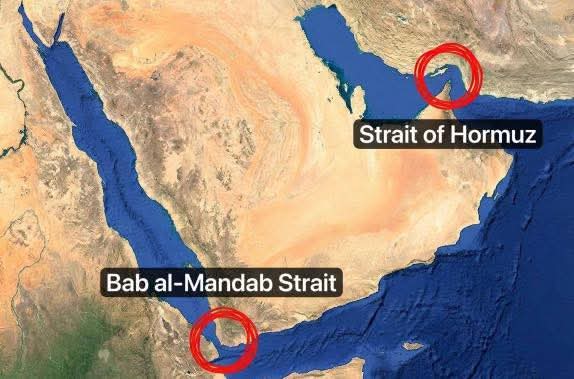

Britain, Thursday, accused Iran of holding the world’s economy hostage as diplomats from more than 40 countries held talks on ways to press Tehran to reopen the Strait of Hormuz, a vital oil route that has been choked off by the U.S.-Israeli war against Iran.
The U.S. didn’t attend the virtual meeting, which came after U.S. President Donald Trump made it clear that he thinks securing the waterway is not America’s job.
Trump has also disparaged America’s European allies for failing to support the war and renewed his threats to pull the U.S. out of NATO.
U.K. Foreign Secretary Yvette Cooper said the talks, which focused on political and diplomatic rather than military means, showed “the strength of our international determination” to reopen the strait.
The 41 countries represented came from all continents except Antarctica, a reflection of the global tremors from a war that has sparked shortages of fuel and fertiliser and higher prices for food far beyond the Middle East.
“We have seen Iran hijack an international shipping route to hold the global economy hostage,” Cooper said at the start of the meeting. Cooper said “unsustainable” spikes in oil and food prices were “hitting households and businesses in every corner of the world.”
Shipping in Strait slowed to a trickle
Iranian attacks on commercial ships, and the threat of more, have halted nearly all traffic in the waterway that connects the Persian Gulf to the rest of the globe’s oceans, shutting a critical path for the world’s flow of oil and sending petroleum prices soaring.
There have been 23 direct attacks on commercial vessels in the Gulf since the war began on February 28, and 11 crew members have been killed, according to shipping data firm Lloyd’s List Intelligence.
Traffic through the Strait has slowed to a trickle, with what remains dominated by sanctions-evading tankers carrying Iranian oil, Lloyd’s List Intelligence said in a briefing Thursday. It said a murky operation under which Iran vets who can pass continues to operate as Tehran maintains its chokehold over the key waterway.
Iran unwilling to negotiate – US intelligence
Meanwhile, the United States (US) intelligence assessments have indicated that Iran was currently unwilling to negotiate end to war.
According to assessments conducted by multiple US intelligence agencies, the Iranian regime believes it was in a strong enough position to continue the war and not cede to US demands, the New York Times has reported, citing US officials familiar with the assessments.
According to assessments conducted by multiple US intelligence agencies, the regime believes it is in a strong enough position to continue the war and not cede to US demands.
The report additionally indicated that Iran was willing to keep diplomatic channels open, but does not trust the US or think US President Donald Trump was serious about engaging in negotiations.
Two Iranian officials and one Pakistani official told the NYT that the Iranian regime could engage in diplomacy under the right conditions. Still, they needed to see that the US is willing to seriously discuss ending the war rather than negotiating a temporary ceasefire.
US and Iranian officials both confirmed that the two countries have been exchanging messages through intermediaries, but are not discussing ceasefire terms or ending the war.
A senior Iranian source told Reuters on Wednesday that Iran demands a permanent end to the war and that no mediator-facilitated talks have taken place regarding a temporary ceasefire.