China, long described as one of Japan’s ‘most important neighbouring countries’, was downgraded to an ‘important neighbour’. While a small shift in bureaucratic lexicon, this amendment carries the weight of shifting ties between Tokyo and Beijing, and not for the better.
Relations between Tokyo and Beijing have entered what analysts are now terming as a ‘structural deterioration’.
This souring of ties can be traced back to prime minister Sanae Takaichi’s November 2025 parliamentary remarks stating that a Chinese attack on Taiwan could constitute as an ‘existential crisis for Japan’, a statement that infuriated Beijing and led to trade retaliations that include rare earth export restrictions, air-travel cancellations and other manifestations of economic reprisals estimated to have cost Japan between $500 million and $1.2 billion.
The US Intelligence Community’s Annual Threat Assessment, published this March; has described Takaichi’s remarks as ‘a significant shift for a sitting Japanese prime minister’.
In the wake of these developments, the 1960 Treaty of Mutual Cooperation and Security between Washington and Tokyo, the legal foundation of East Asian security for over six decades, has not faced comparable pressure since the Cold War.
The Anpo & The Makings Of The Security Treaty
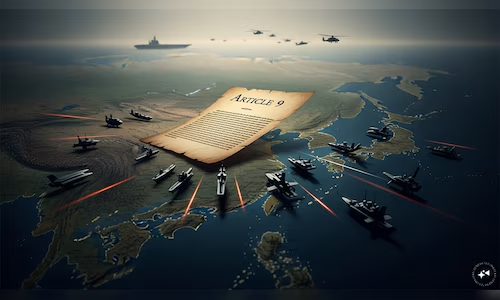
The treaty, known as the Anpo jōyaku or simply the Anpo, is inseparable from Japan’s postwar constitution written under American occupation in 1947. The single-most seminal piece of text in this document is Article 9, also known as the ‘pacifist clause’, a renouncement of war as a sovereign right that bars Japan from maintaining ‘war potential’.
The clause was designed to prevent Japanese remilitarisation, but it left the country without a conventional defense.
The solution was the security treaty, first signed in 1951 and revised into its current form in 1960 – Japan would host US forces while America would guarantee Japanese security. As Article 9 prohibits a standing military, Japan’s armed forces were reconstituted as the ‘Self-Defense Forces’; nominally a defensive institution though one that has since grown into one of the most capable militaries in the region.
The treaty’s core provisions are straightforward.
Article V commits both parties to act against an armed attack on Japan, while Article VI grants the US the right to station roughly 60,000 troops and military assets on Japanese soil, with Japan paying approximately $3 billion annually in host-nation support.
The arrangement is deliberately asymmetrical; the US is obligated to defend Japan; Japan carries no reciprocal obligation to fight for America. This imbalance is what President Donald Trump has repeatedly termed ‘unfair’ and ‘nonreciprocal.’
Where The Treaty Is Being Tested
The most immediate real-world test of Article V is the Senkaku Islands, a chain of uninhabited islets in the East China Sea; administered by Japan but claimed by Beijing as the Diaoyu Islands.
Both the Biden and Trump administrations have stated explicitly that Article V covers the Senkakus, a position reaffirmed by a US Senate resolution in December 2025. Chinese coast guard vessels however, have steadily increased pressure around the islands in the past decade and a half.
Beyond the Senkaku’s, the next point of stress for the treaty remains the question of Taiwan, which sits at the center of the region’s security calculus, the First Island Chain- an arc of archipelagos stretching from Japan’s Ryukyu Islands through Taiwan and the Philippines to the South China Sea. The chain functions as a geographic barrier between China’s coastline and the open Pacific.
This is the context in which Takaichi’s remarks reverberated. By suggesting a Taiwan contingency could legally trigger collective Japanese self-defense, the Japanese PM signals that Tokyo may not wait for direct military confrontation with Beijing to enter any armed conflict regarding Taipei.
This effectively narrows the legal gap between defending Japan and getting involved in Taiwan’s defense; a message that sent alarm bells ringing through the corridors of power in Beijing.
Domestic Calls For Legislative ‘Rearmament’
China’s posturing in the South China Sea, including its maritime standoffs over the nine-dash line; have now catalysed a decade-long domestic debate over the amendment of Article 9.
Many policy makers posit that the provisions of the Article have atrophied heavily since 2022, when national security documents were revised to allow counterstrike capabilities. With the LDP winning 316 of 465 lower house seats in February 2026- its largest majority in postwar history; Sanae Takaichi has declared a formal constitutional revision a top priority. The ruling party however, still lacks the two-thirds upper house majority a referendum requires, and may need to wait for 2028 elections.
On the flip side, some analysts argue that a revision could complicate the alliance as much as strengthen it. Article 9’s ambiguity has long given Japan diplomatic flexibility. A formal Japanese military with an unambiguous legal mandate would change the political calculus in both Washington and Beijing in ways that are not straightforward to predict.
Would Trump’s America Defend Japan?
While the treaty obliges the US to act, it does not specify how. A sitting president would still need Congressional authorisation for a formal war declaration, and would retain wide discretion over the scale and form of any response. This, however, as seen with in the case of Venezuela and Iran, can be circumvented in the maximalist interpretation of executive power the Trump administration and its backers have come to deploy.
The alliance’s most durable deterrent, however, has never rested on the legal text alone; it rests on the physical presence of 60,000 American troops on Japanese soil. That has been the tripwire for 65 years.
Whether it holds against the pressures now accumulating, may that be Trump’s conditional approach to alliances or China’s sustained economic and military dominance; one thing remains certain. As seen in West Asia, any conflict regarding Taiwan will inevitably and multilaterally pull the entire region into it- such is the domino effect of 21st century wars.