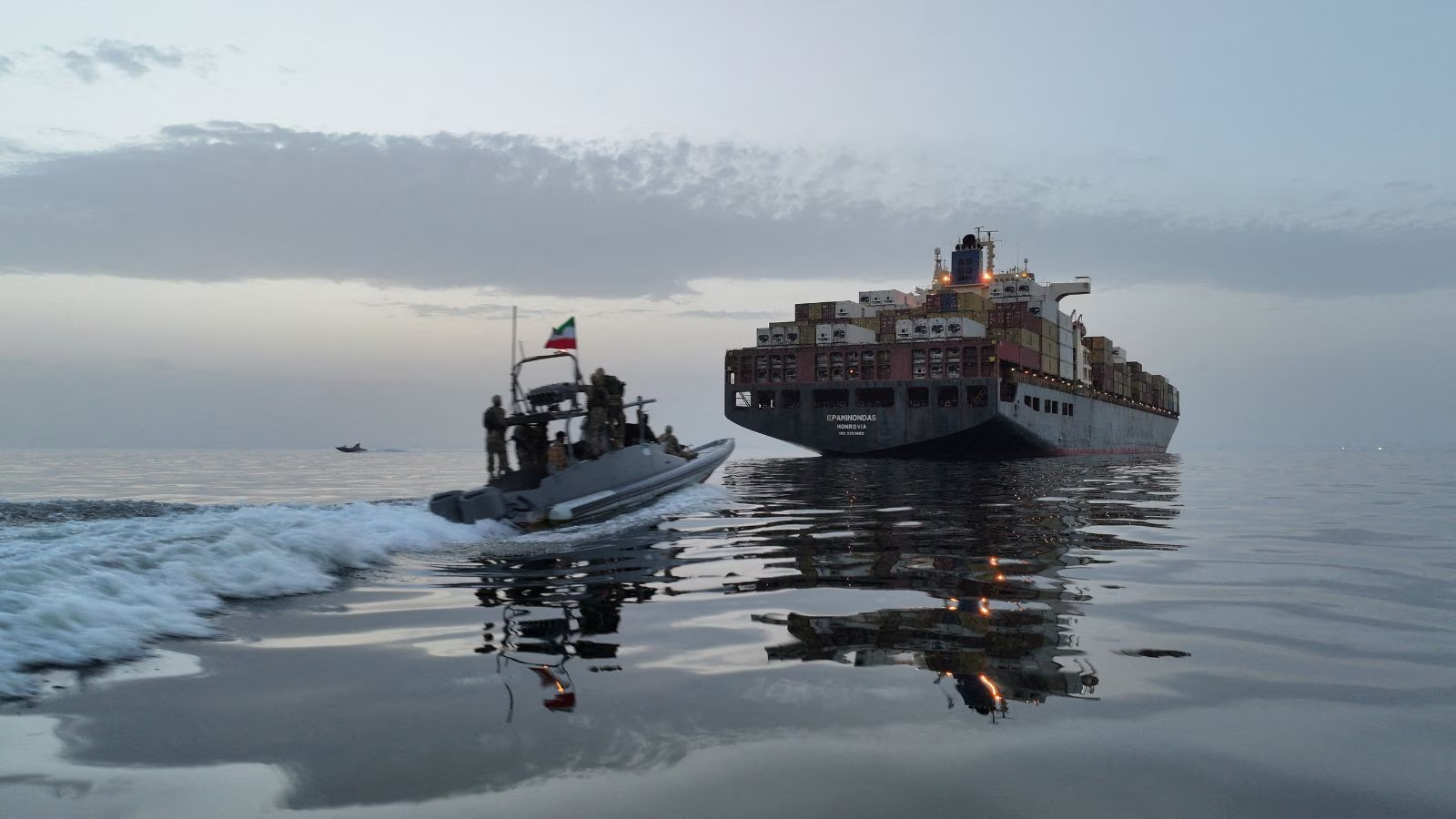
The US Navy is working to clear, what President Donald Trump said, are Iranian mines from the Strait of Hormuz, but Pentagon officials have privately told American lawmakers the operation could take up to six months, even with a tenuous ceasefire holding between Washington and Tehran in the weekslong war, news agency Associated Press reported.
The waterway, through which roughly 20 per cent of the world’s oil typically passes, has seen its disruption increasingly threaten the global economy, with rising energy prices and wider economic effects posing a political risk for the Trump administration.
In a classified briefing to the House Armed Services Committee on Tuesday, Pentagon officials offered the six-month estimate, according to a person familiar with the situation who spoke to AP. Defence Secretary Pete Hegseth declined to confirm the figure at a Pentagon news conference on Friday, but did not deny it.
“Allegedly, that was something that was said,” Hegseth told reporters, adding that the military felt confident in its ability, in the correct period of time, to clear any mines it identifies.
Trump has publicly escalated the operation. In a social media post on Thursday, the president said American minesweepers were already clearing the strait and ordered the activity to continue at a “tripled-up level”. He has separately ordered the Navy to attack any boat laying mines in the strait.
Alongside the minesweeping push, the US has blockaded Iran’s ports, seized ships tied to Tehran, and planned to take part in a second round of ceasefire talks in Pakistan this weekend.
How long will it really take to clear the Strait of Hormuz?
Mine-clearing is a painstaking discipline. Steven Wills, a retired US Navy lieutenant commander who served on an Avenger-class ship and is now an expert at the Center for Maritime Strategy at the Navy League of the United States, drew a sharp distinction between two operations the Navy may be running in parallel. He said the Navy is likely looking for sea explosives to create a safe channel through the strait, with minesweeping a slower process that usually occurs after a conflict.
Story continues below this ad
Minehunting, Wills said, is like walking through your yard pulling individual weeds and dandelions so that you can walk safely from one side to the other. Minesweeping, by contrast, is more like mowing the grass.
Scott Savitz, a researcher with the RAND Corporation who focuses on naval operations and mine clearing, said the Navy does not necessarily have to remove every last mine. There are still areas, he noted, that have not been cleared from World War II — and in some cases, World War I — simply because the work is so resource-intensive and time-consuming.
What is US Navy actually deploying?
The US Navy now has two littoral combat ships in the Middle East that are capable of sweeping for mines, according to a defence official who spoke to AP. Two US Avenger-class minesweepers based in Japan have also departed for the Middle East but were in the Pacific Ocean as of Friday, the official said.
There is no indication that the US military is currently using warships, its most visible mine-clearing assets, in the strait. But the Navy also has divers and small teams of explosive ordnance disposal technicians in the region capable of clearing mines, a less obvious target than a large warship. Experts also say some mine-clearing equipment could be moved off ships and deployed from land.
Story continues below this ad
Teams on the Navy’s littoral combat ships can deploy remotely operated, uncrewed vehicles that use sonar and other technology to find mines, Wills said. They also carry charges to destroy the explosives. US Navy ships may also have explosive ordnance disposal teams, including divers, that can hunt for and destroy mines. Helicopters can search for mines using lasers.
Why Iran’s threat persists even if the mines are gone
The deeper challenge, analysts say, is psychological as much as physical. Emma Salisbury, a scholar at the Foreign Policy Research Institute’s National Security Program and a fellow at the Royal Navy Strategic Studies Centre, argued that Iran does not even have to have laid mines; it just has to make people believe that it has. Even if the US sweeps the strait and declares it clear, she said, all the Iranians have to do is insist the Americans have not found them all yet. There is, she said, only so much the US can do to give that confidence back to commercial shipping.
It remains unclear whether a single mine has been deployed. Iran has mentioned only the “likelihood” of mines in the strait’s prewar routes. Estimates of Iran’s mine stockpiles are in the low thousands, Salisbury said, with most of its underwater explosives believed to be older Soviet models and some newer ones possibly from China or made domestically.
Minelaying, Salisbury noted, is a lot easier than minesweeping; the devices can literally be pushed off the back of a speedboat — though she acknowledged the US could likely see that. Iran also has small submarines that can lay mines and are much harder to detect, and she said she has not seen indications that they have been destroyed in the war.
Story continues below this ad
If Iran has set mines in the strait, Salisbury said, they are not the spiky balls floating on the surface seen in the movies. The explosives are likely sitting on the seabed or moored to it by a cable and floating under the surface, triggered by the water pressure changing when a ship passes or by the sound of its engine.
Iran threatens retaliation against the US blockade
Even as the minesweeping operation gathers pace, Iran has issued a fresh threat against Washington’s parallel pressure campaign — the naval blockade of Iranian ports that Trump announced almost two weeks ago in response to the effective closure of the strait.
In a statement carried by the semi-official Tasnim news agency, Iran’s Khatam al-Anbiya joint military command warned that if the “aggressive American army” continued its “siege, banditry, and piracy” in the region, it could be sure of a response from the powerful Iranian armed forces.
The blockade has done little to sway Tehran into a peace deal, with Iranian officials refusing to come to the negotiating table until it is lifted.
Story continues below this ad
Why insurers and shippers remain unconvinced
Eventually, shipping companies will be willing to take some risks to travel through the strait, particularly given how lucrative it is, Savitz said.
Under Iran’s approval procedure for vessels wanting to transit the strait, ships must take a different route than before the war — to the north, near Iran’s coastline. Insurers, meanwhile, are adding a clause that requires ship owners to contact Iranian authorities to ensure safe passage, said Dylan Mortimer, UK marine war leader for the insurance broker Marsh.
That certification does not mention mines specifically and is intended to protect against the entire spectrum of threats, including missile and drone attacks or seizures, Mortimer said. But mines, at the very least, play a psychological role — a phenomenon Mortimer called the “spectre of threat”. That plays in the Iranians’ favour, he said, because whether or not mines are actually there, people think they are, and they will operate accordingly.
Those fears could mean it takes longer to restore confidence that the Strait is safe, even after the war.
(With inputs from AP)