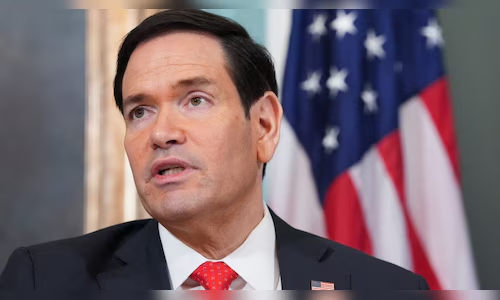
In a recent interview with Fox News, Rubio made it clear that Donald Trump decided the next move. He said, “That’s POTUS’ decision to make… the level of sanctions on Iran is extraordinary, the level of pressure on Iran is extraordinary, and I think more can be brought to bear”.
Right now, talks appear to be going nowhere. A fragile ceasefire has been in place since early April, but it hasn’t translated into meaningful progress. Meetings in Islamabad failed to produce any breakthrough, and hopes for another round of direct talks faded after Iran’s foreign minister, Abbas Araghchi, left Pakistan before a US delegation could arrive.
Iran has reportedly tried to shift the focus of negotiations. Its latest proposal suggests delaying discussions on its nuclear programme until the ongoing conflict ends and tensions around Gulf shipping are resolved. Well, that has not gone down well in Washington. The US wants nuclear issues front and centre, and reports suggest Trump is not satisfied with Iran’s approach.
Meanwhile, the US has taken steps such as blocking Iranian shipping due to the pressure, while Iran has hinted it could escalate by tightening control over the Strait of Hormuz, which is a critical route for global oil supply.
On this, Rubio said, “The Strait is basically the equivalent of an economic nuclear weapon they are trying to use against the world, and they are bragging about it… Imagine if those same people had access to a nuclear weapon—they would hold the whole region hostage.”
He also pushed back against criticism of US actions, saying, “The blockade is not against shipping broadly; it’s against Iranian shipping, because they cannot be the sole beneficiaries of an illegal, unlawful, and unjustified system of control in the strait.”
Beyond immediate tensions, Rubio raised deeper concerns about Iran’s leadership and long-term intentions. He described the country as ‘revolutionary,’ adding that they seek to “expand their revolution.”
He also questioned who is really in charge in Tehran, especially regarding Mojtaba Khamenei. He raised suspicions whether Khamenei has clerical credentials to act as supreme leader or if someone else is taking the decisions.